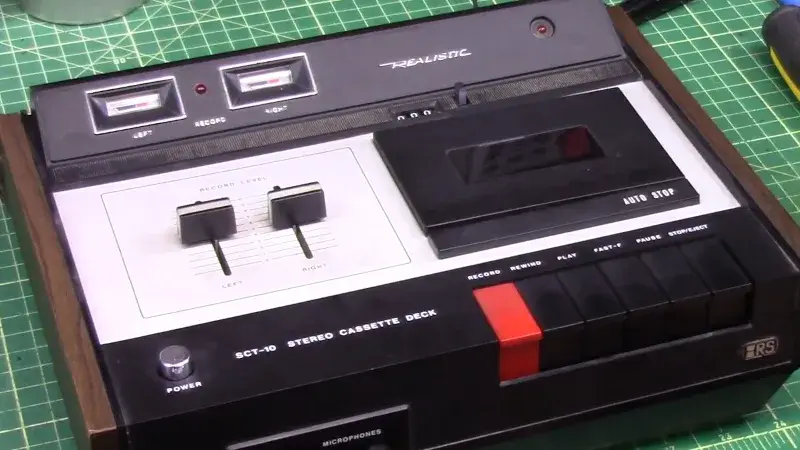
This Realistic cassette deck is not a legendary machine. That is exactly why it is interesting. On the Ken's Shop bench, an ordinary consumer device several decades old comes back through very ordinary operations: cleaning, lubrication, belt replacement and mechanical adjustment.1
Hackaday places the deck around the late 1970s or early 1980s and points out that this otherwise unremarkable consumer electronics was built robustly enough to remain serviceable.1
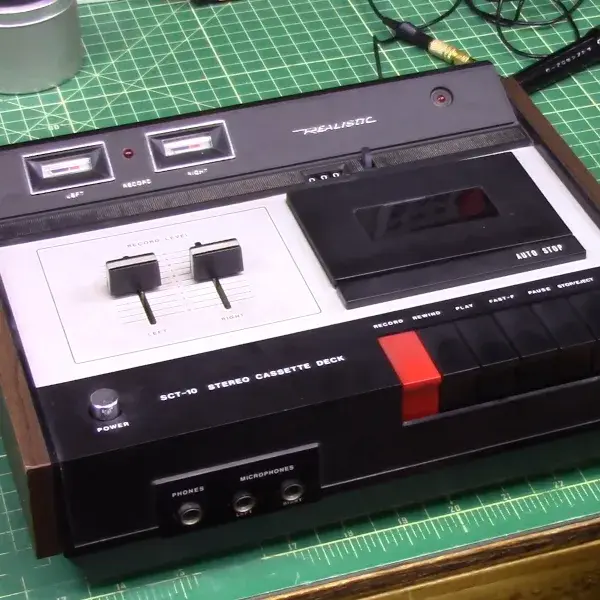
The visible repair path
After decades, the expected problems are physical. Grease dries out. Belts age. Sliding and rotating parts need cleaning and fresh lubrication. Head alignment may require an azimuth adjustment.1
None of this means repair is effortless. Hackaday notes that decks like this can be fiddly to work on.1 But the difficulty stays in the same world as the object. A tired mechanical transmission calls for a belt. Sticky motion calls for cleaning and lubricant. Misaligned playback calls for an adjustment.
That differs from many contemporary devices where maintenance can also depend on authentication, vendor software or paired components. Physical access and diagnosis do not guarantee success here, but they are still enough to begin meaningful repair.
The video does not prove that everything used to be better. An old cassette deck has wear parts, mechanical drift and adjustments that a digital audio file will never need. It demonstrates a narrower point: maintainability can be a visible property of an object's architecture.
The adjustable machine
A fresh belt alone does not return a tape transport to its nominal state. Speed, roller pressure and head alignment all affect what reaches the listener. The azimuth adjustment mentioned by Hackaday is exactly this kind of calibration: a slightly misaligned head can degrade playback even when the mechanism is moving.1
That detail exposes another property of this generation of hardware. Maintenance does not always mean replacing an entire module. It still includes continuous adjustments. That requires more skill, but it also allows drift to be corrected without discarding the whole subsystem.
The tradeoff is obvious: repairability depends on someone understanding the mechanism well enough to tune it. An accessible but illegible device is not truly repairable. The service video therefore becomes practical documentation in its own right, showing sequence, access points and how much disassembly is actually required.2
That legibility also has a simple economic effect. An identifiable wear part lets a repairer decide whether an intervention is worthwhile before replacing the whole device. The deck does not promise infinite life. It merely preserves enough separation between functions that a local failure can remain a local failure, which is already a meaningful design property.1
The machine remains imperfect, but its failures still have names, locations and interventions a technician can reason about.
You can look at the mechanism and follow a chain from symptom to component to intervention. Several decades later, that legibility is almost as appealing as the nostalgia of a Play button that still produces an actual mechanical clack.