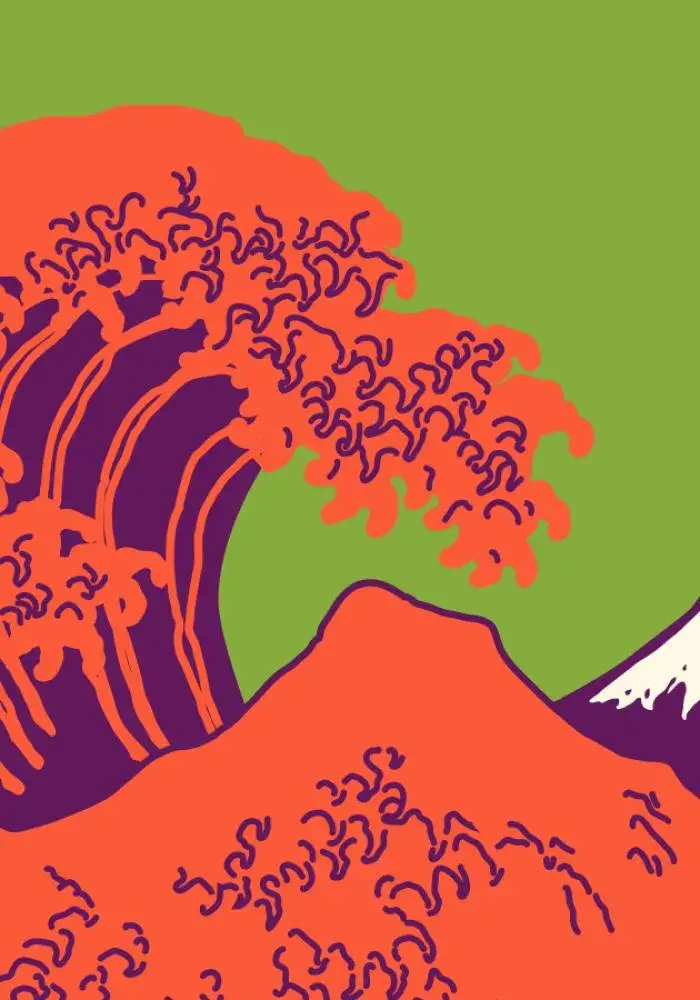
In Brussels, a digital image ends up this week in about the least digital form possible: more than 700,000 flowers laid across the Grand-Place.1
For the 2026 Flower Carpet, Japanese artist Hiro Sugiyama reworked Hokusai's The Great Wave off Kanagawa. His version uses digital techniques, changes the rhythm of the composition and keeps the original's instantly recognizable wave, Mount Fuji and Japanese motifs.1 Then the scale and material change completely. The Flower Carpet team translates that design into a 70-by-24-metre surface made mainly from dahlias grown in Belgium and near the Dutch border.12
The result lasts only four days, from 13 to 16 August.2 It is an odd production chain: a nineteenth-century print, a contemporary digital reinterpretation, then hundreds of thousands of organic pieces assembled into an image designed to disappear almost immediately.
The edition also marks 160 years of diplomatic relations between Belgium and Japan. Japan previously participated in the carpet in 2016 and returns ten years later with this design.1
The interesting part is not only the final picture. It is the change in resolution. On a screen, Sugiyama can move a motif. On the square, every pixel becomes a flower with its own size, colour and irregularity. Reproduction turns into material interpretation. One of the world's most reproduced images becomes, for four days, something that cannot be copied exactly.