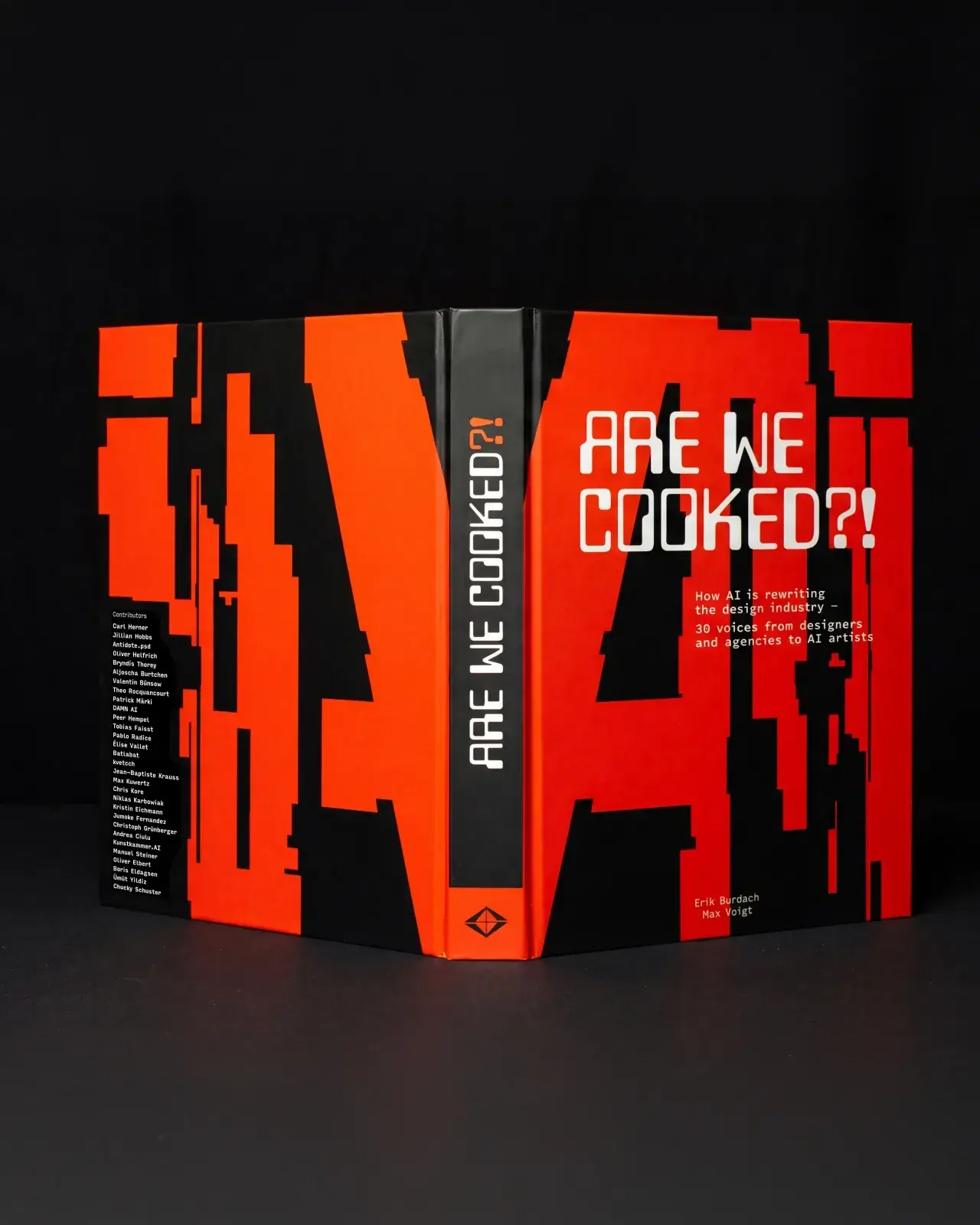
The title already sounds like a bad conference question: Are we cooked?!, a yes-or-no prompt about whether designers remain useful once generative systems can produce an identity, a storyboard or fifty variants before the coffee break.
Max Voigt and Erik Burdach, the young Berlin designers behind Studio Sprengsatz, decided to take that slightly ridiculous question seriously: they conducted nearly 50 interviews with agency leaders, artists, designers and AI practitioners, then selected 30 for a 240-page book.12 The result refuses to settle the argument. Good.
The verdict matters less than how the definition of the problem changes from one person to the next: one contributor calls AI a weak intern, another black magic, another an exoskeleton, revealing very different assumptions about what their work actually consists of.
Wrong question
A yes-or-no question about “the end of design” collapses too many jobs into one, because a branding agency, photographer, product team and generative artist sell different deliverables, different kinds of time and different degrees of responsibility. Even “AI” can mean image generation, assistance, task automation, research, exploration or simply economic anxiety.
The book makes that flaw productive: each participant receives a spread built around a pull quote, rapid-fire questions and a mock file evaluation rating qualities such as enthusiasm, ambivalence and abstraction, keeping disagreements beside one another long enough for them to become visible without presenting the result as a scientific answer.1
That distinction matters because the 30 interviews are the sharpest conversations selected by the authors from nearly 50, so counting yes and no answers as though the sample represented an industry population would be nonsense; what we can compare are the families of arguments the edit puts in conversation.1
Seven metaphors
The book's most useful device may be its “metaphor radar”. Studio Sprengsatz collects seven images participants use for AI: black magic, weak intern, fast food, dream machine, exoskeleton, Aleph and the devil's tools.1
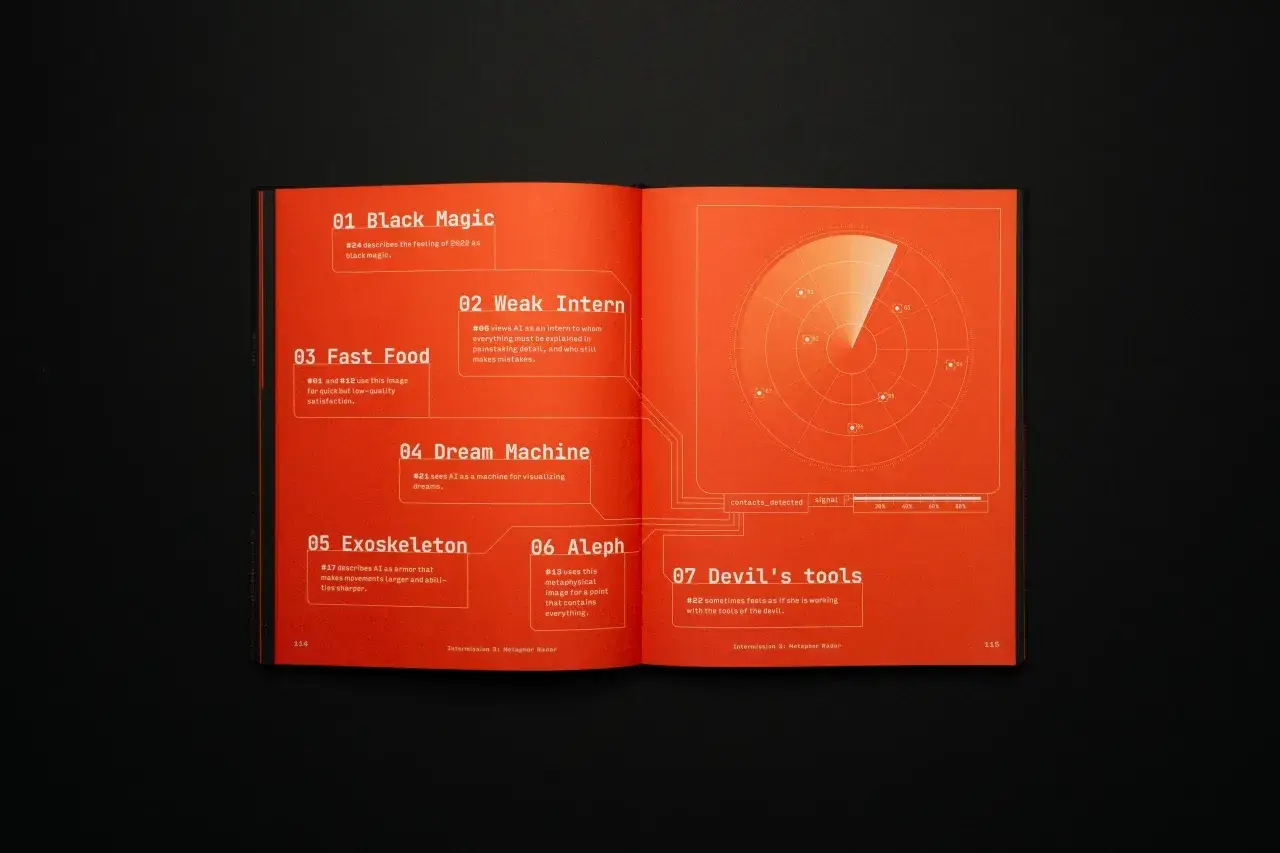
Those seven images can almost be arranged along two axes. One is control: the intern and exoskeleton assume a human director, while black magic and the devil's tools describe a system whose effects can exceed the person operating it. The other is quality: fast food promises speed with limited satisfaction, whereas dream machine or Aleph expand the field of what can be imagined.
That is why “are we cooked?” produces incompatible answers: if your work is mainly the production of a competent first version, the fast-food metaphor describes a direct threat, while a job built around framing a problem, persuading a client, building team culture or deciding what deserves to exist places the technology in a different part of the chain.
Good enough
Boris Eldagsen delivers the book's bluntest risk: “AI can replace everything that is just ‘good enough’.”1 Rather than claiming that AI simply replaces designers, the line attacks the portion of commercial design that used to command a price because producing something acceptably competent required time.
The argument moves the discussion to a more useful level, away from whether Midjourney, Firefly or a coding model can “be creative” and toward a harder question: how much of the market already accepts good enough? A client needing twenty compliant visual variants cares enormously about generation cost, whereas an engagement built around understanding an audience, defending a decision, navigating an organization or carrying public responsibility makes the final image only one slice of the service.
Creative Boom notes that Eldagsen still sees a future for large agencies because branding includes knowledge transfer, client management and understanding a target audience, all decidedly unglamorous tasks that nevertheless remind us an agency's value has never been identical to the number of pixels it can output per day.1
What remains
At the other end of the book, Andrea Ciulu answers with a deliberately absurd line: “Get drunk, AI can't.”1 Taken literally, it offers little labor-market analysis; as shorthand, though, the joke points toward something automation debates regularly flatten, because creative work is partly a social activity before it becomes a production process.
Shared bad ideas, common references, disagreement, corridor conversations, the way an art director reads a client's reaction or the way a team learns to trust one another all shape decisions; that social layer guarantees nothing, obviously, and humans remain perfectly capable of producing mediocre campaigns at impressive speed, but it explains why comparing a prompt result with a designer's final file reduces the profession to its most visible output.
The corpus therefore keeps circling back to a more interesting opposition than human versus machine, production versus judgment: as production gets faster, another option becomes cheap to generate, while selection, responsibility and taste retain costs of their own.
No survey
Another temptation is to use the 30 voices as evidence that “the industry thinks X”, even though the book began as a graduation project and became an edited collection of conversations the authors found most interesting.1 Contributors include people from Kurppa Hosk, Mutabor, KMS TEAM and LVMH alongside independent artists and studios, while the sample itself is neither random, exhaustive nor weighted by profession or company size.1
That curation is also what gives the object its character: the authors say interviewees repeatedly wanted to know what everyone else had answered, meaning the lack of consensus was already information the participants themselves wanted.1 Stan Hema, whose design lead Peer Hempel appears in the book, publicly described the perspectives as ranging almost from salvation to the gates of hell.4
To be sure, a curated book cannot tell us what the industry thinks in aggregate; a more useful reading is “here are 30 sufficiently different ways of cutting the same problem to expose the fault lines.”
Archive 2026
The book is also guaranteed to age quickly. The models dominating conversation in 2026 are unlikely to be the same ones designers use ten years from now. Studio Sprengsatz seems aware of that problem: the questions are less interested in comparing software than in asking what design is for, what an agency sells and which skills still matter.1
For print, that editorial choice should age better than a catalogue of current tools, because the book's future value may come less from correctly predicting the business model of 2030 than from showing how a profession described itself while its tools were changing faster than its vocabulary.
The Kickstarter campaign proposes an independently published first edition limited to 500 copies.13 The scale suits the project: a massive report might claim to describe the future, while this book records a moment of organized uncertainty.
The bad question eventually finds its purpose because “Are we cooked?” cannot produce a reliable answer; instead, it forces each participant to reveal what they believe they could lose, which is considerably more useful than yes or no when the goal is understanding a profession in motion.