An FPV drone that fits inside the weight of three nickels does not get there through one miraculous material. It gets there by removing things ordinary versions keep for convenience: connectors, thick wires, spare length, propeller blades and screws.
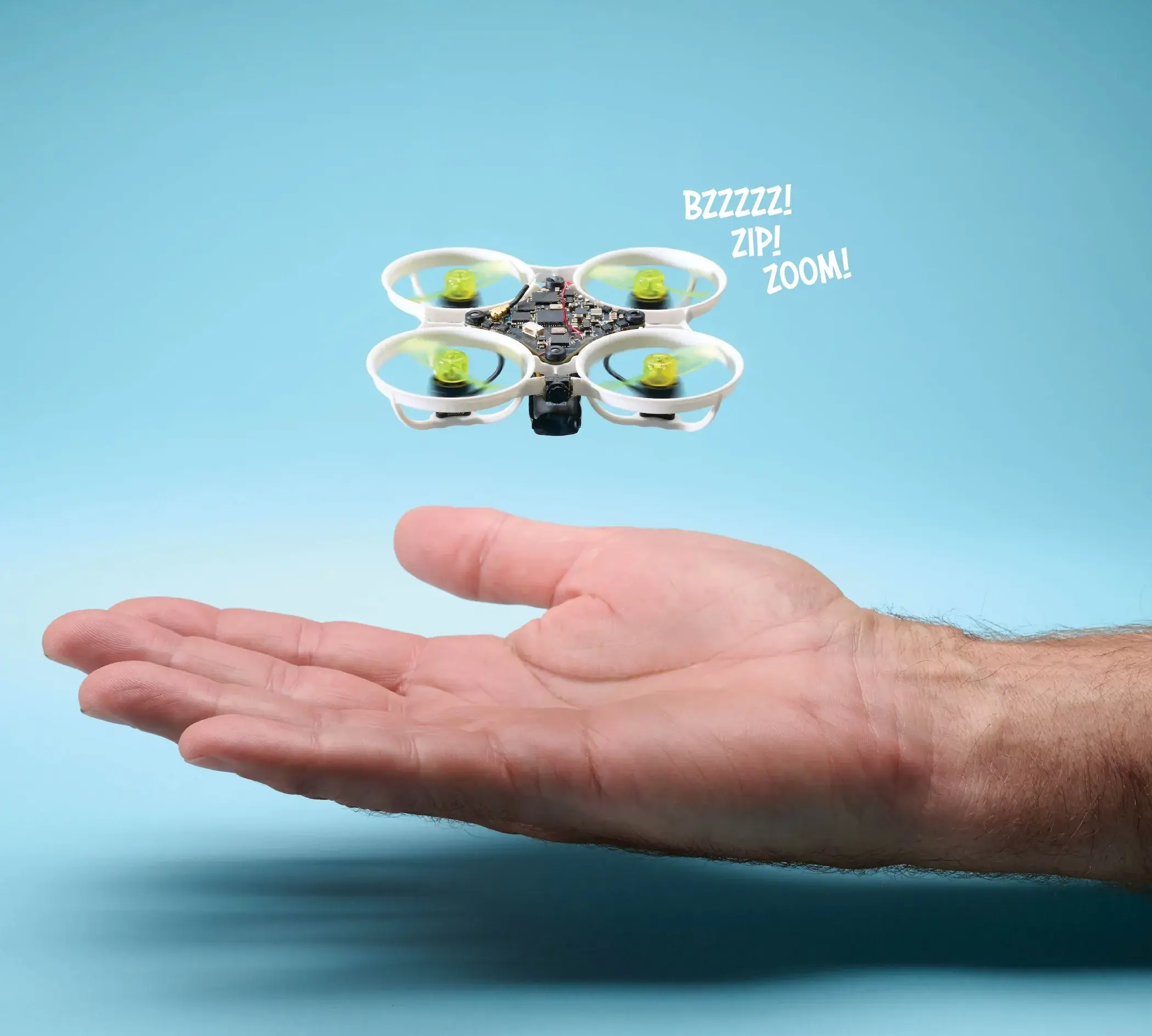
Scott Stevenson’s project targets a complete 65 mm brushless whoop, including its FPV camera, at between 13.5 and 14 grams.1 The number is tiny, but the interesting part is the system problem underneath it. Every part still has to work with the others after the weight comes out.
Remove the middlemen
The first move is almost boring: desolder the four motor connectors from the Matrix flight controller, then solder the motors directly to their pads.1 A connector makes assembly easier and replacement more comfortable. It also adds a part, metal and an electrical interface between motor and board.
The same reasoning appears around the camera. Its original wires are too thick and stiff for this build, so Stevenson replaces them with short silicone wires and fine enamelled wire.1 The board provides 5 V for a conventional camera, while this tiny camera needs 3.3 V. Reaching the regulator already on the board avoids adding a separate converter.1
The gram moves around
The BOM still uses familiar whoop parts: a 65 mm brushless frame, Matrix 1S controller, four 30,000 kV 0702 motors, a tiny FPV camera, 300 mAh LiPo battery, antenna and 31 mm propellers.1 The separate product pages document the controller, camera and motor references.234 The decision is therefore not simply “choose the lightest thing.” Stevenson favours the Matrix’s robustness over an even lighter Air controller.12
The weight then turns into manual work. Motors are soldered straight to pads, nearby components need protection, battery polarity is checked with a tester, and solder bridges are inspected under a loupe before power is applied.1 At this scale, a shorter connection may weigh less, but it costs more concentration.
Even the props get scissors
The last reduction looks ridiculous and makes engineering sense: two opposite blades are cut from each of the four propellers.1 The remaining clips are installed in a “props out” configuration. The plastic PEEK motor screws can also be shortened after assembly, and excess glue around the camera is trimmed with a knife.1
These choices are easy to present as a collection of tricks. They are really a chain of dependencies. Removing a plug demands direct soldering. Shortening a wire reduces room for handling. Lightening the antenna requires an exact 12.92 mm measurement.1 The weight hunt does not remove precision; it concentrates precision in less material.
Flight is still the test
The build calls for fine soldering, Betaflight configuration and real FPV piloting skill.1 Make: recommends flying low and slowly for the first flights, while checking for construction or configuration faults.1 The advertised weight therefore cannot prove that this drone is better for every use.
It proves something narrower and more useful: a standard machine can become extremely light when every interface is treated as a design decision. The connector, wire, blade, screw and antenna length are not separate details. Together they decide what the drone can still carry, survive and fly.