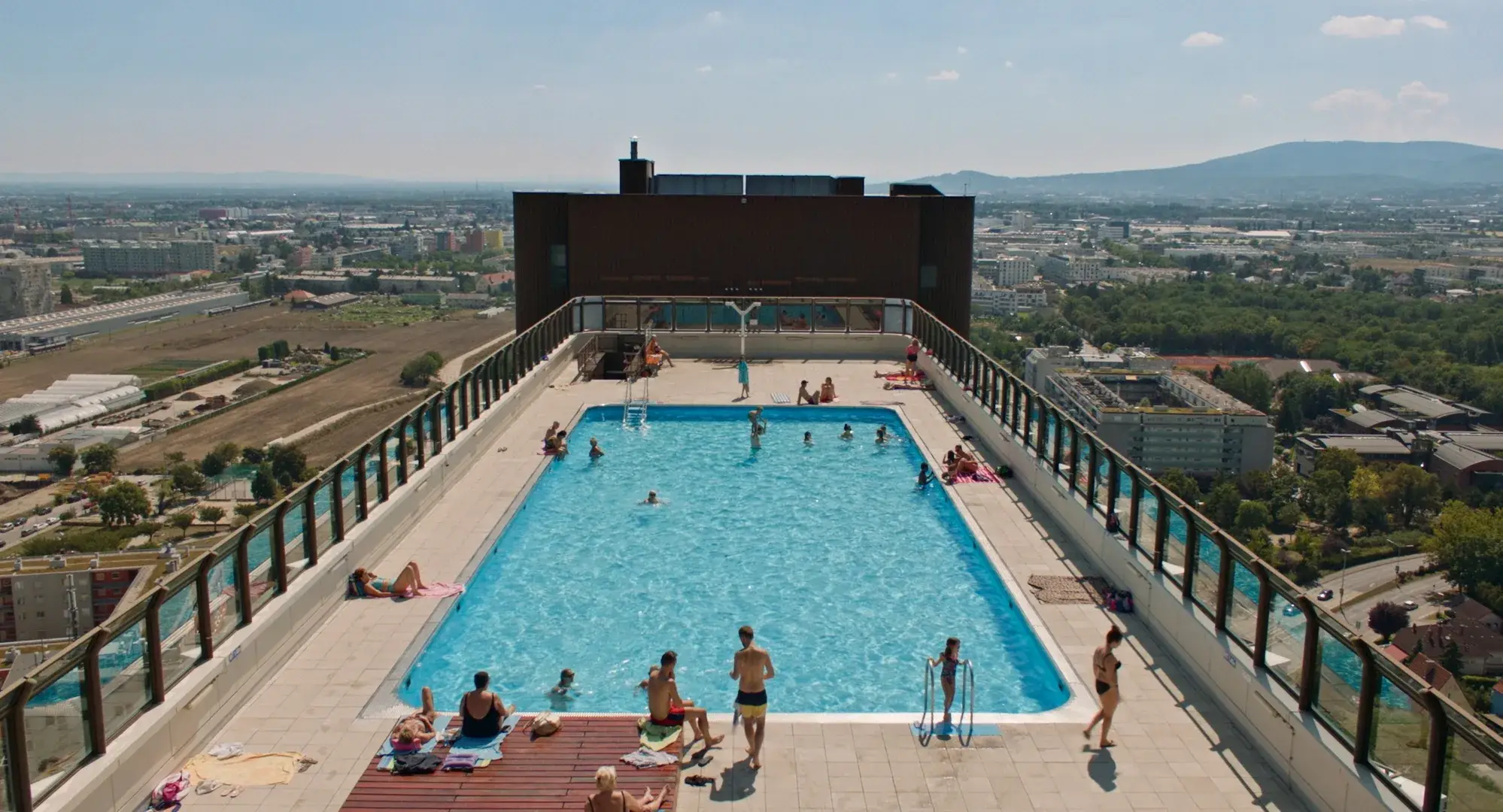
Alterlaa is easy to flatten into one very good photograph: a stepped wall of housing on the southern edge of Vienna, planted balconies, terraces, rooftop pools. The picture does too much work, making the place look as if the form explains everything.
The documentary 27 Storeys pushes back. Bianca Gleissinger returns to Alterlaa as an old family home, which gives her access but also no clean distance from the place she films.1 She is not only asking whether the architectural utopia looked good in the 1970s. She asks what is left after the children grew up, after the club rooms filled with regulars, after the corridors and underground parking absorbed four decades of use.
The useful answer is stubborn, not heroic: Alterlaa lasts where somebody still bothers to organise it.
Mischief Films lists the documentary as an 82-minute Austrian-German production from 2023, released in Austrian cinemas on 2 June 2023.1 It later won Best Cinematography at Diagonale 2023 and was nominated for the 2024 Austrian Film Prize in the Best Documentary category.1 Those credits matter because 27 Storeys belongs to cinema rather than to the tidy genre of the housing-authority tour, with return, embarrassment, timing and waiting built into its method.
Lived promise
Mischief Films presents Alterlaa as Austria’s largest social housing park and sums up Harry Glück’s premise with the line “living like the rich for everyone”.1 Designboom describes the same bet from the resident’s side: a 1970s complex imagined as a city inside the city, where swimming, shopping, school and services could sit inside everyday life instead of becoming a luxury trip elsewhere.2
ArchDaily gives the scale: more than 3,000 apartments, nearly 9,000 residents, built between 1973 and 1985, with shops, schools, medical services and cultural facilities folded into the complex.3 The numbers are useful until they are not: they describe the machine, but not whether people still know how to live with it.
The amenities become interesting once they leave the brochure. Pools, clubs, circulation, parking and services only matter after the opening ceremony if people keep them awkwardly, materially alive.
Slow evidence
Designboom points to the film’s long takes: an elevator lobby, wallpaper, someone waiting in an underground parking area, scenes so ordinary they start to show habit.2 A clean architectural tour would hurry past, but Gleissinger stays long enough for the waiting to start explaining the building.
Residential utopias are usually sold through sections, models and aerial views. Real life leaves duller evidence: a table in a club room, improvised storage, a poster, a route repeated until nobody notices it, a pool that is no longer futuristic and teenagers who mostly see the clubs as places for old people.2
The film also follows long-term residents. Designboom mentions Peter, there since the opening, in an apartment still thick with the 1970s, saying that he will leave Alterlaa dead, not voluntarily.2 As data, the sentence is useless; as testimony, it is sharp, because one person has attached enough life to this place to attach his ending to it too.
Clubs, not magic
Start with the clubs, not the pool, and Alterlaa looks different: model making, cards, photo and video, stamps, shooting, pottery, plus a small Freddy Quinn museum kept by the parents of one of Gleissinger’s childhood friends.2
Those rooms show the part architecture can only invite: a building can reserve common space, but it cannot manufacture the habits, jokes, rivalries and minor obligations that make people come back on a Tuesday evening.
Designboom notes the generational tension: younger residents see the clubs as old people’s territory, while older residents read young people’s attachment to technology as isolation.2 The point goes beyond local colour, exposing the problem of collective infrastructure in plain sight: something can keep functioning and still become socially dated.
That is the part current affordable-housing debates often smooth over. Copy the amenities and you still have to grow the practices that keep them alive.
Governance Layer
Designboom’s account of the film also points to the machinery that photographs badly: a tenant advisory board, meetings, newsletters, and a charitable corporation in which residents hold shares and can veto changes to the community.2
That detail explains duration better than a rooftop pool. A built utopia with no shared decision mechanism depends on a manager’s goodwill. Alterlaa seems to have added another layer: residents use the amenities, hold a stake in them and argue inside a collective order.
The open sources consulted here do not precisely measure current satisfaction, rents, social composition or real access to the apartments. 27 Storeys is not proof that the model can simply be repeated. It is narrower than that: a situated, personal, sometimes ironic investigation into a place that has already lived many lives.1
That limit gives the film its strength. Instead of asking whether Alterlaa “succeeded” in the abstract, it shows the slower version of success: uses maintained, ageing accepted, conflicts visible, commons still open.
Glück’s promise was large. The film makes something smaller more useful: a residential utopia survives through design, then through the dull work after design, as pools open, clubs meet, boards argue and residents claim the place strongly enough to become, sometimes, very difficult to move.