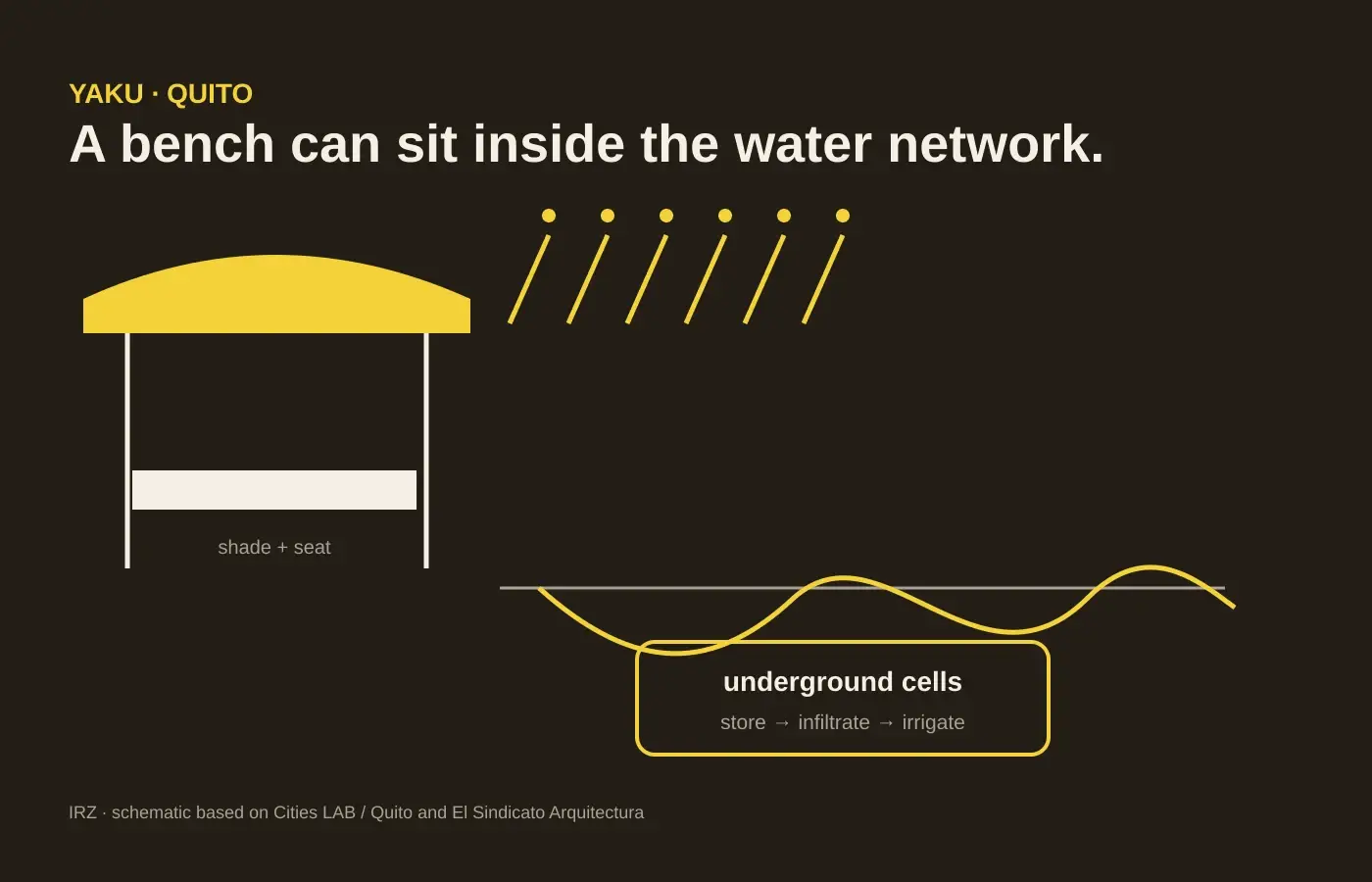
A bench will not stop a flood. It can, however, keep a small portion of the rain from becoming the sewer's problem immediately. That distinction is what makes Yaku worth looking at.
Installed in Isla Tortuga Park in northern Quito, the 27 m² prototype first reads as street furniture: seating, shade and planting. El Sindicato Arquitectura designed it with the Inter-American Development Bank's Cities LAB and Quito's Secretaría de Hábitat y Ordenamiento Territorial.13
Underneath, the water takes a different route. Rain is captured, sent into underground cells, stored and then released gradually into the soil, while some of it can be reused for irrigation.2 The Cities HUB now publishes a concrete result from the pilot: more than 1,000 litres retained during a single rain event.2
That number does not turn Yaku into a miniature reservoir. It shows that hydraulic infrastructure can be distributed through ordinary objects in the city.
Before the drain
On an impermeable street, rain has few places to go. It moves across roofs, paving and roads, reaches an inlet and joins other flows arriving at roughly the same time. The less water the ground accepts, the faster that concentration happens.
Yaku intervenes before the flow is concentrated. Project documentation describes permeable surfaces, storage and underground cells that gradually return water to the soil.12 The hydraulic point is not merely to “collect rainwater”; time matters too. A volume held now and infiltrated or reused later is a volume that does not enter the runoff peak immediately.
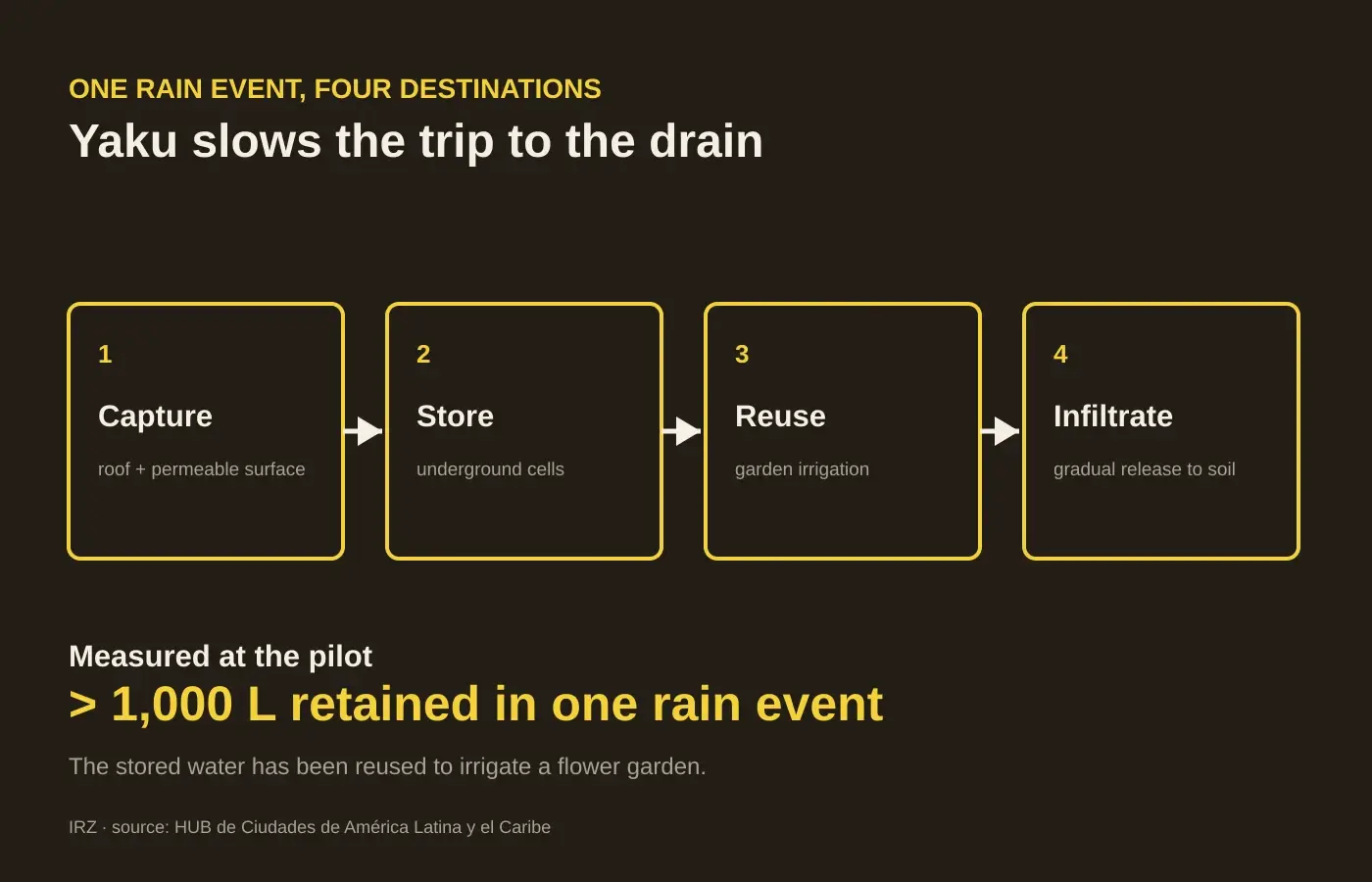
The 1,000-litre figure needs to remain in context. The HUB describes the prototype's capacity during one rain event and says stored water has actually been used to irrigate a flower garden.2 The public material we found does not provide a rainfall-runoff curve, detailed emptying time or a before-and-after measurement of the municipal drainage network.
We know the object retains water. We do not yet know how many modules, in which locations and on which soils would produce a measurable reduction in neighbourhood flooding.
Quito floods
That caution matters because the problem around Yaku is anything but decorative. Between January and May 2026, Quito's metropolitan emergency centre coordinated 552 adverse events; 188 were floods, the most common category ahead of fallen trees and mass movements.5
The city is also responding with heavy infrastructure. In July 2026, Quito listed several storm-relief collectors: $4.6 million for Eloy Alfaro, roughly $3.4 million for La Granados and $1.7 million for Jorge Piedra, alongside about $4.45 million for expanded capture works at the El Tejado ravine.4
Those projects and Yaku operate at different scales. A relief collector moves large storm flows below the street and adds capacity to the drainage system. A 27 m² module instead tries to keep a small amount of water from reaching that system at the same moment.
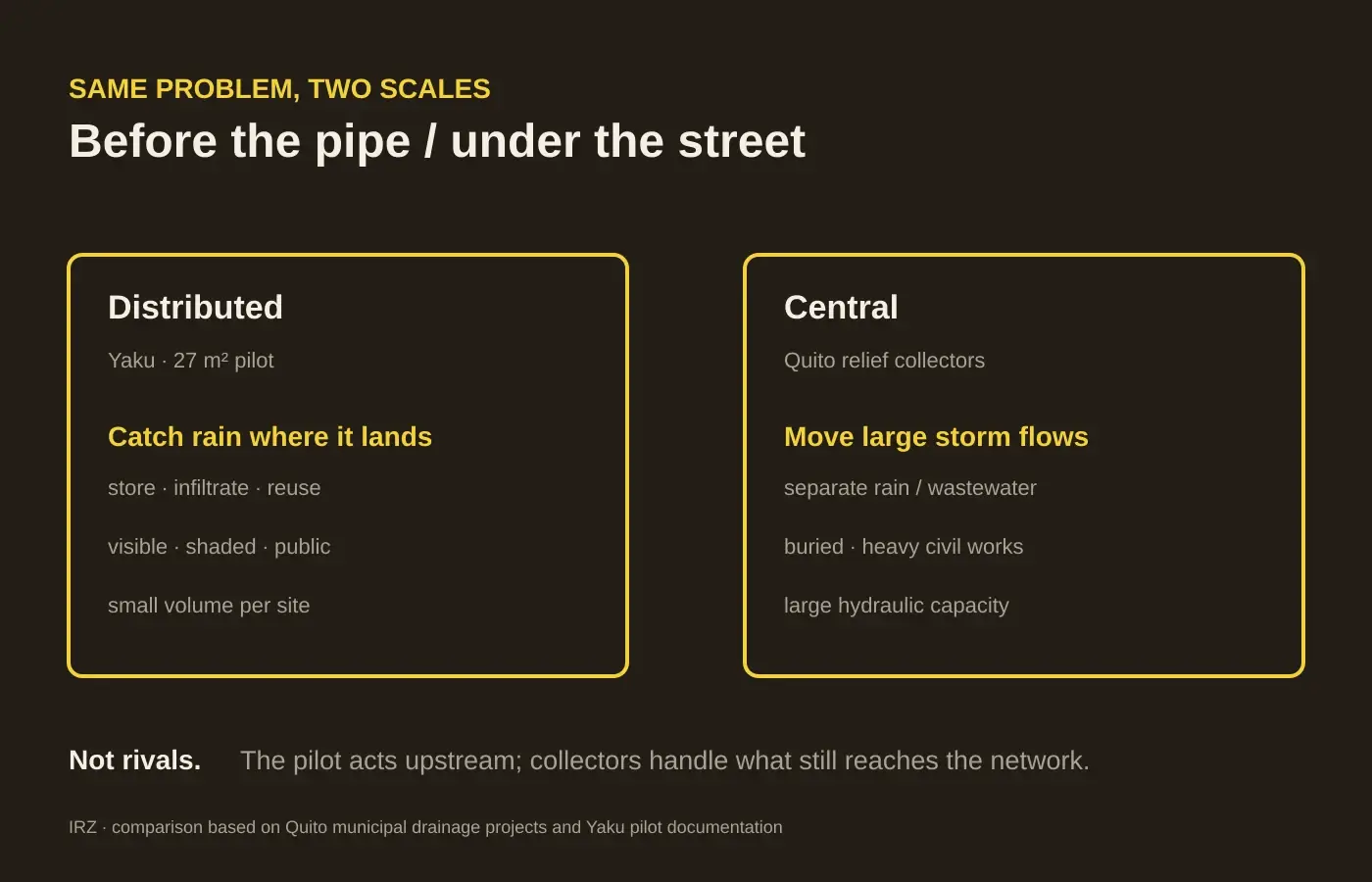
Calling it a “flood-proof bench” would therefore be generous. The pilot tests a less spectacular idea: can a hydraulic function be spread through public space instead of asking the buried pipe network to accept every drop after it has already become runoff?
Distributed layer
Quito formalised that logic before Yaku. Metropolitan Ordinance 060-2023 on green-blue infrastructure explicitly calls for a policy of sustainable urban drainage systems, or SUDS, and nature-based solutions in new development as well as the existing consolidated city.6
A built city cannot simply become an intact watershed again. It can restore small parts of the water cycle where urbanisation removed them: infiltration, vegetation, slower flow and temporary storage.
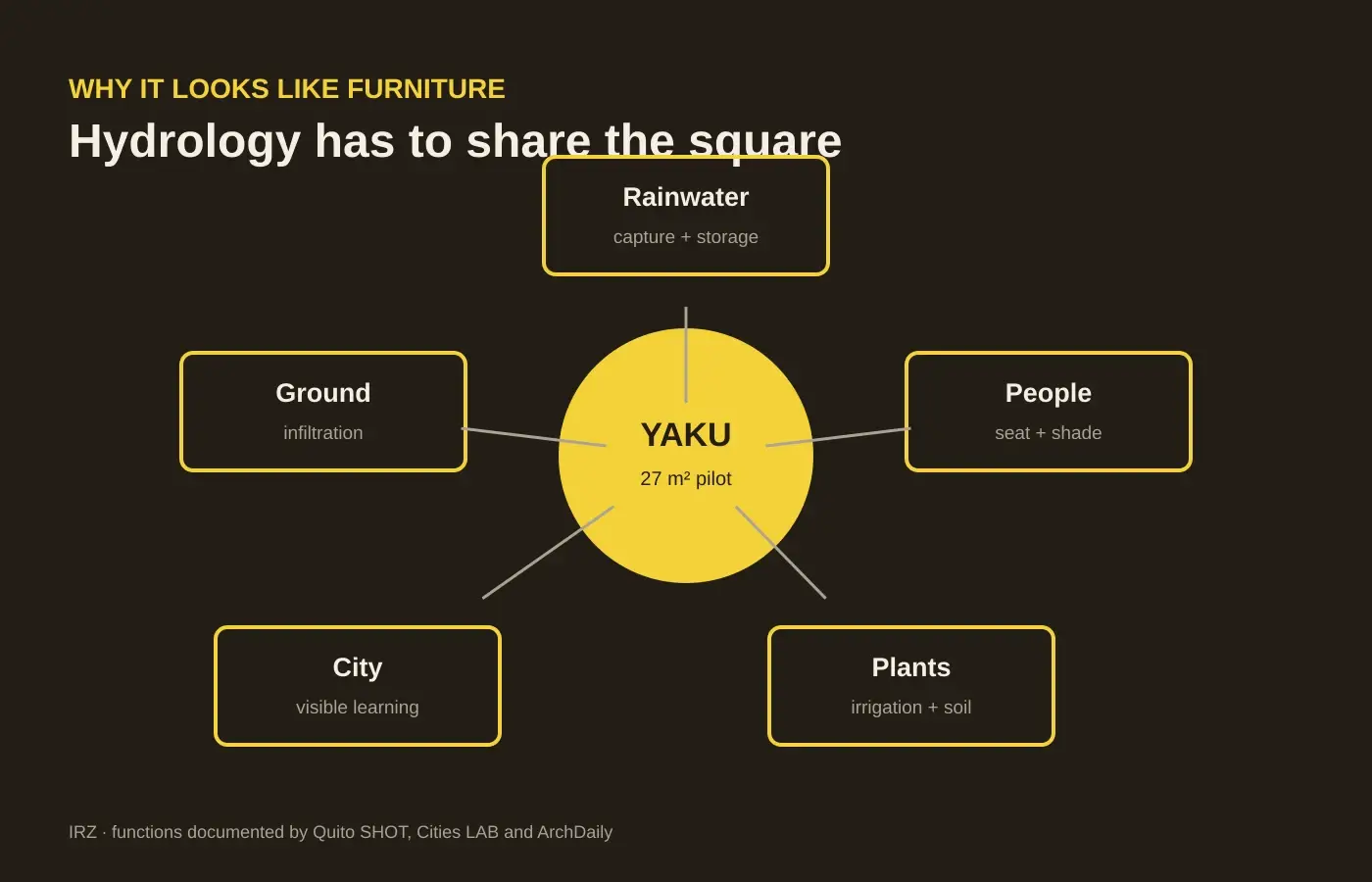
Yaku packs those functions into an object small enough to occupy ordinary public space. The project combines a rain garden, storage, infiltration, irrigation, seating and solar protection.23 Street furniture is not decoration applied after the engineering; it is how hydraulic equipment competes for scarce ground with circulation, comfort and everyday use.
Dry weather
This may be the smartest design decision in the project. A storm drain is visibly useful when water needs somewhere to go, whereas Yaku also has to earn its place through the dry stretches Quito experiences. The Cities HUB describes a city alternating between intense rainfall and prolonged dry periods, with strong solar exposure affecting the comfort of public space.2
Shade and seating keep the installation active between storms. Storage also makes a wet day useful later because captured water can irrigate planting. One object therefore connects problems usually filed under separate budgets: too much water during a storm and water demand when the garden dries.
The municipal proposal won one of three $30,000 pilot grants awarded by the BID Cities HUB in 2024; six SHOT technicians had led the design submitted to the programme.3 Two years later, the HUB's results page reports water retention, garden irrigation and positive use of the furniture by visitors. It also records a first prize from the Ecuadorian Sustainable Building Council in its sustainable urban infrastructure category.2
Still missing are the measurements required for serious hydraulic scaling: performance across seasons, maintenance of permeable surfaces and underground cells, clogging, water quality, recurring costs, behaviour on different soils and, most importantly, the cumulative effect of a network of modules. The public pilot page does not provide them.
Visible network
Yaku becomes more useful once we stop asking whether it can replace a sewer. It cannot, and it does not need to.
The project shifts the boundary of infrastructure. Part of a drainage network can be above ground, used every day and understandable without lifting a manhole cover. The seat makes it social, the planting shows reuse and the shade gives people a reason to remain there.
Quito's large collectors will still be necessary, but a city that wants less water to hit them simultaneously also has to work before the pipe. Rain gardens, permeable soil and small modules are tiny next to kilometres of underground drainage. Their advantage comes from that smallness because they can be repeated where rain actually lands.
For now, Yaku proves a modest and useful point: within 27 m², public furniture can retain more than 1,000 litres during a rain event, reuse that water and remain occupied when the sky is dry.12 The next question is no longer whether a bench can participate in drainage, but what happens when a city measures and operates many such pieces as a system.