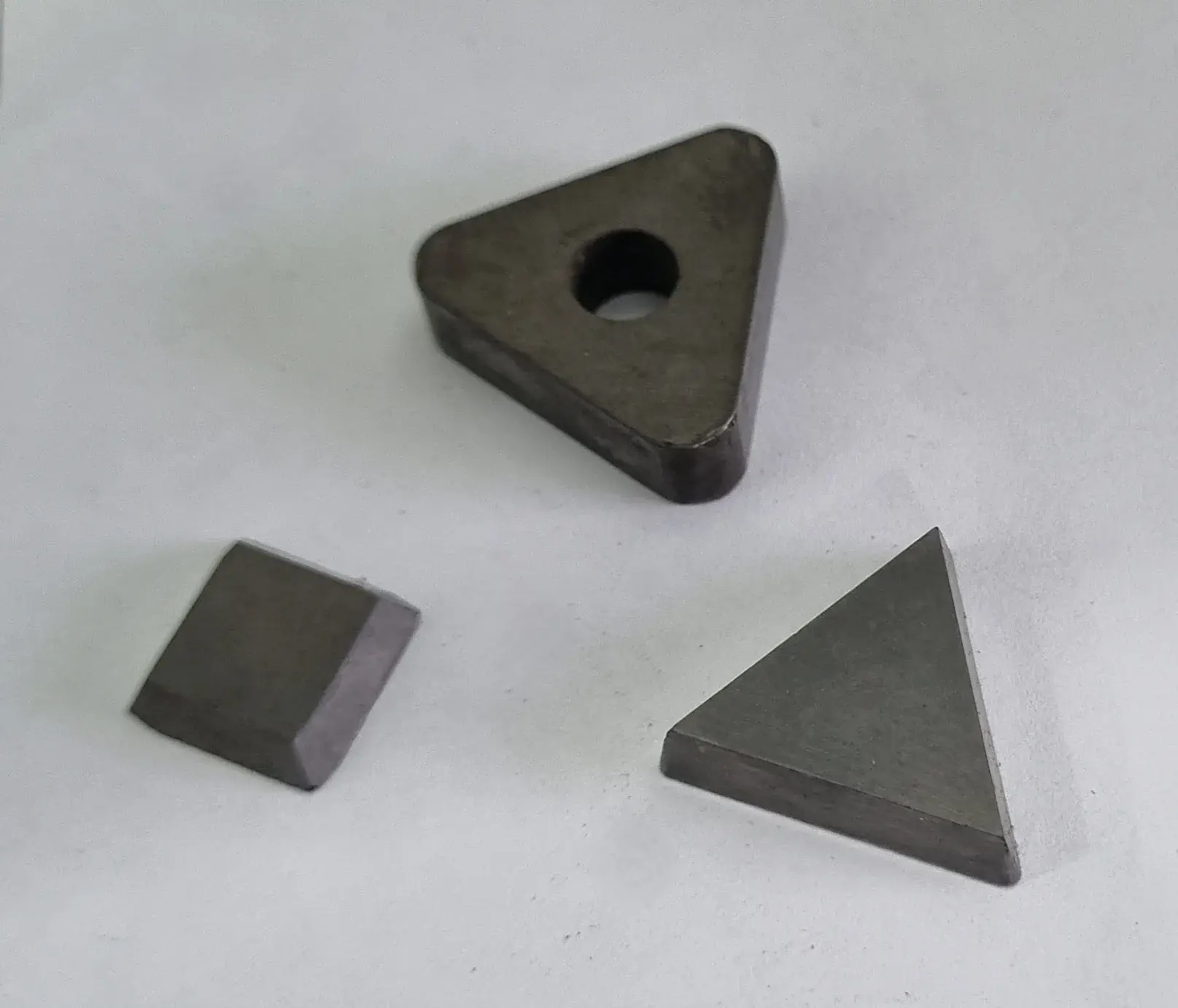

Tungsten carbide bonded with cobalt (WC-Co) is what cuts your metals. Turning inserts, drills, milling cutters, construction tools: wherever an edge must survive wear, there it is. Its hardness is also its manufacturing nightmare — nearly impossible to machine once formed, expensive in raw materials, and produced by powder metallurgy that consumes a lot of material for limited yield.
A team at Hiroshima University, working with Mitsubishi Materials, has now shown this material can be deposited layer by layer with a laser, without fully melting it, achieving industrial hardness above 1400 HV with no major defects.12
Why you can't just melt it
WC-Co combines two roles: tungsten carbide provides hardness, cobalt acts as the metallic binder holding the particles together. Today, fine powders are compressed under high pressure and then sintered — bonded at heat without everything liquefying.2
That nuance is crucial. Fully melting tungsten carbide alters its internal structure and degrades precisely the properties that make it valuable. Conventional melting-based 3D printing methods (laser powder bed fusion, wire-arc) therefore hit a wall: the material doesn't tolerate a complete bath.
Soften rather than melt
The tested solution is called hot-wire laser irradiation: a laser beam combined with a filler wire preheated before reaching the workpiece. Preheating raises deposition rate while reducing the energy demanded from the laser. Crucially, both metals are merely softened — enough to form and deposit, never fully molten.12
The researchers compared two arrangements. In the first, the laser strikes the top of a cemented carbide rod positioned ahead of the build direction; in the second, the laser leads the process, heating the zone between the rod's bottom and an iron substrate. The verdict is instructive: the rod-leading configuration partially decomposes WC near the top of the structure and creates defects; the laser-leading arrangement avoids those problems but initially struggled to hold the required hardness.12
Reading the right indicators
The team fixed the shortfall with two levers: a nickel alloy-based middle layer between substrate and carbide, and tight temperature control — kept above cobalt's melting point but below the grain growth threshold, since enlarged microcrystals change hardness and mechanical performance.1[2](#ref-2]
For evaluating results, the relevant indicator isn't “did it print?” but Vickers hardness: above 1400 HV, the resulting carbide joins the hardest materials in common use, just below sapphire and diamond. And with no detected defects or decomposition — that's the real finish line, not simply depositing material.2
Saving expensive material beats setting records
The decisive argument isn't technical prowess but material economy. Tungsten and cobalt are costly — and cobalt is a critical metal with supply concerns. In conventional production, you machine from a block or fill a mold, and much of the expensive material ends up as chips or waste. “By using additive manufacturing, cemented carbide can be deposited only where it is needed, thereby reducing material consumption,” summarizes Keita Marumoto, corresponding author of the study.2
For a cutting tool, this means hybrid geometry: a cheap steel body, plus a few tenths of a millimeter of carbide exactly where the edge runs. The process's value lies in that selectivity, not in the ability to print a whole block of WC-Co.
What's missing before industry
Blind spots remain, acknowledged by the authors: reducing cracking, improving durability, and above all producing complex shapes — current demonstrators stay close to deposition on flat plate. Future work targets practical cutting tools and extension to other materials, the “soften without melting” approach being potentially transferable.2
Between the Hiroshima lab and the workshop floor, road remains. But the conceptual barrier has fallen: we now know how to deposit one of industry's hardest materials without destroying what makes it useful. For a sector where every gram of wasted carbide is paid for twice, that's less a record than a beginning.