A quest marker solves an enormous problem with a few pixels.
It says where to go, often gives a distance, survives a camera pointing the wrong way, and saves the player from remembering the name of a village, the shape of a tower or a sentence spoken twenty minutes earlier by a side character who seemed terribly confident about being important.
The developer of UNPAINTED explicitly dislikes that solution.
The title of a prototype posted to Reddit is unusually direct: players can ask NPCs for the location of current objectives because the developer does not like quest markers.1
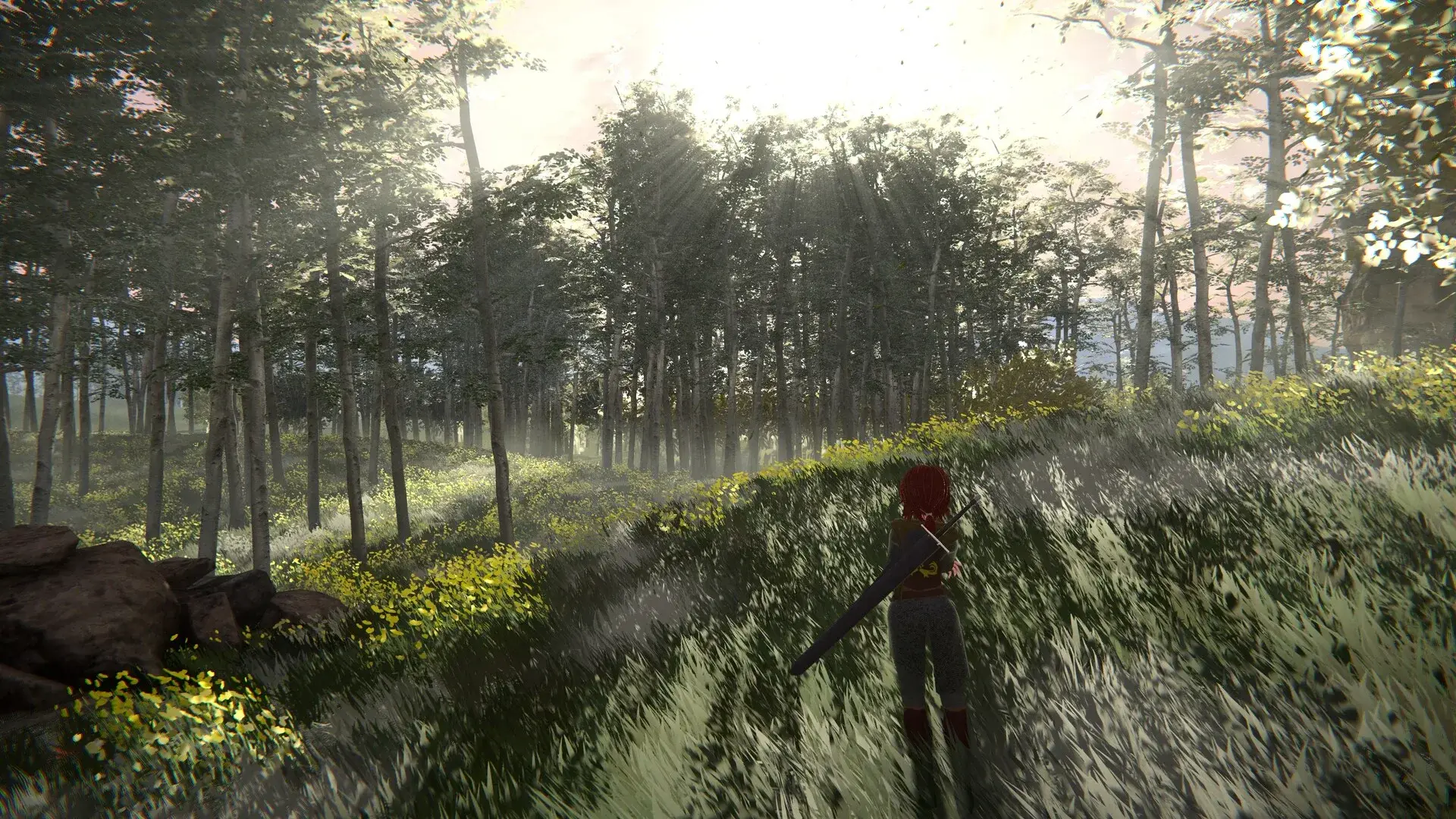
In the demonstration described by 80 Level, protagonist Jayne is looking for Sir Reynald, the first character only knows enough to point her towards the village, where other residents recognise the name and provide a more precise direction.6
So, contrary to the first angle proposed for this article, UNPAINTED is not simply replacing an icon with environmental scenery.
It is doing something broader by redistributing the marker's information across conversation, world knowledge and a cartography system the player has to use.12
That distinction matters because deleting an icon is easy, whereas replacing everything it knew is a much more interesting design problem.
A compressed icon
A quest marker is a compression format.
The game may contain a complicated instruction such as “cross the old bridge, continue north to the mill, then find the house behind the church”. The interface can reduce all of that to a yellow diamond sitting 487 metres away.
The benefit is obvious in the near absence of ambiguity, while the cost is less visible: a player can cross the world without building much spatial knowledge because the next point continually replaces memory of the route.
None of this makes markers inherently bad, since a huge game full of parallel objectives, limited play time and widely differing accessibility needs can use them to eliminate a remarkable amount of useless friction. The conflict appears when orientation itself is supposed to be part of the experience, because the icon may then solve exactly the task the game wanted the player to perform.
UNPAINTED therefore makes the information less compressed. Locating a person involves asking someone, understanding the answer and then recognising what the answer refers to.16
The route becomes a small spatial investigation.
Ask to navigate
Turning NPCs into a navigation layer changes their role by making each character an access point to local spatial knowledge as well as a source of dialogue, lore or quests, with the useful narrative consequence that information can depend on what a person is reasonably expected to know.
The Sir Reynald example works because the first NPC knows only an intermediate destination, while residents in the village have more precise local knowledge.6
That structure is more credible than a peasant magically projecting a stranger's GPS coordinates onto the player's compass, but it also creates new obligations for dialogue and level design.
If twenty NPCs all answer “I don't know”, the system has not produced immersion, only twenty useless conversations. If a direction names a place the player has never seen and the environment provides no way to recognise it, the failure belongs to the supplied information rather than to player memory.
An interface without markers therefore contains no less UX, part of that work has simply moved into dialogue.
Draw the map
Moths Games is also experimenting with manual cartography.
In another Reddit prototype, the developer shows a system for creating a player's own map.2 80 Level reports that the developer acknowledges the risk of making the process tedious and is looking for a balance that might encourage a community of cartographers.6
That admission is useful because a system can fit the fiction beautifully and still be ergonomically miserable in repeated use.
Drawing a map makes exploration an explicit activity. The player no longer passively receives a plan that fills itself in as they walk, and instead has to decide what deserves to be recorded.
Every repeated decision has a cost, however: if recording a route demands thirty seconds of administration after every junction, cartography can become clerical work, while excessive automation simply recreates a mini-map through extra steps.
The useful balance depends on what the game actually wants players to remember. A hand-built map does not need every stone if it records relationships such as village east of bridge, tower visible from valley or merchant behind square, in which case it behaves less like GPS and more like external memory.
Let landmarks confirm
The environment then recovers the role imagined in the issue's original angle, because a verbal direction only works when the player can recognise what it names in the world.
“Turn after the large red tower” is useful when the tower is visible, distinctive and stable enough to remain a landmark. “Take the third slightly darker stump” is a poorer instruction unless the project happens to be an unusually vindictive forestry simulator.
Wayfinding research gives a concrete reason to care about landmarks: in an immersive virtual-environment study, participants navigating with distinctive landmarks completed the maze faster and committed fewer errors than participants who lacked them.5
Games can exploit the same principle through architectural shapes, silhouettes, lighting, colour differences, movement or localised sound.
A landmark does not need to shout “OBJECTIVE”, it needs enough salience to enter memory and enough stability to be found again when a direction refers to it.
Pixels alone
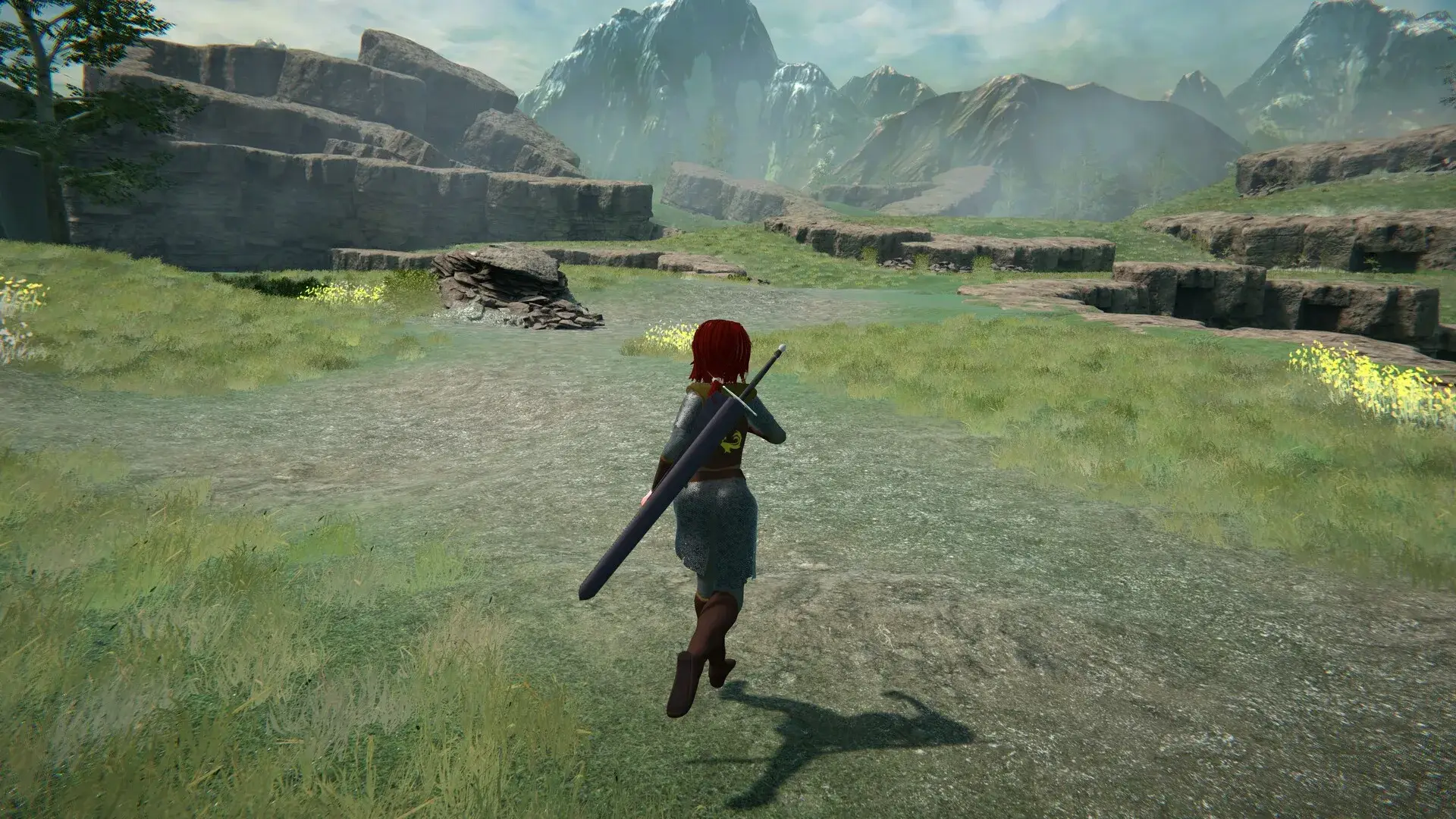
A paper published in February 2026 pushes the question in an amusing direction: how far can an agent navigate commercial 3D ARPGs using only the pixels on screen?4
Kaijie Xu, Mustafa Bugti and Clark Verbrugge built an agent that receives live game frames, detects visually salient interest points and uses a finite-state controller to explore linear, Dark Souls-style levels.4
The result avoids both comfortable conclusions: the agent can traverse most required segments and exploit meaningful visual navigation, while limitations in the visual model still prevent comprehensive, reliable automatic navigation.4
For level design, the useful point is that an environment can carry a great deal of navigation information without HUD elements while still failing to communicate the right cue to every player at the right time, the world can guide, but it cannot read minds.
Measure errors
A system like UNPAINTED's should therefore be evaluated with more than the question “does this feel immersive?”, because the more useful test is where information breaks and what the player does next.
The following are not published Moths Games results, they are the measures I would watch during playtesting:
- time before choosing the correct direction after a conversation,
- wrong branches before correction,
- backtracking distance,
- pauses and camera sweeps while searching for a landmark,
- ability to restate the direction just received,
- number of NPCs questioned before obtaining actionable information,
- and the difference between “I am lost but I know what to try” and “I have no idea what the game expects”.
That final distinction is crucial. Being temporarily lost can be enjoyable when the player observes, forms a hypothesis, tries a path and recognises a familiar building, because the world becomes more concrete as it is learned, being lost without a hypothesis instead produces random search until the correct collision eventually triggers progress.
Those experiences can have similar travel times and completely different qualities.
Accessibility matters
Removing markers also has a consequence that purely nostalgic discussion of Morrowind can overlook.
Players do not share the same spatial memory, vision, hearing, ability to retain verbal instructions or available time to resume a game after two weeks away.
A world-integrated navigation system can be excellent as the default while still offering optional assistance.
A journal might preserve exact directions already heard, while text landmark descriptions, audio assistance, a more supportive map or even optional markers could exist without turning the default experience into permanent GPS.
Offering those options does not betray the design, it recognises that an interesting constraint for one player can become an arbitrary barrier for another.
The important choice may be less “markers or no markers” than how much assistance the game forces, offers or allows players to disable.
Replace the information
UNPAINTED still has no announced release date on Steam.3 Its navigation systems are therefore part of a game still in development, and treating them as the definitive formula for markerless design would be premature.
The experiment does frame the problem correctly, because a quest marker is both a visible icon on the landscape and an extremely efficient packet of information.
Removing it creates a debt. Direction, distance, context and the ability to recover from mistakes all have to be paid back somewhere.
UNPAINTED is trying to distribute that debt among residents who know their region, a map the player constructs and a world distinctive enough to be described and recognised.12
That redistribution is much harder than hiding the HUD, and it is also why the result can become more interesting than a game that simply advertises “no quest markers”.
When the interface disappears, the whole world has to learn how to do its job.