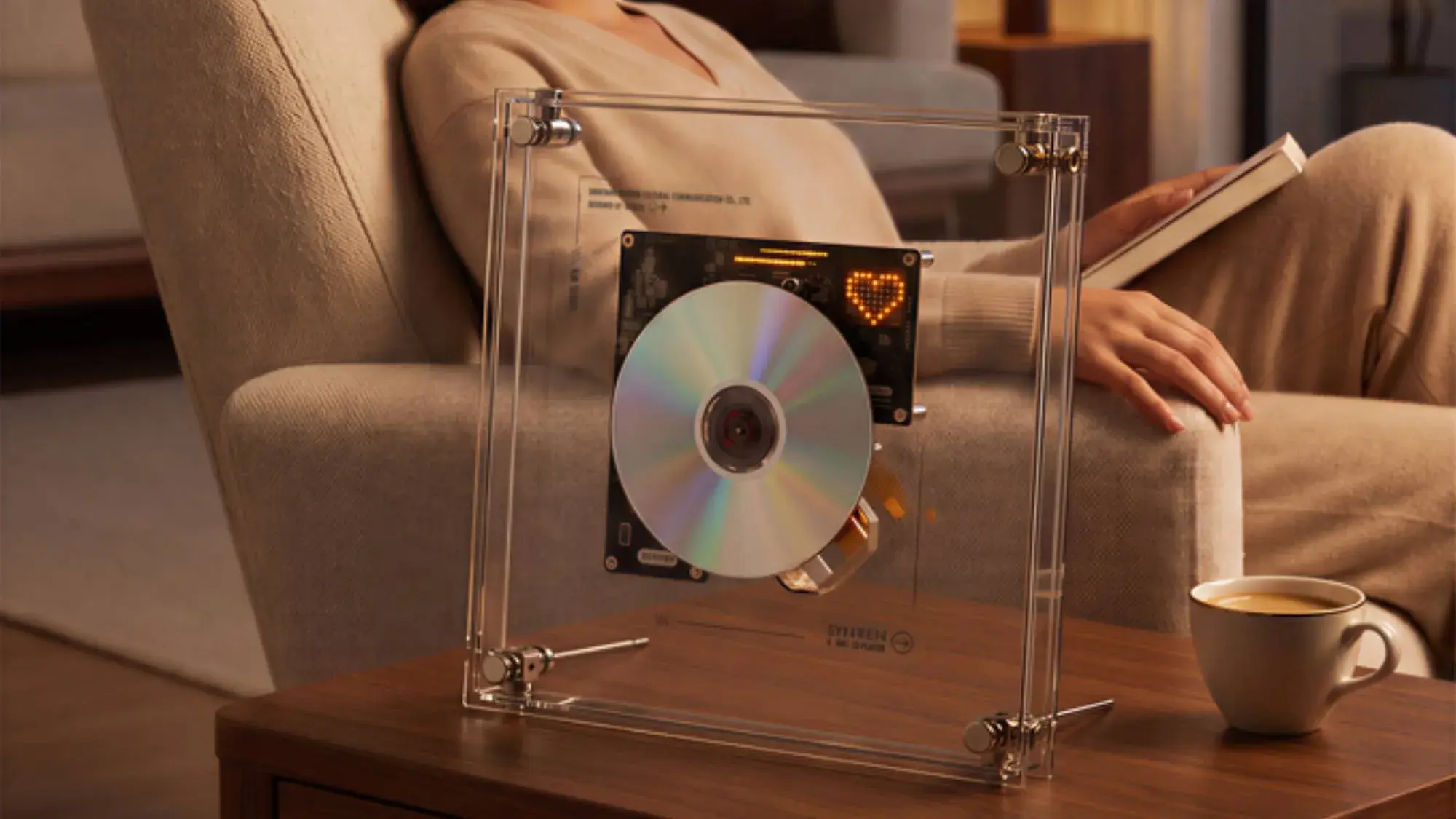
A CD player is usually a small box that asks for your trust: insert the disc, press play, let things happen under the plastic, and it gets on with the job like a toaster.
Syitren's RM1 heads the other way, using two transparent acrylic panels to frame the disc, optical mechanism and electronics; the CD becomes a moving piece, the circuit board becomes scenery, and playback becomes visible again.1
This is not an audio breakthrough so much as an interface proposal: rather than adding another screen to music, the RM1 puts the physical act that was already there back in view.
The object still needs to stay at the right distance, because the RM1 is being presented through a Kickstarter campaign and its specifications, price, performance and schedule are Syitren's claims, not the result of an independent review or evidence of a product already in customers' hands.12
A disc on stage
The clearest choice is not technical. It is refusing to hide the CD.
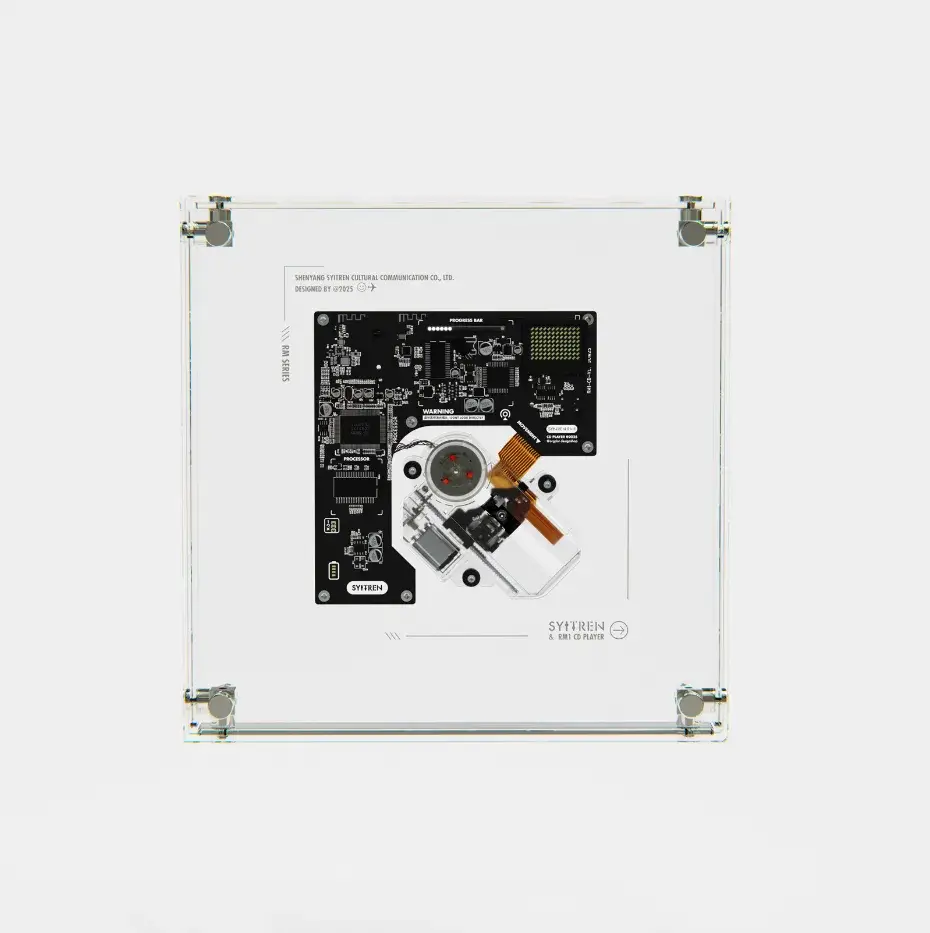
Most players treat the disc as consumable material: slide it into a slot or under a lid, then it vanishes. The RM1 keeps it central and facing the listener. The campaign describes a 260 x 260 x 42 mm chassis with two acrylic layers and metal corner posts. During playback, the disc's iridescent surface, optical assembly and printed circuit board remain in sight.1
Nothing in the available sources establishes that transparency makes the device repairable, and it certainly does not expose all of its electronic logic; instead, it gives visual feedback to an action that streaming reduced to pressing on black glass.
Watching a disc spin is not essential information, which is exactly why it can be pleasurable: it reminds you that the music came from an object selected from a shelf, placed by hand, and eventually returned to its case. An interface can make a gesture desirable rather than merely shorter.
Useful frontage
Syitren is not only asking people to watch a disc rotate. The campaign promises a progress bar and a small amber LED matrix for track number, volume and battery status. A remote handles playback; the listed connections include a 3.5 mm jack and Bluetooth 5.3.1
On paper these are ordinary features, but their placement is less so: playback information sits beside what actually makes the sound, disc, mechanism and progress, instead of yielding the whole face to a large screen.
Leaving out a built-in speaker fits that decision. It requires headphones, speakers or a hi-fi system, and TechRadar accordingly describes the project as a source player rather than a self-contained mini system.2 The arrangement is less convenient, but an honest one: a 42 mm transparent frame does not pretend to do everything at once.
The vertical promise
The RM1 is shown lying flat, standing at an angle or mounted on a wall. That is where the design takes a modest risk: a vertical CD player has to address vibration differently from a horizontal living-room unit. Syitren claims 40 seconds of anti-shock buffering for audio CDs and 120 seconds for MP3 discs, as well as an optical pickup designed for this orientation.1
Those are manufacturer claims. They tell us what problem the project is trying to solve, not how the machine will behave in practice. The sources do not yet tell us how it handles a vibrating wall, a scratched disc, an ageing battery or months of repeated handling.
The distinction matters because this object sells its material presence. Software changes out of sight, whereas an exposed mechanism puts dust, fingers, expectations and manufacturing flaws in the foreground.
Not a mass comeback
The story writes itself: physical media are back, therefore CDs are back, therefore a transparent CD player arrives at exactly the right moment. TechRadar and Yanko both lean into that line, and the latter includes commercial links to the campaign.23
RIAA's 2025 year-end report calls for more precision. It tracks physical formats separately, yet the numbers do not amount to a broad reversal comparable to vinyl's cultural comeback story. CDs remain a real market, with collectors, reissues and concrete uses, rather than the statistical emblem of a general victory over streaming.4
None of that diminishes the RM1; it makes its likely audience clearer. The device need not prove a mass trend to make sense to people who already own discs and want them visible in their room and listening routine.
Object before slogan
The RM1 offers a small, useful inversion: while many digital products conceal their workings behind a perfect surface, this one frames an ordinary mechanism and says that looking is part of what you came here to do.
Its strongest idea is neither acrylic nor nostalgia, but the possibility that physical media can make an action more present without turning it into a ceremony: pick an album, place it, watch the progress, take it off. No automatic profundity there, just an interface that leaves room for listening time.
One test cannot be performed from a campaign page: the test of the finished product. Before calling it a durable design object, we need to see delivered units, hear the audio output, measure battery life, and learn whether the exposed mechanism ages like a well-used tool rather than a shop display. For now, the RM1 is a sharply framed proposal, not yet proof.