Skanda is eleven and does not have a phone yet. His father would like to keep it that way for a little longer.
The chosen solution is not exactly minimal: five connected intercoms, a relay on a VPS, encrypted audio, OTA firmware updates and an enclosure eventually designed by the child himself.
The project is called Sidebar. Sundararajan Mohan, a product manager with an electrical engineering degree, wanted something deliberately narrow: tap a friend's name, make a device ring in their house and talk. No public account, no feed, no user search, no recordings.
He also says that before this project he had never written firmware, worked with I2S or done soldering he would consider serious. Claude became an engineering partner for assembling several domains that would normally each reward a specialist.
The useful story is not simply that AI can now build hardware. The hardware spent much of the project demonstrating that generating plausible code and keeping five physical devices working in children's homes remain different activities.
Parent-made constraints
Each unit uses a Nextion ONX2432G028 board built around an ESP32-S3, plus a touchscreen, microphone and speaker. Mohan reports buying six boards, five for the network and one spare, with microphones and speakers for roughly CAD $250.
The architecture begins with things he does not want.
No device listens on an inbound port in a friend's home. Units establish outbound connections to a relay the parent operates. The roster of allowed children lives on that server. The intended system does not record audio.
Mohan is careful about one tempting word: the encryption is not end-to-end. Audio is AES-256-GCM encrypted to the relay with a fresh key for each call, but the relay operator could technically decrypt live audio. His monitoring dashboard is a separate process, opens the metadata database read-only and has no access to those call keys.
That qualification is more useful than a perfect security slogan. A system used by children should describe the protection it actually provides, not the line that would look best on a product page.
The bricked intercom
The most useful part of the build arrives with a clock.
Mohan ships firmware version 1.2.0 over the air. New date-formatting code runs inside a networking callback whose task stack cannot handle it. Skanda's device boots, crashes, reboots and repeats.
The unit is recovered over USB. The other devices had not accepted the update. The OTA path also has a health gate intended to avoid marking a new image healthy until it can reach the relay.
The rule added afterward is less glamorous: never publish an update that has not run on real hardware.
A later release produces another useful failure. Testing a firmware download URL from the server hosting it returns a wall of Cloudflare 403 responses, so Mohan concludes delivery is broken. Devices on home broadband update normally. He had verified the path from the wrong vantage point.
These are ordinary mistakes to an experienced hardware engineer. They matter here because an agent can get someone to a plausible implementation quickly without also delivering the instincts accumulated from breaking twenty previous boards.
Acceleration does not remove learning. Sometimes it lets you reach the educational failures much faster.
Eleven-year-old designer
For two weeks, the electronics sit bare on a table. Then Skanda starts designing a case.
He begins with pencil and paper, moves into FreeCAD, measures the board, speaker and microphone, then measures screws with calipers. The family does not own a 3D printer, so the files go to their community library.
According to his father, the first print fits.
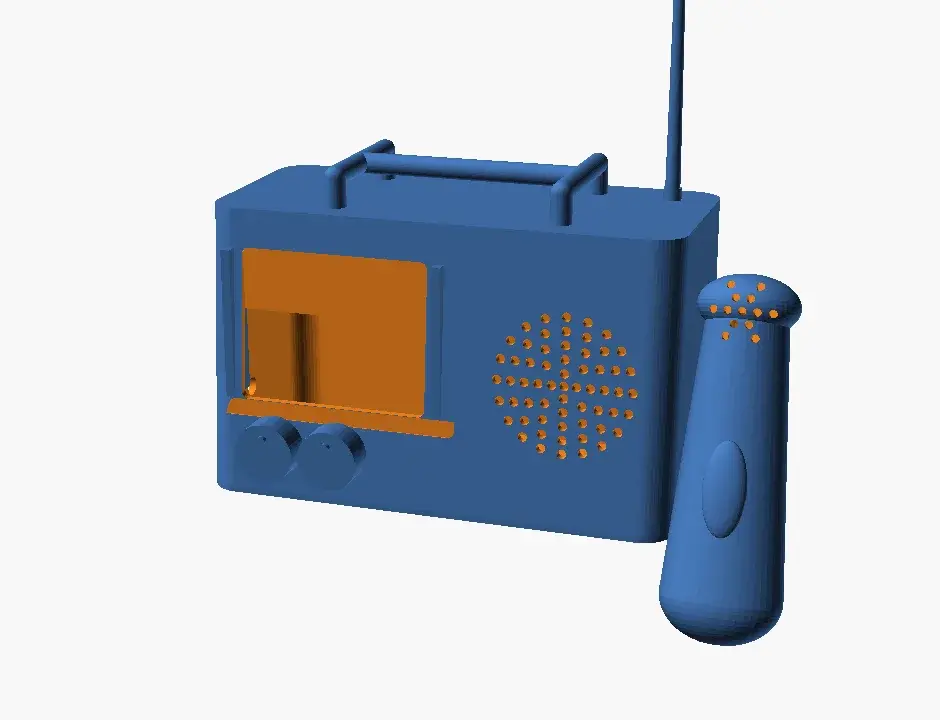
A physical constraint changes the design along the way. The microphone uses a flat ribbon cable that makes a classic handheld radio-style fist mic awkward. Skanda instead puts the microphone and speaker as far apart as the front allows, with the speaker in its own chamber to reduce echo. The echo is not fully solved, but the case starts responding to the system that exists rather than the object imagined at the beginning.
The MainTalkie, MainLid and MainStand STL files are now in the public repository. Its MIT license explicitly notes that Skanda designed those enclosure files and asks remixers to preserve attribution.
There is also a small timing artifact in the story: his father's article still says the code is "not open yet." The current repository is public and MIT licensed. The project kept moving after the story froze on the page.
AI did not choose
The repository now describes five units, three in daily use and two still being brought up, after more than a dozen OTA releases tested on hardware.
That is not industrial validation. This is a very young family project, using a parent-run relay and security choices designed for one small circle.
But the process transfers better than the hardware recipe.
Mohan could ask models how to capture a PDM microphone, play I2S audio or structure an update protocol. The decisions that gave the product its shape came from somewhere else: delay the phone, constrain the social circle, record nothing, avoid opening other families' networks, and let a parent inspect system health without gaining a convenient listening interface.
Then the physical world performed its usual service by rejecting abstractions that were not precise enough.
By the end, the object is not only something a father assembled with Claude. One of its most visible parts belongs to an eleven-year-old who had to pick up a ruler, measure screws and find out whether a FreeCAD file actually matched reality.