Creative Review supplied an irresistible 2026 headline: Puresport ditches AI-generated product shots for oil paintings.1
It also makes the project sound slightly different from the evidence.
We found no indication that Puresport had an existing AI-generated campaign which it then removed. Creative lead Mikey Robinson instead describes a road the team could have taken: in 2026, he says, the easy option is to feed some product shots into an AI workflow and produce hundreds of assets. Puresport deliberately looked for the opposite process.1
The four commissioned works are not even all oils.
That correction makes the campaign more interesting, not less.
Four artists
For the launch of its Pomegranate Ultra Electrolytes developed with British sprinter Amy Hunt, Puresport commissioned original still lifes from Trish Walsh-O’Neill, Tomás King, Tony Robinson and Patricia Robinson.1
Each artist received the same physical kit: a bottle, a sachet and a box. The strong requirement was that the packaging remain prominent, while medium and interpretation were otherwise left open.1
It is almost a controlled creative experiment.
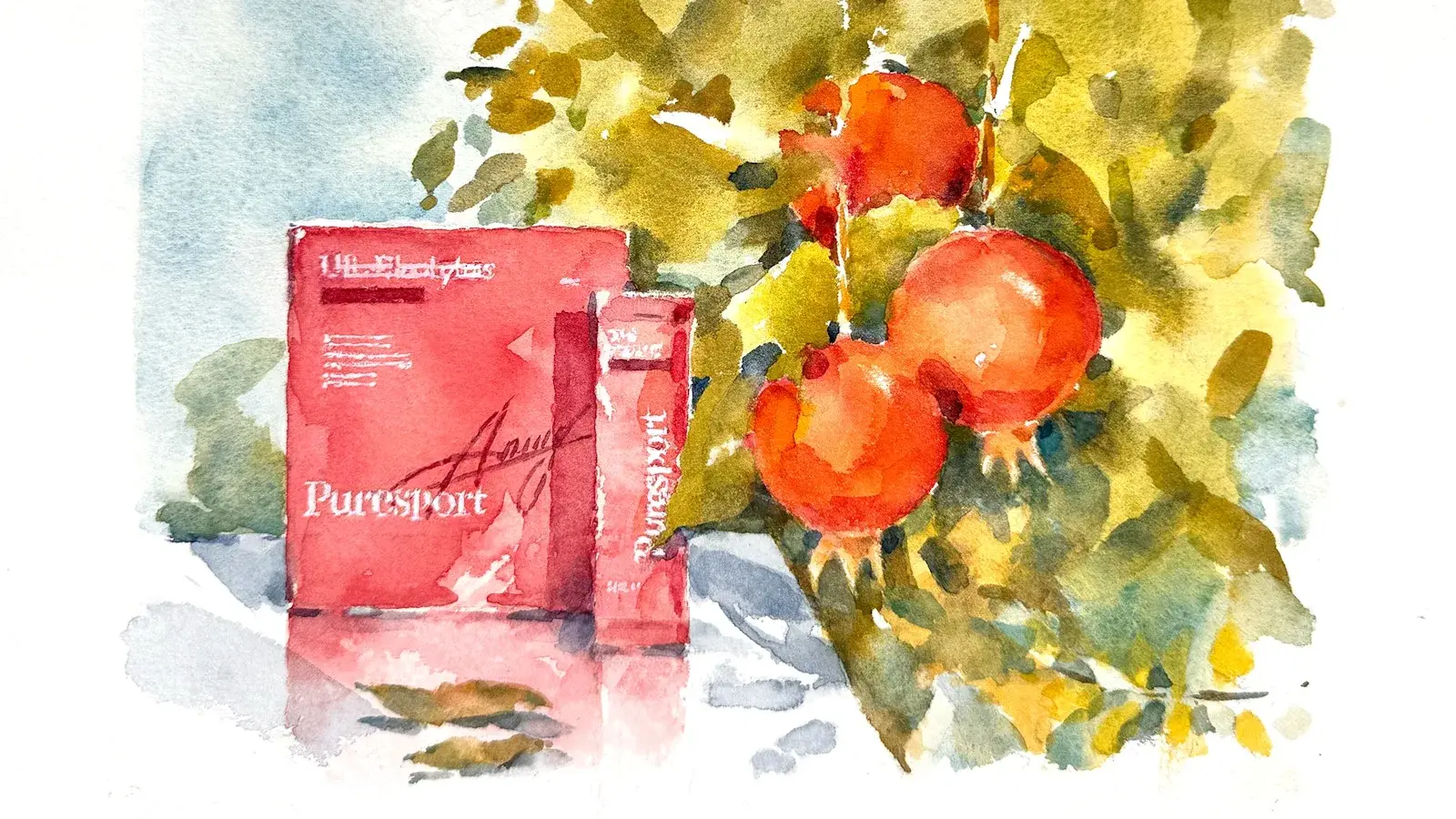
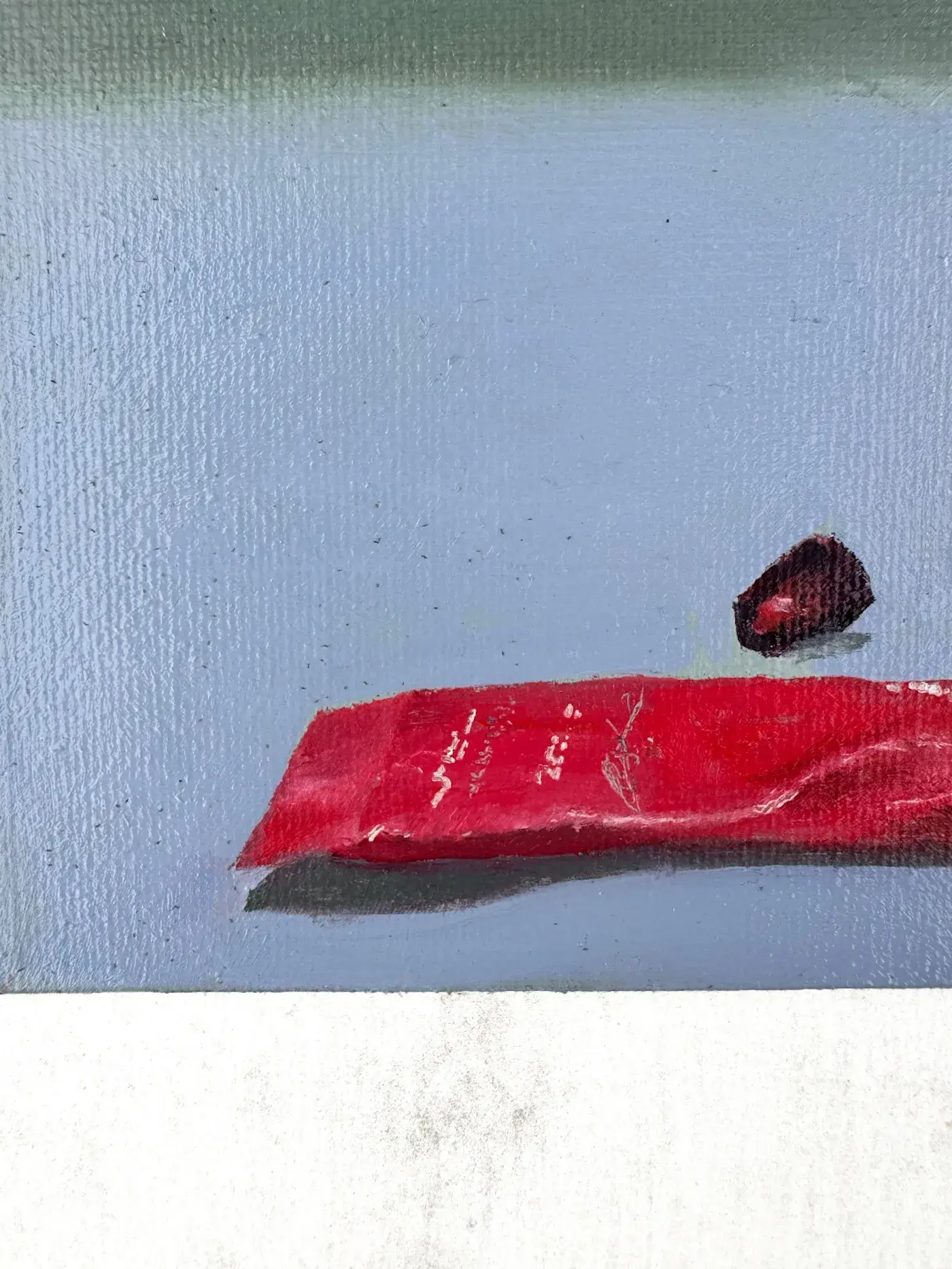
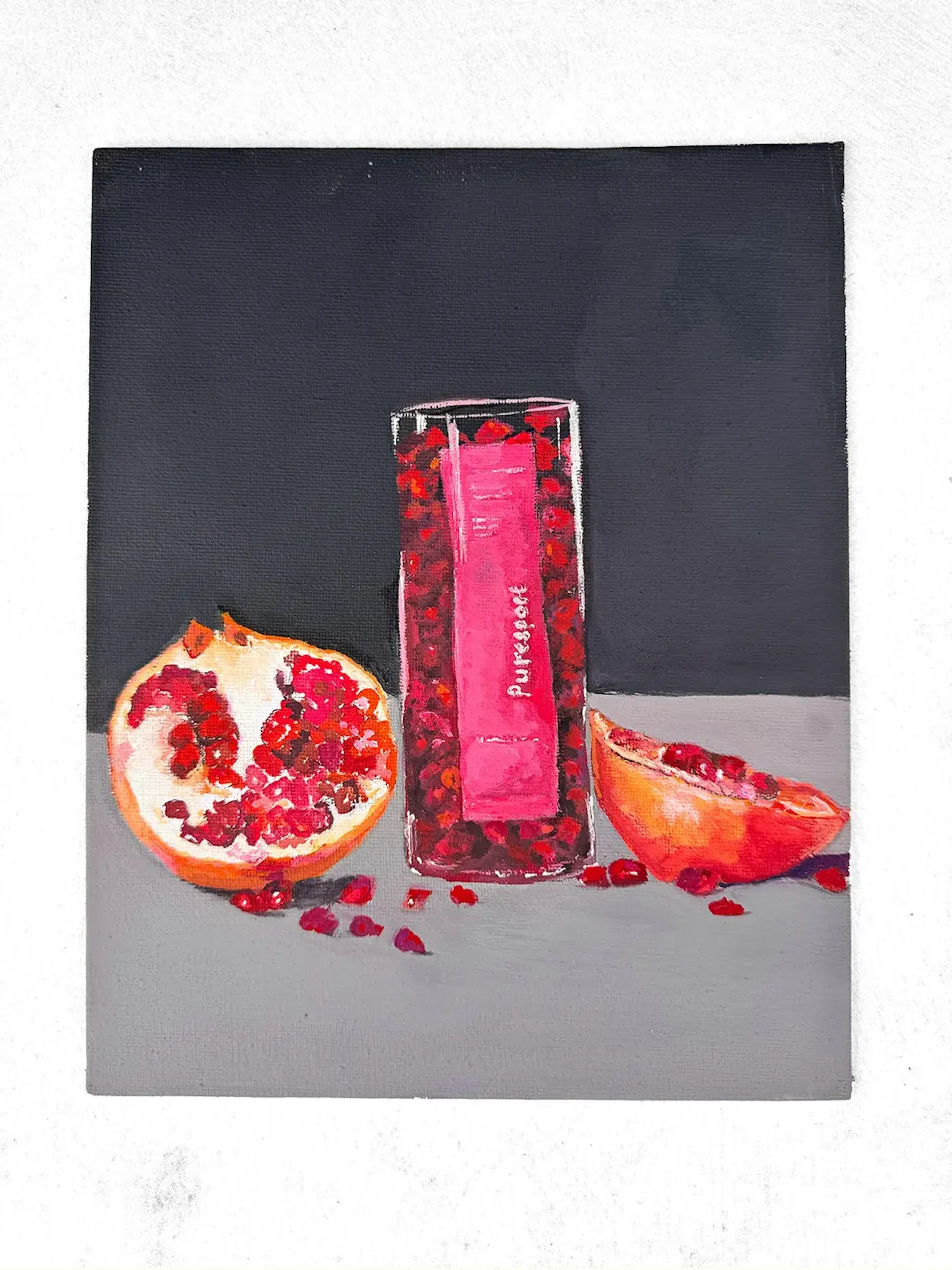
One artist put flowers in a bottle, another introduced an oil can as a reference to the mechanics of running, while another worked from a personal photograph of a pomegranate tree taken during travel.1 Same objects, same broad brief, four different authors.
Not four oils
The neat “four oil paintings” description falls apart when Robinson lists the originals: a dark oil painting, a bright summery watercolour, an acrylic and a gouache.1
Puresport is therefore not replacing one recent technology with one old medium. It is accepting four processes whose texture, correction cycle, drying behaviour and physical result differ from one another.
That choice fits the wider collaboration. Hunt did more than attach her name to an existing flavour: Puresport says she was involved from early tastings through the final formula, while the product page treats her interest in fine art, nail art and favourite colours as material for the campaign moodboard.23
Painting becomes less of an anti-technology manifesto than a visible way to talk about time spent choosing.
False duel
Puresport frames the production decision through a simple contrast: AI could make a lot of material quickly, whereas painting means choosing the slow and difficult option.1
The contrast works in advertising, but the public record does not support a larger claim. We found no previous Puresport campaign that these works replace asset for asset, and no disclosed test comparing conversion, click-through rate or acquisition cost between the paintings and generated alternatives.
The campaign demonstrates a production choice, not measured commercial superiority for painting over image generation.
The displacement is still real. A generated route can branch, rerun and multiply with very low marginal creative effort; a physical artwork contains a much harder point of decision, because eventually the artist stops and an original exists.
That is not automatically better. It is far less reversible.
File returns
There is a useful paradox in the “return to real craft” story: the resulting campaign is rolling out across paid and organic digital social channels.1
A canvas or sheet of paper cannot enter an ad platform on its own. The original has to be photographed or scanned, colour-corrected, cropped, exported into platform ratios and delivered as files; the press images published by Creative Review are themselves digital reproductions of the physical works.1
Puresport did not replace digital production with painting. It moved the point at which the image is authored.
In Robinson’s hypothetical AI route, product photography becomes input for a system capable of returning a large number of variants. Here, those references become a singular composition made by an identifiable person. After that stage, both routes face the ordinary needs of campaign production: clean files, platform formats, copy, tracking and distribution.
The rights
Four authors create another difference that “craft” narratives often skip: four works mean four copyright relationships.
Under UK guidance, the creator of a commissioned artistic work is normally the first copyright owner unless a different arrangement is agreed in writing.4 Government guidance makes the distinction unusually concrete: buying a painting does not by itself give the buyer permission to reproduce it for something such as a book cover or campaign.6
A brand contract therefore needs to cover reproduction, territories, duration, relevant media and paid uses. When an image commissioned for one purpose later moves into another medium or campaign, a narrow initial licence does not automatically cover that extra exploitation.5
The agreements between Puresport and these four artists are not public, so we cannot say whether the brand acquired copyright, an exclusive licence, a non-exclusive licence or different arrangements for different works.
That unknown matters because a fair cost comparison cannot stop at the physical price of a painting.
Price unknown
Neither Creative Review, Puresport nor the public campaign material we found gives artist fees, production duration, purchase price for the originals or digitisation cost.12
Inventing a claim that “human art costs X times more than AI” would be particularly silly in an article about misleading shortcuts.
The public quantities are narrower: four artists, four original works, four media, three physical product items sent to each artist, followed by organic and paid distribution.1
The likely extra cost buys things that a per-image calculation misses: a physical original, provenance, a named author, a production story, a collaboration and the radical scarcity of an image that initially exists only once.
Real scarcity
That may be the campaign’s best inversion.
Puresport is not really fighting AI by claiming that paint produces superior pixels. It has chosen the opposite attention economy.
Generation promises abundance: more routes, more versions, more tests, faster. Artist commissions voluntarily reduce the number of answers before distribution even begins.
That constraint changes the brief as well. Sending the same three objects to four artists means accepting that the brand will not precisely control the final composition, whereas a generative direction can keep asking for another version until it circles back to what the art director already imagined.
The result scales badly. That is part of the signal.
Four decisions
The Puresport project does not prove that consumers prefer handmade work, that painted ads convert better, or that the company “quit AI” after a failed experiment. None of those claims is documented.
It shows something smaller and more transferable: scarcity of production can itself become part of the message.
For a campaign internally named “exquisite taste”, around a product developed through repeated trials with an athlete interested in galleries and art history, four separately made originals fit the story of selection, patience and application unusually well.12
Then they become JPEGs, WebPs, vertical crops and paid ads like everything else.
The difference is not the final file.
It is what had to happen before that file existed.