The main pool at Barcelona's Mies van der Rohe Pavilion looks motionless. In summer, keeping that mirror intact means continually replacing what heat takes away.
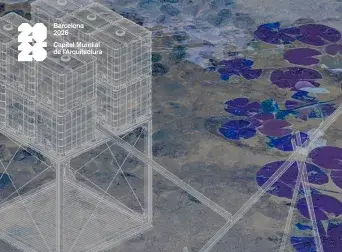
Cierto Estudio, h3o architects and Metrònom built Plou prou? around that otherwise invisible loss.1 Twelve industrial tanks hold more than 12,000 litres of groundwater, the volume estimated to evaporate from the main pool during the installation's fourteen days.2
Spread across fourteen days, that is more than 857 litres every day on average.
Once the number is visible, the pool stops looking passive. Its calm surface is something the site actively maintains.
Twelve tanks
The tanks sit raised beside the pavilion. An elevated channel connects them to the pool and returns the water through a continuous drip.12
The Mies van der Rohe Foundation frames the work around a mundane cycle that photographs erase: the pools lose water and staff keep putting it back.1
No dashboard is involved. The missing volume simply occupies space in twelve tanks large enough to interrupt the familiar view.
The installation is not displaying a permanent stock. It is materializing a maintenance flow.
The distinction matters because visual stability can depend on a flow that never stops.
A reconstructed image
The pavilion's own history complicates the reading further.
The building designed by Ludwig Mies van der Rohe and Lilly Reich for the 1929 Barcelona International Exposition did not remain on Montjuïc for the next century. It was dismantled in 1930.3
What stands there now is a reconstruction. Barcelona set the project in motion in 1980; building work began in 1983 and the pavilion reopened on the original site in 1986.3
The reconstruction even returned to the same kinds and origins of stone used in 1929: Roman travertine, green marbles and golden onyx.3
So the pool maintained by Plou prou? is not simply water attached to an untouched historical object. It belongs to a heritage reconstruction deliberately maintaining the continuity of a 1929 image.
So the installation is not exposing the secret upkeep of an untouched modernist relic.
It is closer to a conservation question: how much material and energy must keep entering a form for that form to appear permanent?
The pool works
In familiar photographs of the pavilion, water mainly reads as a reflective plane. It doubles walls, columns, stone and sky. It deepens the horizontal composition.
Outside, a reflective pool is not a sealed image. Heat, dust, rain and evaporation keep acting on it. Architectural photography tends to crop that labour away.
The Foundation calls the pools “fragile systems” rather than static surfaces.1
Calling the pools fragile systems is more precise than treating them as symbols. It makes the pavilion legible as a small hydraulic infrastructure with inputs and losses.
The twelve tanks are effectively a full-scale section drawing of that maintenance cycle.
Why groundwater matters
The primary source specifies that the tanks contain groundwater.1 That detail matters. The project is not staging a critique of water use by parking 12,000 litres of drinking water beside the building.
The temporary aqueduct then returns that water to the pool.2
Evaporation continues regardless. The aqueduct simply slows the replacement cycle down until visitors can read time in the falling drops.
That is where the installation becomes convincing. “12,000 litres” is a statistic; twelve tanks give it bulk; the drip gives it duration.
Make maintenance visible
The same trick works beyond a reflecting pool.
A cooled facade, an irrigated garden, a climate-controlled display case or a quiet server can all make their current state look passive. Maintenance work, energy and material flows sit outside the frame.
Plou prou? drags that off-frame maintenance into the composition itself.
The lesson is therefore larger than “water evaporates.” It is this: when architecture depends on a flow to preserve its appearance, that flow is part of the architecture even when the design chooses not to show it.
The Barcelona Pavilion is remembered through precise planes, polished stone and perfect reflections.
For fourteen days, twelve tanks remind visitors that the reflection has a material bill too.