One bad spool can waste hours of printing, which is why “turn our plastic waste back into filament” remains much easier to draw as a loop than to run as a process.
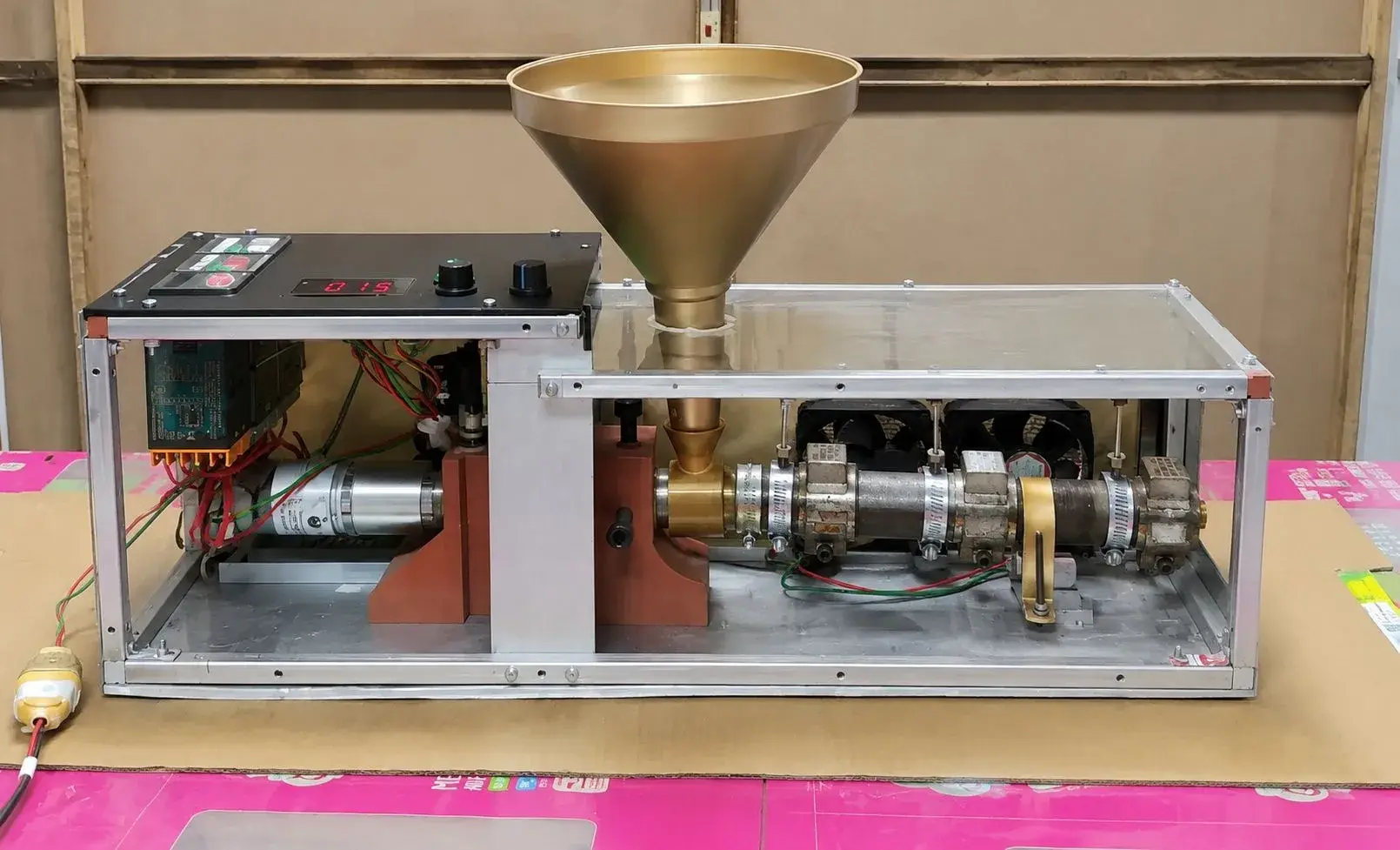
At NIT Rourkela in India, five researchers have developed a portable extruder for making composite filament from recycled plastic. 3D Printing Industry puts the estimated build cost at roughly ₹45,000, around US$470.1
That price is low enough to be interesting to a school, lab or small workshop, but the machine does not swallow a mixed recycling bin and hand you a clean spool at the other end.
Between two machines
The patent is titled “filament extrusion system for 3D printing applications and method for producing composite filament.” Professor Sujit Sen’s institutional CV records application 202431068691 as filed in September 2024 and published, while local reporting says the patent was secured on July 30, 2026.23
The Rourkela system combines PID temperature control with a controlled cooling stage and can mix recycled plastic particles with reinforcement material to make a composite filament.1 Its useful territory sits between an improvised desktop extruder and the kind of industrial line whose economics make no sense for a classroom or a small production shop.
Keeping that boundary visible makes the project more useful, because extrusion is only one operation in recycled filament production.
Before the nozzle
A 2026 review of recycled thermoplastics lays out the less photogenic chain: collection, sorting by polymer, mechanical size reduction, washing, drying and regranulation.4 Those steps do not disappear because the final extruder is compact.
PLA, PET and ABS do not become one friendly feedstock merely because they all arrived in the same waste bin. They melt and flow differently, moisture affects them differently, and contamination adds another source of variation.
A workshop recycling its own identified PLA failures starts from a much cleaner problem than one receiving anonymous post-consumer plastic. In the first case, material identity can be preserved when the waste is created; in the second, somebody has to recover that information later, usually with more equipment and more labour.
So the reported ₹45,000 describes the extrusion system, not a complete miniature recycling plant.1
Diameter tells on you
For FDM printing, making “plastic string” is not enough. Filament needs a controlled diameter, sensible roundness and repeatable melt behaviour so that the printer’s feed mechanism deposits roughly the amount of material it thinks it is moving.
The literature therefore pays close attention to melt-flow index and melt-flow rate, because reprocessing changes how a polymer flows and repeated thermal-mechanical cycles can degrade polymer chains.45 A spool can look perfectly respectable on the shelf while delivering inconsistent extrusion at the nozzle.
The Rourkela team reports satisfactory mechanical properties and dimensional accuracy suitable for printing in laboratory tests.1 The public material available so far does not expose a full diameter distribution, detailed formulations or mechanical test tables that would let an outsider compare the filament independently.
The patent gives a process description. A user choosing print settings would still want the boring tables: diameter variation, formulations, strength, flow and repeatability across batches.
Reinforce the recycled
Composite filament adds another strategy: instead of asking a recycled polymer to recover every original property by itself, fillers or reinforcement can compensate for some losses. Reviews of recycled 3D-printing feedstocks show that appropriate additions can improve stiffness, strength or print behaviour, depending heavily on polymer and formulation.4
There is a catch, because helping the current cycle can complicate the next one. Once fibres, minerals or other additives enter the polymer, the resulting waste is no longer identical to the clean stream you began with.
No thermoplastic goes around the recycling loop forever without consequences. Thermal and mechanical reprocessing can change viscosity, strength and toughness, while the practical number of cycles depends on the polymer, contamination, processing conditions and final application.45
The right workshop
I think this machine makes the most sense where the waste stream is already known.
A fablab can keep its own PLA failures separate, a school can sort scraps as they leave the printer, and a small manufacturer already knows which material produced its rejects. In all three cases the hardest information problem, “what plastic is this?”, is solved before the object even reaches the waste box.
To be sure, one small extruder is not “plastic recycling” in the abstract; it is a way to close a local material stream while its inputs, additives and history can still be tracked.
At a few hundred dollars, the Rourkela extruder does not need to replace an industrial recycling plant to matter. Its useful job is narrower: become the missing controlled step between a box of known scraps and a new spool whose properties can be tested.
Because the loop only closes once that second spool is good enough to use.