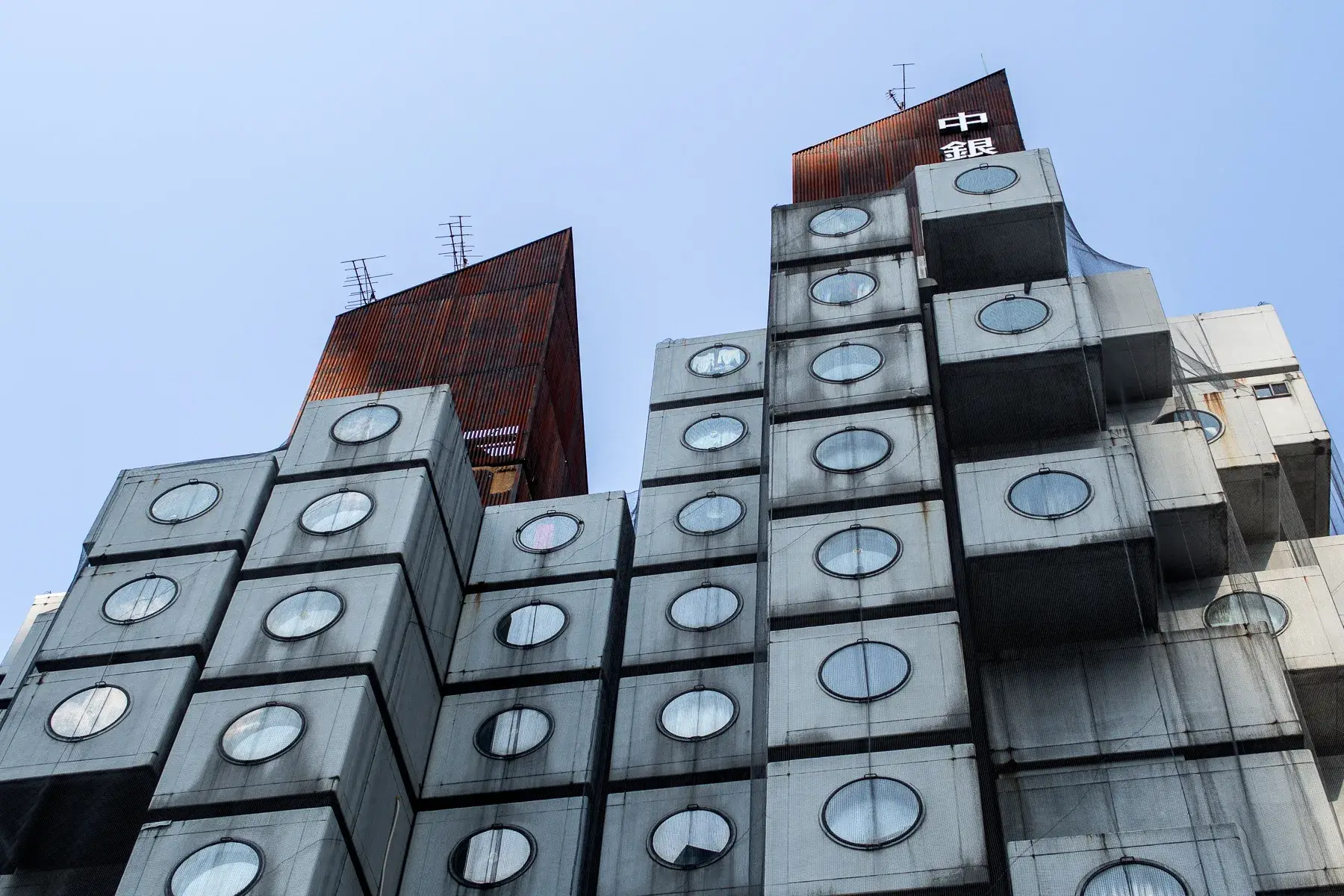
Nakagin Capsule Tower had ageing built into its drawings, but the system needed to keep that idea alive never developed around the building.
Completed in Tokyo in 1972 by Kisho Kurokawa, the tower placed 140 prefabricated steel capsules around two concrete cores.2 The cores were meant to stay. Capsules were conceived as shorter-lived units that could be removed, repaired or replaced roughly every twenty-five years.2
The tower was demolished in 2022, fifty years after completion, leaving time for two theoretical replacement cycles while none of the capsules were exchanged through the system as intended.2
The failure is more useful than another story about a 1970s vision of the future going wrong, because it shows how a replaceable part can exist while the product around it remains impossible to maintain.
Two cycles
The Metabolist principle was almost literal: stable parts of the building acted as a skeleton while living units were supposed to change around them.
SFMOMA describes two concrete towers with seventy capsules each, with every module measuring about 8.2 by 13.1 feet (roughly 2.5 by 4 metres) and serving as a compact residence or private office for people working in central Tokyo.3
The division between the permanent structure and the shorter-lived module helps explain why Nakagin remains relevant to current product design, where the same promise appears in repairable laptops, modular phones, replaceable batteries and machines built around serviceable subassemblies.
The drawing offers a neat rule: keep the expensive structure and renew the parts that age faster.
On the building itself, however, the removable box depended on a much larger system of ownership, money and maintenance in order to move from theory to routine practice.
The system stalls
A physically detachable capsule does not replace itself, because someone has to finance the work, agree on who pays, retain compatible parts, organise access, coordinate owners and believe the building remains valuable enough to justify the investment.
Nakagin accumulated several hostile conditions at once: capsules belonged to different owners, the building was ageing, the cost of repair kept rising and the Ginza land beneath it became more valuable.2
The Society of Architectural Historians describes the economic turn plainly: rehabilitation costs had become too high for the owners, while rising land values made a new building look more profitable.2
SFMOMA also recounts a period in which Nakagin wanted to sell the site while owners resisted demolition, and the conflict unfolded as maintenance declined and the tower continued to deteriorate.3
The mechanical possibility of removing a capsule already existed, while the ecosystem required to turn that possibility into a repeatable operation never formed around it.
The same problem appears outside architecture: a standard interface can outlive its supplier, an accessible battery can cost nearly as much as the device it serves, and a detachable machine component may require three days of production downtime. In all three cases, the physical possibility of replacement survives while the economics of replacement make the part effectively permanent.
Nakagin turned the distinction between physical replaceability and operational replaceability into a thirteen-storey building in the middle of Tokyo.
Twenty-three saved
Demolition produced a strange reversal in the story, because the capsules started travelling after the tower disappeared rather than during its working life.
The Nakagin Capsule Tower Preservation and Restoration Project was founded in 2014 and says it worked with owners, residents, the management association and Kurokawa's architecture office to realise Metabolism by exchanging capsules.1 Once the building came down in 2022, the group extracted 23 capsules and restored them under the supervision of Kisho Kurokawa Architects and Associates.1
Compared with the 140 original capsules cited by the Society of Architectural Historians, the rescued group represents about 16% of the tower (23 modules out of 140). The continuously adapting building imagined in 1972 never arrived, but a material fraction of the project now circulates between new sites and new owners.
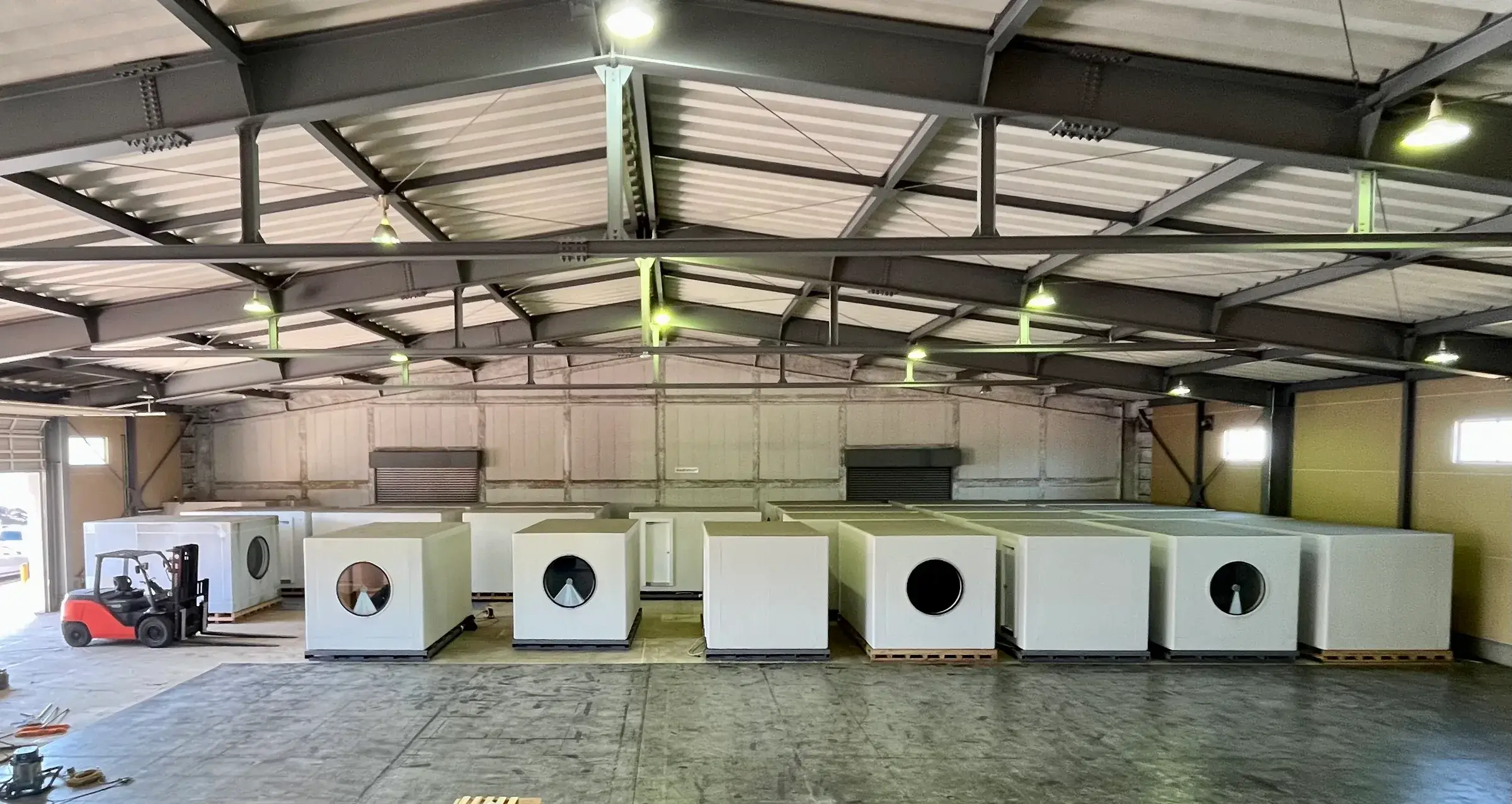
The preservation project now places capsules in museums, commercial spaces, galleries and lodging projects in Japan and abroad.1 Two were reused at the SHUTL space in Tokyo, while SFMOMA acquired Kurokawa's own A1302 capsule.13
SFMOMA's capsule carries the sharpest irony in this afterlife: by leaving its Tokyo core for another destination, the museum notes, it finally performs part of the original vision in which a capsule could be unplugged from the building and continue its life elsewhere.3
After the tower
The evidence suggests that Nakagin's modularity worked more successfully as a salvage strategy after demolition than as a routine maintenance system during the life of the tower.
The physical qualities were the same in both cases: prefabricated unit, separation between permanent core and capsule, and the possibility of detaching a module. The surrounding economics and governance only made that operation practical when the whole building was already condemned.
Architectural Record describes SFMOMA's acquisition as a capsule removed during demolition, restored and prepared for transport to San Francisco.4 Its mobility came at the point when the future of the building had already ended, which is almost the reverse of the maintenance cycle Kurokawa had imagined.
Rather than making Metabolist thinking useless, the failure makes its maintenance requirement stricter and forces designers to pay attention to the institutions and incentives around the module.
Real modularity
For a product designed today, Nakagin suggests a less glamorous checklist than a beautiful exploded drawing.
A useful checklist starts with access and then moves into the less visible parts of maintenance. Can a technician reach the module while leaving most of the product assembled, and will a compatible replacement exist ten or twenty years later to keep the interface useful? The answer also depends on who controls the interface, who approves the work, labour and downtime costs, and whether anyone in the chain benefits from preserving compatibility over time.
If those operational questions have no answers, the word “replaceable” may describe only the geometry of a part on a drawing rather than a real path to maintenance.
Nakagin had separate capsules, concrete cores and a clear theory of how the building should evolve, but it never developed the complete replacement chain needed to turn those parts into an operating maintenance system.
Fifty years later, twenty-three restored capsules are moving beyond their original tower, so part of the promise survived even though the exchange only became practical after demolition.