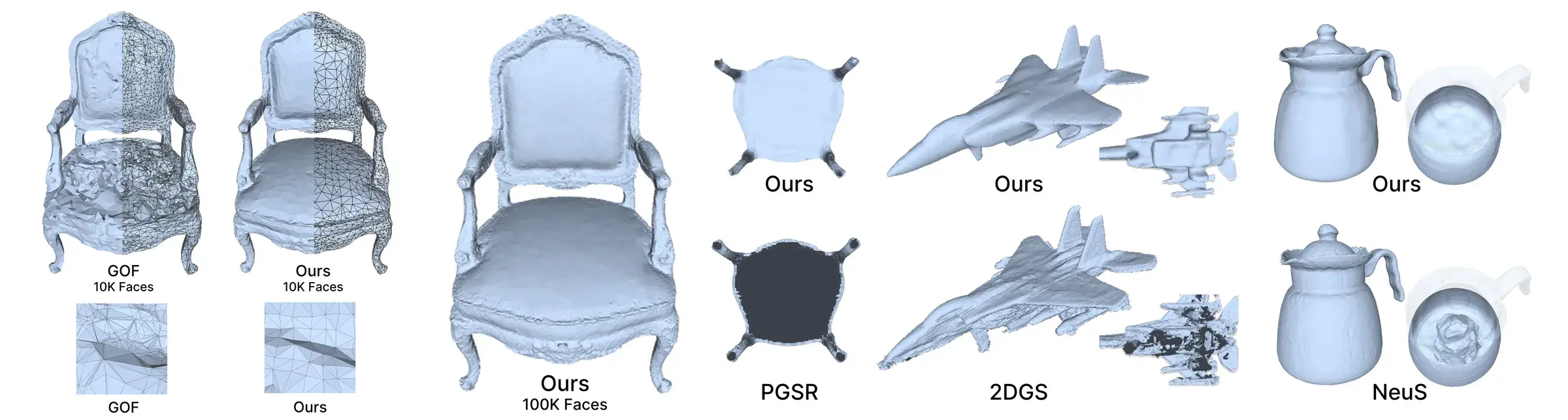
An object can look magnificent in a Gaussian Splat and become a nightmare the moment you ask where its surface actually is.
It is an easy distinction to forget because our eyes judge the image first. If a 3D capture produces convincing views as you move around the object, it is tempting to consider the work finished.
For looking at it, sometimes it is.
For editing a mesh, creating clean collision geometry, building a game asset or preparing geometry for fabrication, the question changes. It is no longer enough to know what color to send to the camera. You need to know where the object begins and ends.1
The paper Gaussian Sculpting, published as a preprint on August 11, 2026, starts precisely from this gap. Its authors try to force Gaussian rendering to answer to a real surface instead of hoping that a clean surface will appear at the end of the process.1
The idea sounds technical. Yet it touches on a very concrete problem: a 3D reconstruction can be visually right and geometrically wrong.
Not tiny triangles
3D Gaussian Splatting has become remarkably successful because it can reconstruct and render scenes quickly from multiple images. The representation uses a set of 3D Gaussian primitives with a position, orientation, scale, opacity and view-dependent color. The rasterizer projects them to produce the image.23
The result can be highly effective for novel-view synthesis. Move the camera and the system recreates what you should see.
But a Gaussian is not a surface facet.
It is closer to a small, oriented volumetric distribution. Thousands or millions of these primitives can work together to produce an excellent image without forming a clean geometric shell.
That freedom is a strength for rendering. It becomes a problem as soon as you ask for an editable object.
The Gaussian Sculpting paper emphasizes this difference: visually plausible renders can correspond to incomplete or unstable surfaces. When some viewpoints are missing, Gaussians can explain the available images without correctly reconstructing poorly observed regions.1
This is a classic reconstruction problem in a modern form. A camera sees projections. Multiple geometries can produce similar images from the same viewpoints.
If the system is rewarded mainly because the rendered image resembles the photograph, it can learn an excellent visual answer to the wrong geometric question.
Errors become triangles
A common way to move from a rendering representation to a mesh is to train the system first, then extract a surface in a second step.
Methods connected to 3DGS reconstruct a field this way, or use Gaussians to infer a surface later with Marching Cubes, Poisson or other techniques. SuGaR, for example, was specifically designed to bring Gaussians closer to a surface and quickly obtain an editable mesh, with pipelines announced for Blender, Unity and Unreal.45
This approach has a huge advantage: it can be fast and practical.
Gaussian Sculpting tackles a different problem. The authors argue that if the initial primitives already contain geometric errors, extracting a mesh at the end merely turns those errors into triangles.1
The paper highlights floating surfaces, missing regions and very poor triangles in some competing reconstructions. The goal is therefore not simply to have more triangles. It is to make the surface itself an optimized variable during training.
The process shifts from:
images → Gaussians → mesh at the end
to something more circular:
images → surface being optimized → Gaussians attached to that surface → rendering → surface correction.1
This shift is the core of the paper.
Appearance serves geometry
Gaussian Sculpting represents geometry with a signed distance field, or SDF.
An SDF assigns every point in space a signed distance to the surface. On one side of the surface, the sign is positive; on the other, negative; exactly on the surface, the value is zero. An iso-surface can therefore be extracted where the field crosses zero.
Here, the field is not a large fixed grid storing a value everywhere. An MLP learns the distance function. The authors then use an adapted version of FlexiCubes to extract a surface differentiably, preserving a gradient path that lets optimization modify the field based on errors observed later in the pipeline.1
At each step, Gaussians are instantiated on the triangles of the current surface.
This is the essential difference from a free-form point cloud. Their position, orientation and scale are constrained by the triangles and their normals. Gaussians remain useful because they can render appearance efficiently. But they are no longer allowed to silently invent a parallel geometry to hide mesh errors.1
The authors also limit their opacity and scale. The intuition is straightforward: if a Gaussian can become nearly transparent, enormous or move independently, it can help produce a good image while no longer honestly representing the surface beneath it.
Gaussian Sculpting tries to remove that escape route.
Rendering becomes a kind of mirror for the geometry. If the mesh is wrong, the Gaussians must suffer visibly enough in the image for optimization to receive a signal and correct the SDF.
Two competing loops
The system does not freely modify geometry and appearance in one big gradient soup.
It uses bilevel optimization.1
In the inner loop, the geometry is frozen and the Gaussians’ rendering parameters are refined. In the outer loop, the system then uses the rendering signal to update the SDF and therefore the surface.
Why take this detour?
Because two variables can otherwise learn to compensate for each other’s errors. If the surface moves while the Gaussians are also trying to explain the image better, it becomes difficult to tell whether the improved rendering comes from better geometry or simply from a more cunning appearance representation.
By separating the steps, the authors try to preserve a specific role for each part: the Gaussian shows what the current surface produces; the surface then carries the geometric correction.1
This principle extends beyond this paper. It resembles a common problem in generative tools and optimization systems: when several layers can all hide the same error, the step you actually wanted to improve may sometimes learn nothing.
Where surfaces might exist
A high-resolution SDF across the entire 3D volume would be extremely expensive.
Gaussian Sculpting therefore adds progressive subdivision in a roughly octree-like structure. Relevant regions around the surface can be refined while the rest of the space remains coarser.1
This is another difference from the naive version of “let’s simply use a finer grid.”
Resolution becomes local. Computation focuses on the places where geometric detail is likely to exist.
The authors use this hierarchy to recover more detail without immediately making memory usage explode. The word “immediately” matters, because the method remains far from lightweight.
Six to eighteen hours
All published experiments were run on an RTX 3090 with 24 GB of VRAM.1
The authors state that the initial surface optimization converges in a few minutes, but that the Gaussian refinements in the inner loop consume most of the time. A scene typically takes between six and eighteen hours, depending on its complexity and the number of iterations.1
That figure immediately puts the promise into perspective.
Gaussian Sculpting is not a new option you can turn on today in Polycam before sending the result to Blender. It is a research project that trades a great deal of computation for better geometry in object-level scenes.
The paper’s limitations are clear: the optimization cost and GPU memory currently restrict the framework to objects. Reflective materials and very fine textures also remain difficult because their geometric cues become ambiguous.1
We did not identify a clean public code repository for Gaussian Sculpting in the version of the paper we inspected. For now, it is therefore impossible to easily reproduce the pipeline at home or verify how it behaves outside the authors’ datasets.
That detail deserves more space than a benchmark table.
Better, not universal
On OmniObject3D, the authors select twelve objects spread across several difficulty levels. They evaluate the Chamfer distance between the reconstruction and the complete reference mesh.1
In their table, Gaussian Sculpting achieves an average of 9.09 × 10^-3. GOF, one of the strongest methods compared on this metric, reaches 14.91 × 10^-3. Other baselines perform worse or fail on certain objects.1
The paper also analyzes triangle quality, not just distance to the surface. That matters if the end goal is a workable mesh: a reconstruction can be close to the object while being full of extremely thin triangles, stray surfaces or topology that is painful to edit.
But we should resist the usual temptation to turn this into a ranking.
Twelve objects are not “the real world.” An RTX 3090 is not a phone. A sequence of 100 calibrated views at 800 × 800 on NeRF Synthetic is not a series of rushed photos taken around a shiny sculpture in a workshop.1
The result supports the paper’s technical idea under its experimental conditions. It does not show that Gaussian Sculpting is the best general-purpose 3D capture pipeline.
The SuGaR trade-off
SuGaR makes the contrast especially interesting.
This earlier work also seeks to connect Gaussian Splatting with surfaces, then extract an editable mesh. Its project highlights optimization and extraction that can be completed in minutes rather than hours, according to its project page, followed by traditional editing tools.45
In other words, the two projects do not maximize the same thing.
A pipeline like SuGaR may be far more attractive when an artist wants to quickly recover a scene, clean it up in Blender and continue working. Gaussian Sculpting accepts a huge computational cost to push harder for consistency between appearance and geometry.
This is not a contest with a single winner. It is a reminder that a “3D scan” can hide several different goals.
You may want to:
- navigate visually through a scene;
- obtain a lightweight representation for rendering;
- edit the object in a DCC;
- measure dimensions;
- simulate collisions;
- manufacture a physical copy.
These uses do not require the same kind of geometric truth.
The printer test
The paper does not present Gaussian Sculpting as a 3D-printing pipeline, and we should not make it say that.
But printing is an excellent way to understand the problem.
A render can cheat. A camera sees only a projection. If a small surface floats behind the object but stays hidden from the important views, it may bother almost no one.
A printer, on the other hand, eventually demands explicit geometry.
Where is the inside? Where is the outside? Is the volume closed? Are there stray pieces? Impossible walls? Zero thickness? Intersecting triangles?
Manufacturing turns a visual ambiguity into a physical problem.
Gaussian Sculpting does not solve this entire chain. The paper discusses surface quality and completeness, not models that are directly ready for a slicer. It does not establish a guarantee of industrial watertightness or metric dimensions ready for fabrication.1
But its direction becomes much clearer when you keep that destination in mind: the more you ask a 3D model to leave the screen, the less appearance alone is enough.
Structure after spectacle
The past few years have dramatically improved our ability to produce something that looks like a 3D scene.
NeRF and then Gaussian Splatting made captures more spectacular, faster to display and accessible from ordinary photos. Other models generate objects and environments directly from text or a handful of images.
As visual quality rises, a less photogenic question becomes important: what can you do with the representation after the demo?
A mesh has vertices, faces and topology. It can be selected, sculpted, cut, retopologized, exported to a simulation or fed into tools built over decades around explicit geometry.
A cloud of primitives optimized to reproduce views can be extraordinary to look at and far less cooperative when a human wants to continue the work.
Gaussian Sculpting is interesting because it takes this problem seriously from the start of training. The surface is no longer the residue you try to extract after finishing the impressive part. It becomes a central constraint again.
That may be the paper’s most transferable idea.
A creative tool is not only good because it produces the most seductive final result. It is also good when that result remains structured enough to support the next gesture.
Today, Gaussian Sculpting still requires six to eighteen hours and a powerful graphics card for a single object. It is therefore not yet that next gesture for most creators.
But it puts a useful requirement back at the center of the pipeline: if you want to make something with a reconstruction, you eventually have to ask the image where the material actually is.