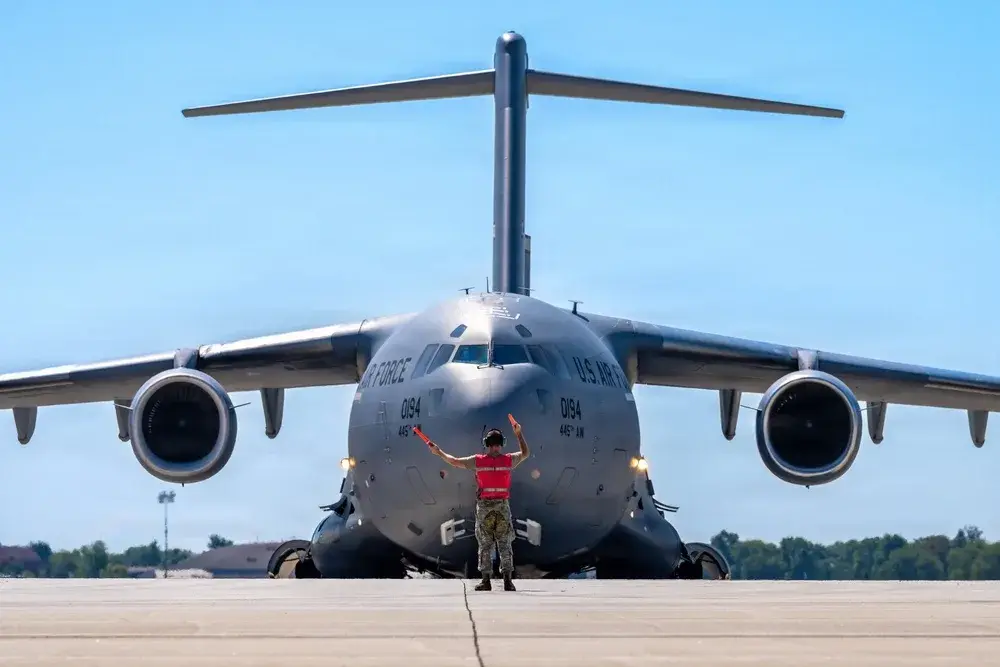
On March 4, 2025, a C‑17 Globemaster III from the 445th Airlift Wing spent the night on the ramp at Fort Worth Alliance Airport in Texas. Severe storms moved through the area. Wind microbursts reached roughly 80 mph. Two private Bombardier Challenger jets were blown into the military transport, damaging its left-side door, fuselage and nose.1
The aircraft made it home to Wright-Patterson Air Force Base with a temporary left nose-panel repair qualified by Boeing and approved by the Air Force. Maintainers repaired the door and fuselage. One problem remained: the left nose panel had to be replaced.1
This is where the story becomes more useful than a simple “robot saves airplane” anecdote.
Boeing determined that no vendor was willing to create the tooling required to make the isolated part. A repair attempt failed. The Air Force says the C‑17 appeared likely to sit in storage for at least a year and then require another year of repair work.1 The missing knowledge was not the panel's approximate shape. The problem was economic: the normal production method assumed a volume this spare part no longer had.
A strategic airlifter was at risk of being unavailable because nobody wanted to temporarily rebuild a small manufacturing system around one sheet-metal panel.
The Air Force Rapid Sustainment Office chose incremental sheet forming, or ISF. A robotic tool progressively deforms sheet metal instead of relying on a massive dedicated die. Production began in January 2026. A fit-check part arrived a little more than a month later. The final panel was installed in July, and the aircraft flew again on July 30.1
The speed matters, but it can hide the more consequential shift. The spare part was not found. The means of production became flexible enough that making one unit became rational again.
For a machine expected to serve for decades, that changes what “inventory” can mean.
Industrially absent
We tend to imagine spare parts as objects sleeping on shelves. A machine breaks, somebody opens a box, the part is swapped and the industrial history behind that little piece of material remains invisible.
That model holds while three conditions survive: somebody still produces the part, demand justifies production, and the necessary tooling still exists.
Aging fleets gradually break all three.
The Air Force describes the same pressure at the READI Lab at Robins AFB. Engineers there use additive manufacturing, reverse engineering and inspection to support aircraft including the C‑130, C‑5, C‑17, B‑1, B‑52, KC‑135 and F‑15. One of the lab's engineers says a major driver is the need for legacy parts when original suppliers no longer exist or are unwilling to manufacture small runs.3
This is a different kind of obsolescence from the one familiar in consumer electronics. The drawing may still exist. The alloy may be known. The function is still valuable. Yet the component has become industrially absent.
A press and dedicated die are brilliant when the job is ten thousand identical panels. Their fixed cost is distributed over the whole run. For a single panel, the equation reverses: the aluminum may be cheap while the physical environment that gives it shape becomes absurdly expensive.
The C‑17 panel makes that asymmetry unusually clear. A highly valuable aircraft can be grounded by a component that no conventional supplier wants to tool up to produce once.1
One answer would be to keep more physical spares. But physical inventory is also a bet. Someone must predict which parts will fail decades later, pay for them while the line exists, store and inspect them, preserve traceability, manage corrosion and accept that many may never be used.
Across thousands of part numbers and several generations of aircraft, shelves become an expensive forecasting system.
The die becomes motion
The basic idea behind ISF is easiest to see if we ignore the robots for a moment.
Imagine a sheet of aluminum clamped in a frame. Instead of stamping it in one operation between precisely machined dies, a rounded tool follows a programmed path and pushes locally against the metal. Pass after pass, the sheet is progressively brought into the desired geometry.
The shape no longer lives only in a physical die. Part of it lives in the toolpath, forming parameters and measurement loop.
That is why the process is attractive for low-volume work. Recent reviews of robotic incremental sheet forming describe precisely this trade: reduced part-specific tooling and greater flexibility, with continuing challenges around geometric accuracy, sheet thinning, forming forces, springback and cycle time.5
The process does not make metal magically obedient. It moves the engineering problem.
Conventional stamping invests heavily in a highly accurate physical shape before production. ISF invests more heavily in motion, sensing, process control and correction during production.
Commercial robotic systems show how far that logic can go. Machina Labs describes its RoboCraftsman as a cell in which seven-axis robots form sheet, laser-scan the surface, compare the result with CAD and feed deviations into subsequent passes. The same system can then trim and drill the part.2
One distinction matters: the Air Force's C‑17 release does not name Machina Labs. It describes the Rapid Sustainment Office's ISF system and work with the University of Dayton Research Institute.1 Machina separately markets RoboForming systems for airframe sustainment and deployable manufacturing.4 They belong to the same industrial shift, but the public sources do not justify silently turning them into the same project.
What both demonstrate is broader: when tooling is digitally controlled and can change geometry without making a new die, variety carries a different cost structure.
Beyond the CAD file
It is tempting to call this “digital inventory”: keep the file, then print or form the part when needed.
The phrase is useful and dangerously incomplete.
A CAD file can describe geometry. It does not automatically contain everything needed to reproduce a qualified aerospace component.
You need material grade and temper, sheet thickness, allowable radii, rolling direction, possible heat treatment, finishing steps, holes, tolerances, load behavior and inspection criteria. A toolpath that creates the correct visible shape may still cause excessive local thinning or leave unwanted residual stresses.5
That is the difference between geometry and a qualified process.
The C‑17 did not return to service because a robot was handed an STL and allowed to improvise. The Air Force describes forming, fit checks, panel tests, a final fit check, installation by Boeing and the 445th Maintenance Group, a nose-gear test and minor adjustments before flight.1
Certification bureaucracy is often framed as the enemy of novel manufacturing. Here it is part of the substance of the story. The goal was not to make something that looked like a C‑17 panel. It was to make a part people were willing to fly behind.
A useful digital inventory therefore has to contain more than a 3D model. The reproducible asset looks more like a package: geometry, material specification, process parameters, scan results, manufacturing history, acceptance criteria and qualification evidence.
Machina describes capturing high-resolution process data and inspection records as a digital twin.2 The term is promotional, but the underlying requirement is real. If the promise is to reproduce a rare component without rebuilding dedicated tooling, you have to preserve the validated way to make it, not merely its outline.
General-purpose tooling
Digital manufacturing is often sold as “tool-less.” That is not really what happens.
An ISF cell is expensive equipment. Robots, scanners, fixtures, software, tools, safety systems and metrology are physical infrastructure. They require maintenance and people who understand metal forming.
What can disappear is tooling dedicated to one part number.
That distinction changes the economics.
A stamping die is like a function compiled into steel: extraordinarily efficient at repeating one operation, expensive to change. A reprogrammable robotic cell is closer to general-purpose machinery whose capital cost can be spread across different geometries.
Machina lists work envelopes up to 12 feet long, formed depths up to 4 feet and sheet thicknesses up to a quarter inch depending on geometry and material.2 Those are vendor-stated capabilities, not universal limits of ISF. They nevertheless show the intended scale: this is no longer only a tabletop research demonstration.
The model becomes most compelling where volume is low and variety is high: aerospace sustainment, specialized vehicles, defense, tooling repair and functional prototypes.
That is exactly where mass-production infrastructure is least comfortable. A line optimized for repetition hates being asked for one old part, then three of another, then a geometry last made fifteen years ago.
Flexible cells turn that disorder into programming, setup and qualification work rather than an endless warehouse of dies.
The ordinary extreme
Military aircraft make the story spectacular. The same industrial failure mode exists in ordinary equipment.
An old machine tool may be perfectly serviceable except for a formed guard whose supplier vanished. A classic car can be immobilized by a body panel no press shop can justify reproducing. An industrial boiler may rely on a formed support used in only a few dozen installations.
Software obsolescence is visible: server gone, app incompatible, certificate expired. Industrial obsolescence is quieter. The object remains understandable while the network of gestures, suppliers and tools that reproduced it dissolves.
The Air Force increasingly treats that network as a manufacturing problem, not only a logistics problem. Its Robins lab explicitly uses reverse engineering and additive manufacturing when legacy suppliers disappear or refuse small runs.3 The C‑17 panel adds incremental forming to the set of possible routes for larger sheet structures.1
The lesson is not that 3D printing or ISF will replace every traditional process. It is almost the opposite: the future spare-parts system may be a portfolio of flexible manufacturing methods, each suited to a different class of geometry and material.
Polymer additive for a duct. Metal additive for a compact complex component. Five-axis machining for a block. Incremental forming for a skin or panel. Cutting and bending for simple structures. Digital inventory works only if infrastructure can select and qualify the right path from data to matter.
Manufacturing memory
The C‑17 first flew in 1991, and the fleet reached four million flight hours in 2021.6 Decades of modifications, repairs, suppliers, drawings and certification decisions accumulate around each aircraft.
As service life extends, the important question stops being only “do we have the part?” It becomes “do we still have a verifiable capability to make it again?”
That capability depends on information that can easily disappear.
A supplier closes. An experienced operator retires. A die is scrapped because it occupies floor space. A specification survives in a PDF while the actual shop settings that made it work are lost. A physical part survives with no one left who remembers the exact process that made it conform.
Digitizing drawings is not enough. Manufacturing memory has to be preserved.
This is where closed-loop systems matter beyond automation. Scanning creates a record of what actually happened to the part. If that trace is associated with material, parameters and inspection results, the next production run starts with more than a drawing.2
The promise is attractive: replace warehouses of physical forms with warehouses of production knowledge.
But the preservation problem moves with it. A file can disappear more quietly than a two-ton die. Proprietary formats become unreadable. Toolpath software is abandoned. Encryption keys get lost. Qualification evidence is separated from the model it belongs to.
Digital inventory does not eliminate conservation. It moves conservation from matter toward data, software and skills.
That is familiar from preserving networked objects. Keeping the box does not help if the server, protocol and testing environment disappear. On-demand manufacturing creates the industrial version of the same paradox. Preserving CAD is not enough if the environment capable of turning CAD into an accepted component is gone.
Where the die wins
The C‑17 case would be much less informative if ISF were simply a better way to form every sheet-metal part. It is not.
A dedicated die wins exactly where the C‑17 situation lost: high volume and stable geometry. Once tooling has been designed, tuned and amortized, a press can form parts very quickly, with repeatability and surface finish that are difficult to match with a long sequence of robotic passes. Incremental forming moves a tool along a much longer path, so cycle time becomes a real limitation.5
Recent ISF literature also discusses problems that are more substantial than the usual vendor footnote: springback, unwanted deformation outside the target zone, local thinning, geometric inaccuracy and surface quality. Assisted strategies, improved toolpaths and closed-loop measurement mitigate those issues, but do not abolish them.5
That creates a fairly clear boundary. If a factory makes the same door panel every day, a die remains an excellent investment. If it needs one aircraft skin whose tooling disappeared years ago, rebuilding the die may be the least rational part of the job.
The advance is therefore not the discovery of the future manufacturing process. It is the addition of a process whose economics become attractive where mass-production economics become poor.
That distinction matters because digital manufacturing is repeatedly narrated as a chain of replacements: printing replaces machining, robots replace people, files replace warehouses. Real shops tend to accumulate processes instead. Keep the press for the volume it loves, then add flexible machinery for the requests it hates.
A production system becomes more resilient not because it chooses one universal technology, but because it maintains several routes from a requirement to a physical part.
The scanner matters
In videos of robotic manufacturing, the dramatic image is usually the arm pushing, cutting or welding. The scanner looks secondary. For a one-off qualified part, it may be just as important as the forming tool.
With mature hard tooling, much of the confidence in the process was accumulated upstream. The die strongly constrains geometry, production repeats a known operation and drift is monitored in a familiar environment. When dedicated infrastructure is replaced by a general-purpose machine and a new toolpath, that confidence has to be rebuilt somewhere else.
The C‑17 fit-check sequence shows the process plainly. The first formed panel was not automatically the flight article. It was used to establish that geometry and integration worked. The final panel went through another fit check, installation and tests on the aircraft before the return to flight.1
Machina's cell takes the same logic into the manufacturing loop itself: form, laser-scan, compare with CAD, correct.2 The point is not merely to generate an attractive colored deviation map. Measurement lets a flexible machine compensate for the absence of a physical die that otherwise imposes much of the shape.
In that sense, metrology replaces part of the certainty that used to be embodied in tooling.
The principle extends far beyond aerospace. Flexible manufacturing is useful only if inspection can become flexible too. A robot capable of making twenty geometries is not especially helpful if verifying those geometries requires twenty unavailable fixtures.
Digital inventory therefore has to include the means to validate whatever comes out of the machine. Otherwise it creates an infinite catalog of possible parts with no serious reason to trust any of them.
Inventory needs versions
The word “inventory” also makes a file sound stable: nose-panel-final.step, stored somewhere and retrieved twenty years later. Anyone who has encountered final_v7_really-final.step knows civilization has not achieved that degree of calm.
Aircraft definitions evolve with the aircraft. A repair changes a local structure. A drawing revision changes a tolerance. A material becomes unavailable and a substitute is qualified. A manufacturing route changes after testing. The important question is not merely “do we have the model?” but “which definition applies to this particular aircraft, and what evidence belongs with it?”
Process data from a closed-loop cell can help, while creating a governance problem of its own. Every record has to be associated with the correct part number, revision, material lot, parameters and inspection results. The system needs a history of what changed, who approved it and whether an older production route is still valid.
That is not an objection to digital inventory. It is what makes the phrase meaningful.
A physical warehouse answers a relatively simple question: is this exact object in the box? A warehouse of manufacturing capability has to answer a harder one: can we reproduce a conforming part today from the correct definition, using a process and evidence chain that are still acceptable?
For machines expected to last decades, the second question eventually becomes more important than the first.
The unwanted parts
Machina Labs says its deployable model can reduce sustainment cost by more than $1 million per design by removing part-specific tooling.4 That is a vendor claim, not an independently audited saving, and should not be treated as a universal number.
The C‑17 case gives a more modest and more persuasive demonstration.
We know the conventional route became unattractive enough that no vendor wanted to tool up for one part.1 We know ISF produced a fit-check panel a little over a month after production began and a tested, installed panel within the year.1 And the Air Force calls it the first ISF-produced part to fly on one of its platforms, with other work already planned.1
That is not evidence that incremental forming should replace stamping in mass production. It should not. Dedicated dies remain extraordinarily effective when demand is high and stable.
The breakthrough is at the other end of the curve: parts whose volume is too low to deserve dedicated tooling but whose value in use is too high to let them disappear.
Our economy is full of those parts. We usually discover them only when something breaks.
The workshop remembers
The repaired C‑17 does not announce a human-free factory where any component materializes on command. The public account contains plenty of human work: maintainers, engineers, UDRI, tests, Boeing, adjustments and qualification.1
It points toward something more credible.
Some physical spare inventory can potentially be replaced by general-purpose manufacturing capacity paired with enough production memory to recreate rare components when needed.
Inventory then stops meaning only objects waiting on shelves. It includes geometry, process, measurement data, acceptance criteria, flexible machines and the people capable of connecting all of them.
That also changes what product designers should preserve when they expect an object to last thirty or fifty years. A drawing helps. Material and tolerance documentation helps more. Process parameters, tests and an alternative manufacturing route may someday matter as much as ordering a final pallet of spare parts before a supplier shuts down.
C‑17 tail 0194 returned to the sky on July 30, 2026.1 Not because a spare panel had been waiting in a warehouse, but because a manufacturing method made an economically irrational request reasonable again: make exactly one part.
For an industrial system built around repetition, that is a small inversion. For all the machines we want to keep repairing after their original supply chains disappear, it could become a very large one.