There is a useful scene for understanding Bill Gates. It has nothing to do with a pie in the face, Jeffrey Epstein or an oversized sweater. It lives in a contract.
By the end of the 1980s, some PC manufacturers were paying Microsoft for every machine they sold even when that machine did not ship with MS-DOS. The U.S. Department of Justice called these “per-processor” licences and ultimately prohibited them in the 1994 settlement.5 It looks like a tiny detail: one contractual line between a software company and a maker of beige boxes.
But the line changes the economics of the whole market. If the manufacturer already owes Microsoft money, installing a rival operating system does not replace the DOS cost; it adds another cost. A competitor can offer a better product and still start from a structurally worse position before the customer sees a screen.
Gates’s career is usually divided into two convenient characters. First comes the Microsoft boss, competitive to the point of obsession and eventually caught in one of computing’s defining antitrust cases. Then comes the philanthropist spending an enormous fortune on vaccines, global health, education and development.
That division captures a real change in public image. It obscures a continuity in method.
Court records, testimony from former Microsoft employees and research on the Gates Foundation repeatedly show a person looking for the point where one decision can move the rest of a system. At Microsoft, that point might be the operating system, an OEM contract or browser distribution. In philanthropy it can be research funding, a market guarantee, a measurement regime, the purchasing capacity of a vaccine alliance, or the ability to keep one problem funded long enough for an ecosystem to organize around it.
The situations are neither legally nor morally equivalent. Funding a vaccine is not the same thing as threatening a manufacturer’s Windows licence. But they raise the same architectural question: how does a strategic position become power?
That is the science of power running through Bill Gates’s career.
The missing computer
To understand Microsoft’s power, start with what the company did not make.
It did not build the monitor, keyboard, processor or hard drive. It did not assemble the IBM PC launched in 1981. IBM’s own history describes a machine built largely from components available on the market, including Intel’s 8088 processor, with an operating system supplied by Microsoft.2
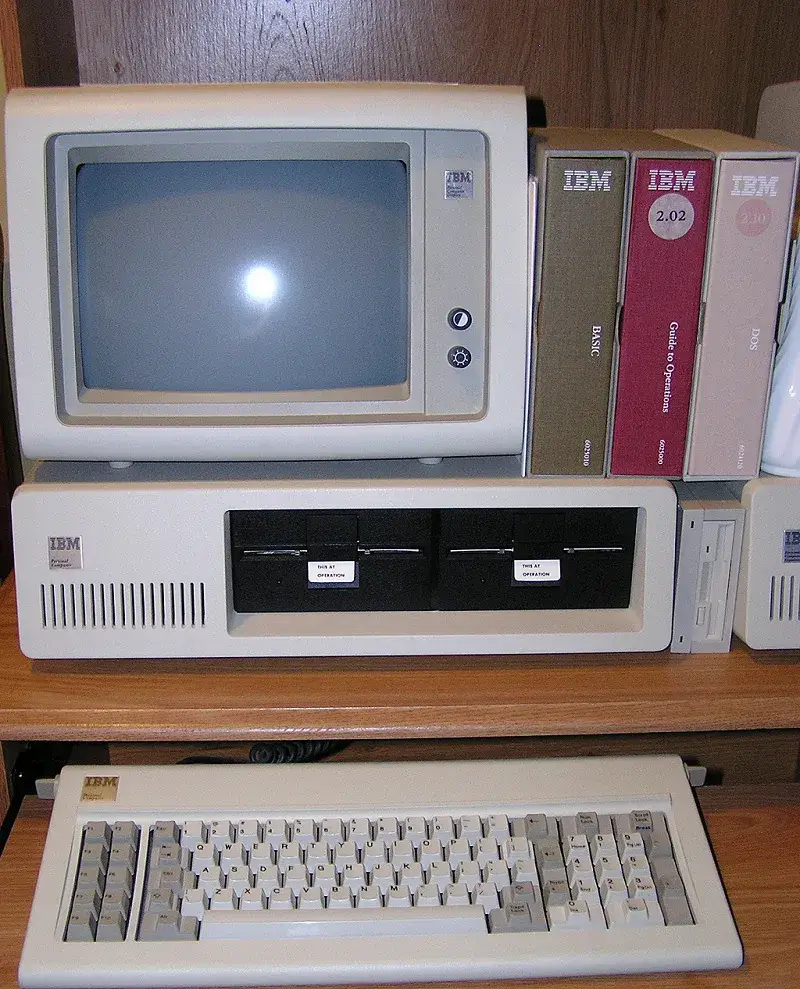

That relatively open architecture produced an outcome no single company could fully contain. Other manufacturers learned to make compatible machines. “The PC” stopped meaning one IBM product and became a family. Compaq, Dell, HP and many others could sell hardware that ran the same growing universe of software.
For IBM, this meant losing control. For Microsoft, it was close to ideal.
A hardware company needs to sell another physical machine. Microsoft could sell the same logical layer across competing manufacturers. The more the hardware market fragmented into compatible vendors, the more valuable one shared software platform became.
This is where the familiar story about the genius who foresaw a computer on every desk becomes less interesting than the business architecture around the prediction. Plenty of people saw the microcomputer coming. Microsoft put itself in the part of the system that could become common to devices made by companies fighting each other.
Software was no longer an accessory attached to a machine. It was becoming the route through which applications, documents and learned habits could travel between machines.
That position creates a loop we now recognise instantly. More compatible PCs running your system give developers a larger reason to target it. More applications make customers ask for it. More customer demand makes manufacturers preinstall it. Each cycle makes the platform harder to avoid.
You can tell this as a clean product victory. That would be incomplete. Microsoft unquestionably made useful software people wanted. It also learned early that a platform is defended through contracts, interfaces, commercial relationships and distribution.
That second part would keep antitrust authorities occupied for more than a decade.
The BillG room
Contracts show where Microsoft possessed leverage. The memories of people who worked there show how Gates exercised it.
Joel Spolsky, a program manager on the Excel team from 1991, later described the BillG reviews. At his first one, a colleague was even assigned to count Gates’s profanity. The folklore is funny; the mechanism matters more. Gates had read the specification and kept escalating the questions until he could tell whether the person in front of him actually understood the subject.1
Spolsky also describes substantial autonomy below those reviews. As a new hire, he was trusted with Excel’s macro-language strategy, work that would contribute to VBA.22


Former Microsoft executive Peter Neupert remembered a company built in reaction to bureaucracy: little process, fast decisions and a taste for “cowboys” who could move without waiting.23 Paul Allen described the cost of that culture: Gates pushed people hard, yelled frequently and could sustain arguments for hours.24
Together the accounts suggest something more useful than the omnipotent-founder cliché: wide autonomy inside teams, extreme pressure at decision points. Gates did not need to choose every button. He stayed close to the junctions capable of moving the platform.
The profitable promise
Microsoft announced Windows in 1983 and did not ship the first commercial version until 1985. The delay was visible enough to fit an industry category already being mocked: vaporware, products announced well before they actually existed. TIME was using the term in 1986.4
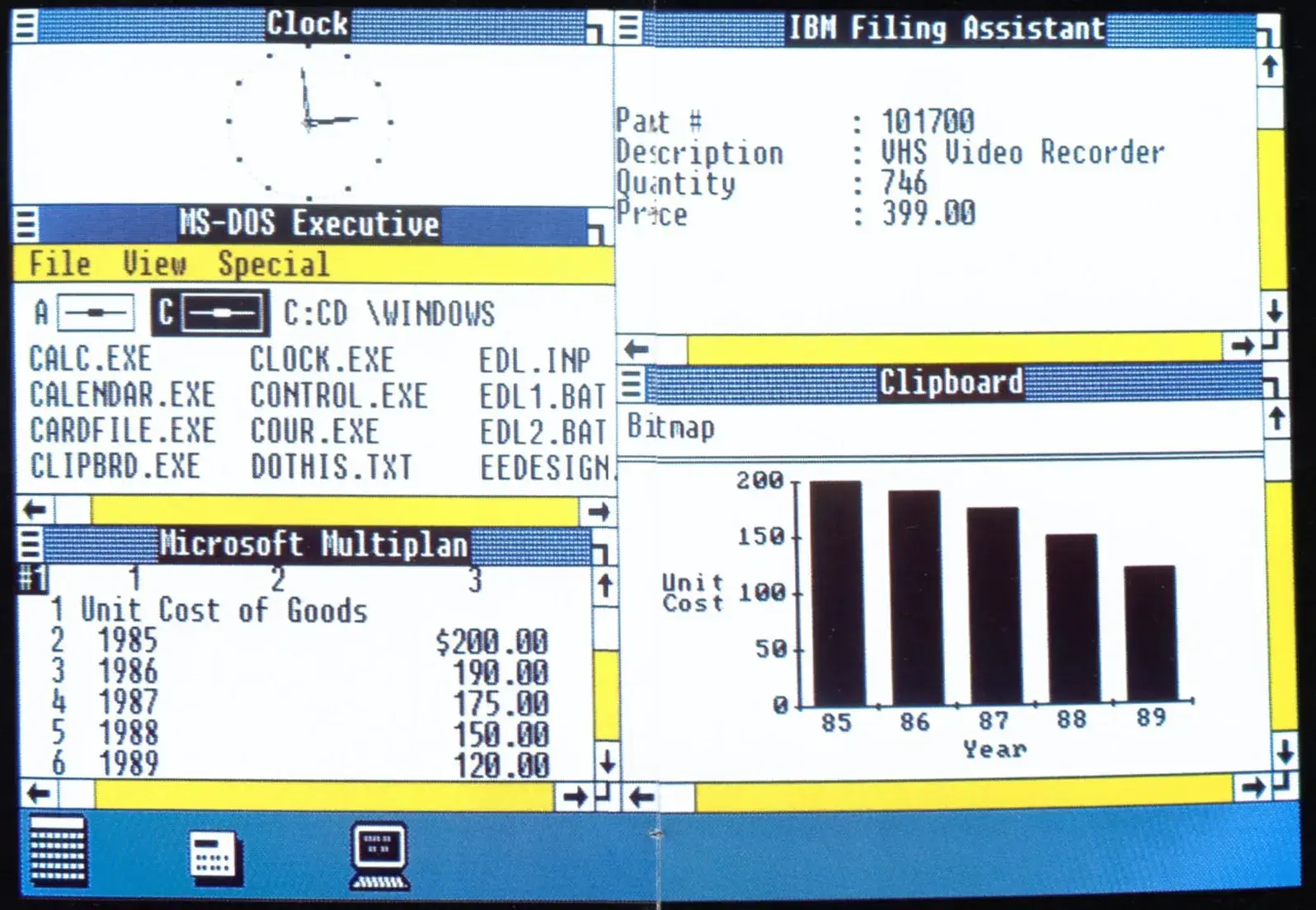

A future announcement can freeze a market without requiring a perfectly executed conspiracy. If a credible company promises exactly the product a smaller rival sells today, some customers will wait. Marketing schedules become competitive variables.
The important point is therefore not that Windows 1.0 was necessarily designed as a phantom weapon to destroy VisiCorp. The available evidence does not justify a story that clean. It is that a company already embedded with hardware makers can make a promise commercially more important than a rival’s available product.
Credibility itself becomes a platform asset.
That asymmetry lasts. A small company announcing a delayed product risks its life. A dominant company can announce the next version, retain partner attention and make waiting economically tolerable. Microsoft did not invent this mechanism. It supplied an early demonstration.
The layer moves
The IBM-Microsoft relationship is often turned into a betrayal story: IBM supposedly funded OS/2 while Gates secretly prepared Windows 3.0 with Dave Cutler. The real chronology is less cinematic and more revealing.
Microsoft and IBM did collaborate on OS/2. Their relationship did deteriorate. Microsoft did increasingly back Windows as it gained traction. But Dave Cutler joined Microsoft in October 1988 to work on a new portable operating system that became Windows NT, whose first version arrived years later.3 He was not leading the Windows 3.0 team.
The split mainly exposes a structural conflict of interest. IBM wanted to regain control over the PC platform. Microsoft benefited when its software layer could live across as many compatible machines as possible, including machines IBM did not sell.
Microsoft’s power came precisely from its lack of loyalty to any one hardware maker.
Windows 3.0, released in 1990, made that strategy much more visible. A buyer could choose among PC brands and retain a common software layer. For a developer, that meant a huge market behind an API. For a manufacturer, omitting Windows became commercially risky. For Microsoft, every additional compatible vendor increased the platform’s value.
Saying Microsoft “killed IBM” erases IBM’s own mistakes, compatible-hardware competition, the changing mainframe and PC markets, internal costs and a decade of decisions. Reality looks less like a heist than a migration of the dominant layer.
In the old world, the company making the machine largely defined the platform. In the new one, the company controlling the common software layer could let hardware makers fight among themselves.
Paid while absent
“Monopoly” is often used as a vague insult. In Microsoft’s history it eventually became a much more precise legal category.
Years before the landmark 1998 case, the Department of Justice was investigating Microsoft’s licensing practices. The 1994 settlement specifically prohibited the so-called per-processor licence.5
The mechanism deserves attention because it shows what “controlling distribution” can mean without any user seeing the control.
A PC maker signs with Microsoft. Instead of paying only when DOS or Windows is installed, it agrees to a royalty for every processor or machine covered by the contract. The DOJ said in 1994 that about 60 percent of the U.S. market had been tied up in such contracts and that Microsoft had used them since 1988.5
Imagine a competing operating system costs less. A manufacturer wishing to install it still owes Microsoft. The competitor is therefore not only competing with the price and quality of Windows or DOS. It is competing with a cost that has already been incurred.
The effect is almost physical. Microsoft does not need to block the manufacturer from loading another system. The contract tilts the economic floor on which the decision happens.
This kind of power is particularly important in platform markets because it is invisible downstream. From the front of the screen, the buyer appears to choose between products. Far upstream, contractual conditions have helped decide which products had a realistic chance of reaching the screen at all.
The 1994 settlement was intended to stop several of these practices, including per-processor licences, certain minimum commitments and unusually long licensing terms.5 It did not end the larger conflict. It moved it.
Within a few years, the key lever would not only be the operating system. It would be a browser icon.
The dangerous icon
Netscape is the most useful part of the entire Microsoft story because the browser war makes platform power almost visible.
In the mid-1990s the Web introduced a threatening possibility. If applications could run through a browser, the operating system might become less important. A developer would not necessarily have to target Windows APIs directly. They could target a layer that existed on Windows, Mac and Unix.
The court that later examined Microsoft described Netscape Navigator and Java as middleware threats capable of weakening the applications barrier that protected Windows.6
That distinction matters. Microsoft was not fighting Netscape merely because it wanted the browser business. A browser could move the centre of gravity of the platform.
Microsoft answered in two ways at once.
The first is completely ordinary competition: build Internet Explorer, spend heavily on engineering, improve it and give it away. The court’s findings explicitly acknowledged that some Microsoft conduct improved browser quality and lowered its price.6 That matters. Honest antitrust analysis does not require pretending every Microsoft product was bad or every consumer benefit imaginary.
The second response is where the platform leverage appears: use manufacturers’ dependence on Windows to influence how the rival browser could reach users.
The Compaq episode is almost absurdly clean. Compaq removed the Internet Explorer icon from its default Windows desktop and promoted Netscape. Microsoft threatened to terminate its Windows licence. Compaq reversed the decision.6
An icon looks trivial. It contains the structure of the market. Compaq can manufacture the computer. It cannot realistically sell a mainstream PC without Windows. Microsoft can therefore turn a user-interface choice, “which browser appears at startup?”, into a licensing issue.
The browser is no longer competing only as software in a shop. It is being placed inside the product on which the manufacturer’s own access to customers depends.
The findings also document restrictions involving OEMs, Internet access providers and other distribution channels, together with Microsoft’s attempts to reduce Navigator’s access to users.6
This is where leverage stops being abstract.
Microsoft did not need to own Compaq. It did not need to acquire Netscape. It did not even need to ban Navigator from Windows. It needed to control a resource its partners could not comfortably do without, then attach conditions to that resource.
Innovation and control
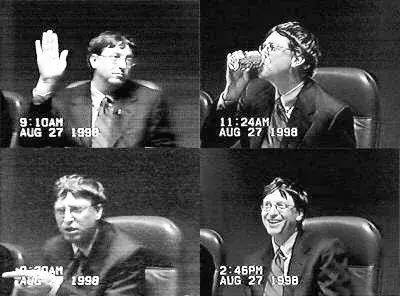

In 1998, the U.S. federal government and a group of states sued Microsoft. In 2000, the district court ordered the company broken into two pieces. The spectacular breakup remedy was later vacated, while a central part of the monopolisation liability survived appeal. The case eventually ended with a settlement and final judgment imposing restrictions, including rules affecting OEM relationships and middleware.7
The pop-history version is easy: Microsoft was a monopoly, the government broke it up, then somebody changed their mind.
The legal story is more instructive.
Being enormous is not itself the offence. Having a very good product is not either. The relevant question was whether Microsoft used monopoly power to maintain that monopoly through anticompetitive conduct.
That distinction avoids two opposite mistakes.
The first romanticises Microsoft: customers chose Windows, therefore everything else was resentment from defeated competitors. The court record documents commercial conduct that cannot be reduced to simply offering a better operating system.6
The second mistake turns every Microsoft success into fraud. Internet Explorer did improve. Windows delivered a common environment with enormous practical value. Developers and users received real benefits. Microsoft’s power is interesting precisely because it combined real innovation with structural control.
A dominant platform does not have to be useless to become dangerous. Its usefulness can be the source of its ability to impose conditions.
That idea extends far beyond Microsoft.
An app store can be extremely convenient and still control access to users. A marketplace can generate billions in trade and decide which sellers remain visible. A cloud service can be excellent and make leaving painfully expensive. A platform is not suspicious because it works. It becomes politically interesting when working well turns it into a passage everyone else has to use.
Gates learned that world earlier than almost anyone.
Then, as the trial turned his name into a shorthand for monopoly, he moved into a different one.
The power changes clothes
The public-image change is remarkable.


The Gates of the 1990s is the executive rocking through a hostile deposition, the digital robber baron of cartoons and business magazines. The Gates of the 2000s talks about vaccines, infant mortality, malaria, education and poverty.
It is tempting to choose one interpretation and stop.
The generous version: an entrepreneur accumulated a giant fortune and chose to devote a substantial portion of it to problems governments and markets often underfund.
The cynical version: a monopolist uses philanthropy to launder his reputation and replace one form of power with another.
Both are too easy.
The Gates Foundation spends sums large enough to change the operating capacity of public-health programs. Its 2024 annual report records $8.015 billion in charitable support for that year, including $889 million for polio and $318 million for malaria, plus hundreds of millions for immunisation, tuberculosis, HIV and vaccine development.8
In January 2026, the foundation announced a steady annual payout of $9 billion and confirmed that it intends to close in 2045. Gates plans to direct virtually all of his remaining wealth through the foundation, with more than $200 billion in additional spending expected over the next two decades.9
Those numbers are not decoration. At this scale a private institution can fund a meaningful portion of product development, support trials, guarantee purchase volumes, subsidise delivery, finance disease surveillance and stay engaged for years.
It does more than write cheques.
It can build a chain.
The 99% problem
Polio is where the temptation to turn collective infrastructure into one person’s biography is strongest. The success is real. Attributing it to a single philanthropist would be falsely simple.


In 1988, polio still paralysed an estimated 350,000 people a year across more than 125 endemic countries. WHO says wild poliovirus cases have fallen by more than 99 percent since then.10 It is one of the most extraordinary public-health achievements of the past half century.
But the Global Polio Eradication Initiative began in 1988 and depends on national governments, WHO, Rotary International, UNICEF, the U.S. CDC, and later the Gates Foundation and Gavi.10 Vast numbers of people administer vaccines, monitor sewage, negotiate access, maintain cold chains, investigate paralysis, manufacture doses and organise campaigns.
“Gates eradicated polio” turns an international infrastructure into a biography.
More importantly, polio has not yet been eradicated.
In March 2026, WHO’s Polio Emergency Committee was still reporting wild poliovirus type 1 transmission in Afghanistan and Pakistan, with environmental detections showing that circulation had not ended.11 Eradication is historically close and operationally brutal in the final reservoirs.
None of this diminishes the foundation’s contribution. It shows what Gates philanthropy looks like at its strongest: it joins an enormous collective system and supplies unusual amounts of money, persistence and appetite for long-term risk.
That is exactly why the power question remains legitimate.
If private funding accelerates a program that prevents paralysis, nobody serious should want the program to fail so they can win an argument about billionaires. But a desirable outcome does not answer every governance question.
Who decides to put $889 million into polio instead of cardiovascular disease, primary-care systems or mental health?
Part of the answer is simply: the foundation does.
A topography of resources
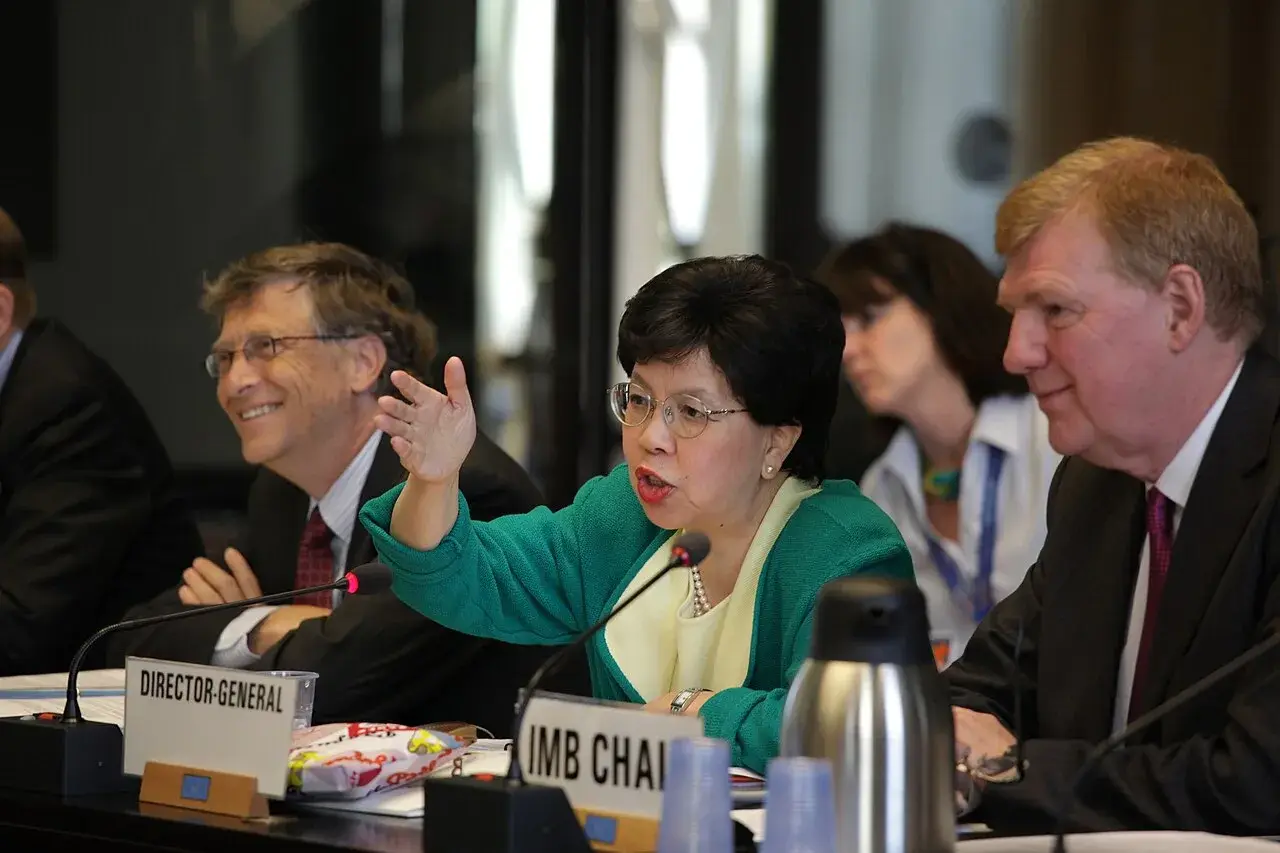

A study in BMJ Global Health gives unusually concrete numbers for this concentration. The researchers analysed Gates Foundation grants to WHO from 2000 through 2024.12
They identified 640 grants worth $5.5 billion. Every one was earmarked for a specific purpose. About 82.6 percent of the money went toward infectious diseases. Polio alone received $3.2 billion, 58.9 percent of the foundation’s grant value to WHO during the period.12
The authors also calculate that Gates Foundation money accounted for 9.5 percent of WHO revenue between 2010 and 2023.12
There are at least two ways to read those numbers.
The first is favourable: a donor stayed obsessively focused on finishing an eradication campaign long after political attention might otherwise have moved on.
The second is institutional: an organisation responsible for almost the entire field of human health receives a meaningful share of its resources from a private actor whose grants are heavily concentrated on a relatively narrow set of priorities.
The paper’s authors argue that dependence on earmarked voluntary contributions can skew the distribution of resources.12 That does not mean one donor simply writes WHO’s program: WHO remains a member-state organisation with its own governing bodies. Earmarked funding works more indirectly by changing what becomes materially easy to pursue.
Both dimensions can be true.
A donor does not need to phone the WHO director-general and issue instructions. It is enough for a very large pot of money to exist for A and not B. Teams, recruitment, partnerships and technical capability naturally grow around resources that are actually available.
Modern power often looks like this. Not a secret command. A topography of resources.
Building vaccine markets
The foundation’s 2024 annual report uses a revealing term: volume guarantees.8
The mechanism is straightforward. A manufacturer may be able to produce a vaccine or medicine cheaply at high volume, but hesitate to build capacity if it does not know whether anyone will buy enough units. A funder or alliance can guarantee a minimum volume. Risk moves. The manufacturer invests. Capacity grows. Unit prices may fall.
It is a market mechanism used to produce a public-health good.
And it is very Gates in its logic.
The problem is not merely “invent a better vaccine.” The problem becomes: find the constraint holding the system back, put resources on that constraint, then let the other pieces reorganise.
In software the bottleneck might have been distribution. In a vaccine program it may be uncertain demand, manufacturing capacity, regulation, cold-chain logistics or procurement price.
This way of thinking helps explain the foundation’s attraction to measurable interventions, vaccination campaigns and technical programs. They provide variables that can be acted upon: price per dose, coverage, manufacturing volume, case counts, development time.
It also explains some criticism. Problems that do not resemble an optimisable chain are much harder to attack with the same toolkit.
There is, however, an unusually useful empirical test of this logic. Gavi’s final evaluation of the pneumococcal-vaccine Advance Market Commitment examined the full program using quantitative data, more than 80 documents and interviews with 71 experts.30 It found no evidence that the AMC accelerated new-product R&D in the way its designers had hoped. It did find that the mechanism accelerated vaccine uptake, produced higher coverage than several comparator antigens and, through that coverage, likely saved more lives.30
That is precisely why philanthrocapitalism cannot be dismissed as a slogan. A market instrument can fail through one causal channel and succeed through another. The useful question is not “market or public service?” but what market was built, who set its rules, who carried the risk, and which outcomes can actually be attributed to the mechanism?
A fragile health system is not one isolated bug. Poverty, trust, staffing, wages, infrastructure, local politics and institutional history overlap. There is not always one broken API to patch.
American education would demonstrate that limitation rather painfully.
Power across the chain
The pandemic made Gates’s influence easy to overstate and difficult to describe accurately. COVAX was not “Gates’s organisation.” WHO describes it as co-led by Gavi, CEPI and WHO, with UNICEF as a major delivery partner.13 The Gates Foundation is an important founding funder of both Gavi and CEPI alongside governments and other institutions.2021 That is real influence, not ownership.
COVAX was meant to stop wealthy countries from buying most early vaccine supply. It did not fully succeed: bilateral contracts, export restrictions and production limits outweighed the alliance. Billions of philanthropic dollars do not replace states able to buy doses or block exports.
The patent dispute reveals the same problem of scale. Asked in April 2021 whether sharing vaccine “recipes” would help, Gates said no and emphasized factories and production safety.19 Days later his foundation supported a narrow intellectual-property waiver for vaccines.14
A patent can legally block a manufacturer. Removing it does not provide a validated production line, trained engineers, quality control, raw materials or tacit manufacturing knowledge. That is why WHO’s mRNA hub, launched in 2021, aimed to transfer not only usable rights but processes, training and manufacturing capability.16
The WTO’s June 2022 decision did not abolish vaccine intellectual property either. It created targeted, temporary flexibility that could allow developing countries to produce and export despite certain patents.15
The useful dispute is therefore not “patent or no patent.” It is about how capability is distributed. The foundation has often preferred industrial partnerships, purchase commitments and negotiated technology transfer to radical openness of every component. That can move quickly. Permanent regional capacity costs more and takes longer, but makes the next crisis less dependent on one manufacturer, one donor or one exporting country.
No single lever
Gates philanthropy becomes more revealing when it fails. In 2009, Gates acknowledged that the foundation had spent more than $2 billion over nine years on high-school improvement and that many of the small schools it funded had not significantly improved student achievement.17
The next strategy kept the same instinct: measure better. The foundation invested in teacher evaluation and management reforms. RAND and AIR’s final evaluation found substantial changes to the systems involved, but no achievement or graduation gains matching the initiative’s goals, especially for disadvantaged students.18
Megan Tompkins-Stange identifies another layer: large foundations do not merely finance organizations; they also spread ideas, metrics and strategies into education policy.28
This is almost the anti-Microsoft case. A central API can produce relatively predictable reactions among developers. A school mixes teachers, families, unions, budgets, neighbourhoods and local politics. Money provides leverage; it does not provide a perfect causal model.
Public capacity, private choice
Philanthrocapitalism describes less the generosity of billionaires than a method: importing investment and business tools into giving, with an emphasis on scale, measurement, risk and sometimes market creation.
Rob Reich states the paradox clearly. A large foundation converts private assets into public influence without the accountability mechanisms of an election, while benefiting from tax advantages.25 Yet that independence can also fund work governments and markets underprovide: long, uncertain or politically unrewarding experiments. Reich calls this a function of discovery.25
That is the strongest argument for the Gates model and the source of its democratic problem. Linsey McGoey argues that when entrepreneurial methods and public welfare are treated as naturally compatible, democratic scrutiny can start to look like bureaucratic friction.26
The money makes the issue concrete. David McCoy and colleagues analyzed 1,094 Gates Foundation global-health grants made between 1998 and 2007, worth $8.95 billion. Twenty organizations received 65 percent of the total; among funding outside supranational organizations, 82 percent went to U.S.-based recipients.27 “Global” funding can therefore reinforce a small network of institutions able to absorb very large programs.
Gwilym David Blunt pushes the critique toward domination: the problem appears when power is highly asymmetric, creates dependency and remains difficult for affected people to contest.31 No secret command center is required. Power can work by defining funded problems, accepted metrics and which organizations count as scalable.
Its governance matters precisely because the model can genuinely accelerate vaccination, sustain risky research or create a market. An ineffective actor would be easy to ignore. A useful actor that is difficult to replace is not.
Microsoft travels too
Rachel Schurman studied the foundation’s agricultural-development program in Africa through interviews with officials, grantees and consultants alongside internal documents. She describes an analytical “culture of smartness” confident in planning, measurement and generalizable solutions.29
Her interviews also describe the need to manage up: anticipate what senior leadership will find persuasive and produce the expected strategy, metrics and scale. The risk, Schurman argues, is simplifying the social world of small farmers until it fits a program architecture.29
Gates himself acknowledged in 2009 the danger of transferring Microsoft lessons too directly into countries with far less infrastructure and stability, even while continuing to emphasize talent and measurement.17
The tension of the BillG review returns in another form. At Microsoft: do you understand the product well enough to defend every assumption? In development: who decides what counts as understanding the problem? The leverage point easiest to measure is not always the most important one.
The 2045 exit
In 2026, the foundation is preparing to disappear by increasing its weight. It has announced $9 billion in annual spending and a 2045 closure, with Gates planning to devote most of his remaining fortune, more than $200 billion by current estimates, to the period before then.9
The end date avoids the prospect of an eternal dynastic foundation, but creates another problem: more programs will depend on a donor that has already announced its departure.
The decisive question is what survives the funding. Buying doses creates a recurring budget need. Building laboratories, training teams and transferring know-how can leave autonomous capacity.
The best test of Gates’s final chapter may be simple: how many institutions will still be able to act when they can no longer call him?
The power to refuse
Gates’s power never required “controlling the world.” In the 1990s, Windows mattered because manufacturers, developers and users genuinely needed it. In global health, billions of dollars a year matter because many programs have no immediate substitute.69
That is also why good outcomes do not end the argument. They make it harder. Useful contributions create dependency more easily than useless ones.
Reducing that power does not require preventing foundations from funding vaccines. It means making other institutions able to refuse: a WHO less dependent on earmarked contributions, regional manufacturers with transferable know-how, public systems able to absorb a program without reorganizing themselves around one donor.
A partnership remains balanced when either side can leave the table without destroying the other. The same asymmetry once shaped Microsoft’s relationship with PC manufacturers. It reappears when a small organization depends on one grant, a country on one supplier, or an agency on one stream of targeted funding.
That is the strongest continuity across Gates’s career. He learned early that power does not require owning every actor in a system. Sometimes it is enough to occupy a passage they cannot easily avoid.
The foundation is supposed to close in 2045. If its exit succeeds, it will leave fewer unavoidable passages behind, not more.