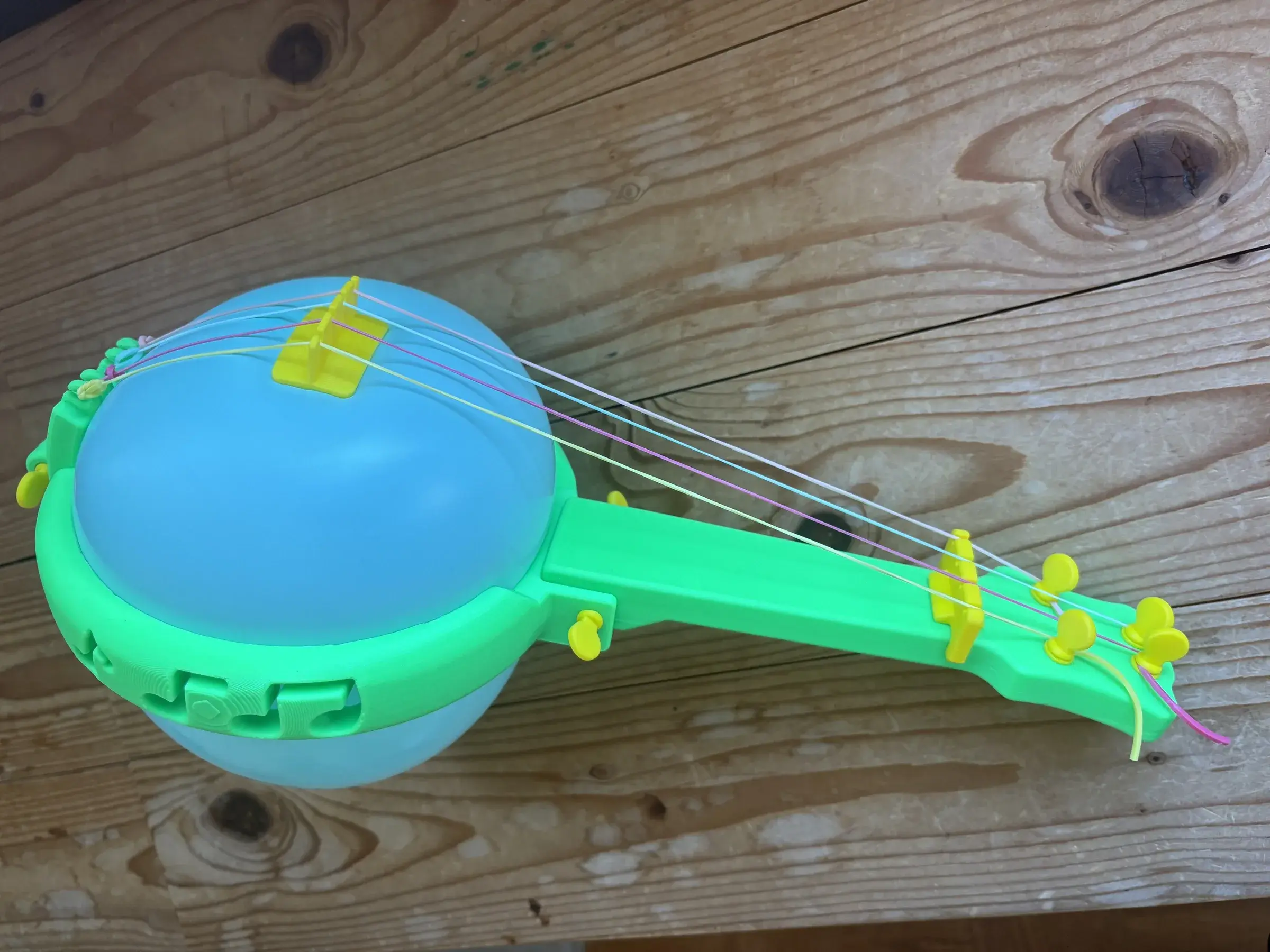
A science toy ought to be simple to build. Co:Creation Lab reached that goal in a slightly backwards way: the Balloon Banjo is split into 19 printed pieces.1
It has four strings, a printed neck and a bridge resting directly on a party balloon. Add air and the resonance moves; let some air out and it moves back. The strings can be retensioned or replaced as well, giving a child two parts of the sound to alter with fingers and lungs without opening the instrument.1
The balloon is inevitably the visual hook, but the design brief is more revealing. A parent was meant to build this with a child rather than print a finished toy for them, and that requirement eventually changed the fasteners, print orientation, tolerances and even the direction from which the balloon enters the frame.1
Hands first
Metal screws were the first thing to go.
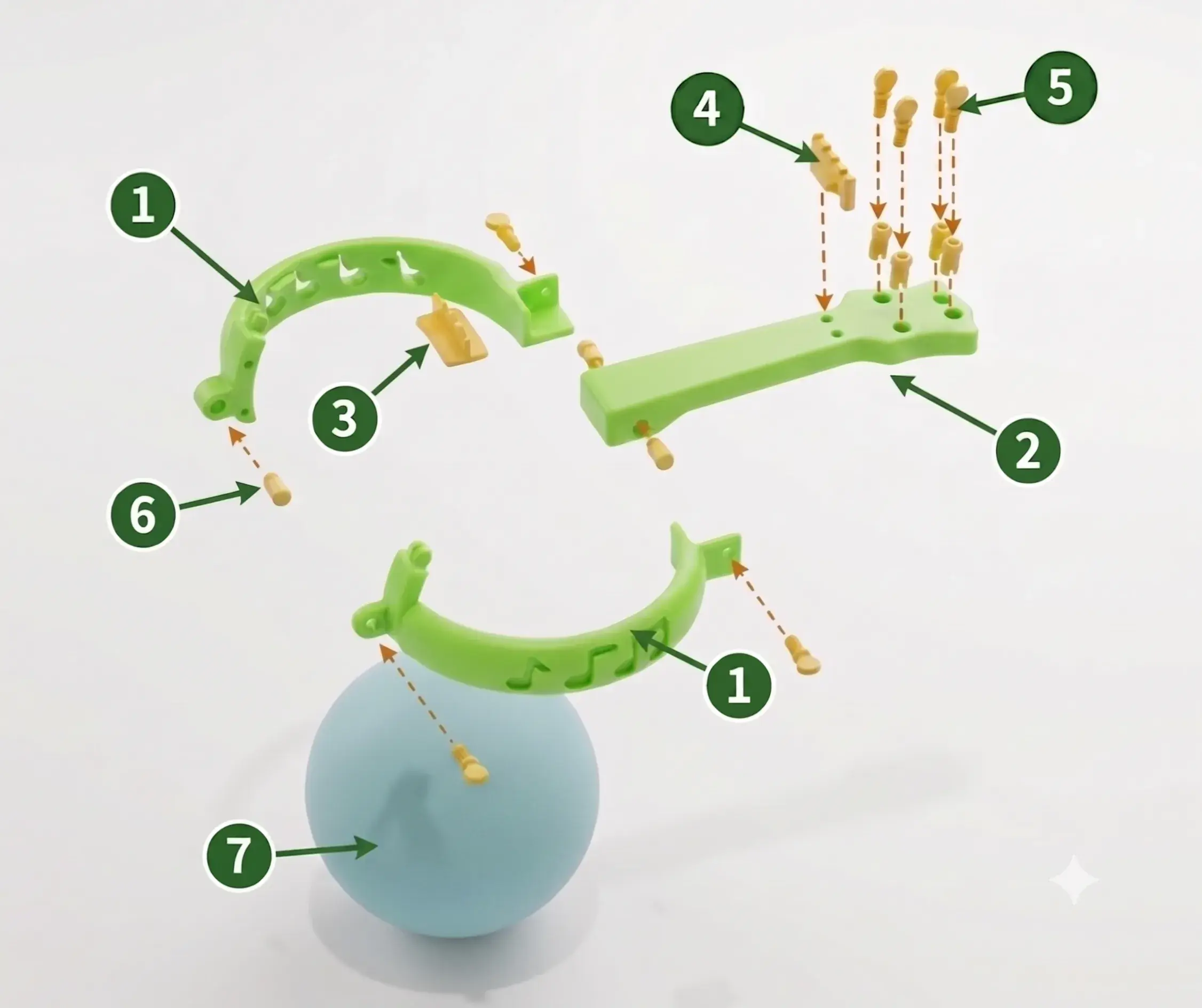
They require a screwdriver and can quickly chew through a printed thread when overtightened, so this project uses seven large printed plastic screws: four tune the strings and three hold the structure together. They turn by hand, undo just as easily and make an assembly mistake reversible.12
The joints handled by the child also avoid printed snap fits. A snap can remove tools and parts, but it still takes seating force and is less friendly to repeated disassembly. Co:Creation Lab did keep one press-fit operation in the design; it was simply moved out of normal use, into seven threaded sockets that an adult presses into the neck and flanges once.1
That decision is why a supposedly simple toy reaches 19 printed pieces.
Seven sockets
The first version printed those threads directly into the large parts, until the build showed that strength was not the problem.1 The threaded holes point in different directions around the neck and flanges, which means no single orientation on the build plate can leave all of them vertical; Co:Creation Lab reports that the angled ones printed badly.1
The fix adds seven pieces rather than removing them. Each socket can now print upright in a favorable orientation and be pressed into its hole once. Separating the troublesome detail from the larger geometry also concentrates nearly all of the fit tolerance into one relationship: screw against socket.1
The print settings make that hierarchy unusually explicit. Screws and sockets use a 0.16 mm layer height, while the other 17 pieces can stay at 0.2 mm. The model assumes about 0.15 mm clearance in PLA, with roughly another 0.05 mm suggested for PETG.1
Printing all 19 pieces at the fit-critical settings would stretch a job already estimated at around eleven hours for no useful gain. Precision is spent on the two mating parts that need it, then relaxed elsewhere.1
Tolerance becomes easier to understand here as a decision about where precision actually matters, and where it can safely be relaxed.
Balloon underneath
The resonator follows the same idea.
An earlier version required opening the structure to replace the balloon. In the published design it slides in and out from underneath while the instrument remains assembled.1 The balloon is treated as a consumable, much like the fishing line used for the strings.
The bridge sits on its surface. Plucking a string sends motion through that bridge into the latex membrane and the air it encloses. In Co:Creation Lab's demonstration, adding or releasing air audibly shifts the resonance, while string length, tension and material provide separate ways to alter pitch and timbre.1
Describing this only as an “air” control, however, makes the physics sound cleaner than it is.
More than volume
Inflating a balloon does not change only the amount or volume of enclosed air. The membrane stretches, its curvature changes and the internal pressure moves as well, so the bridge is loading a coupled system in which several parameters change together.
Research on inflated elastomer membranes supports that broader picture. Work on their resonant behavior shows that natural frequencies can shift with prestretch and applied pressure.3 Acoustic models of inflated membranes also find a substantial influence from the volume of the cavity behind the membrane.4
To be sure, those papers did not measure this banjo, and IRZ has not run a spectral test on the instrument. Their useful role here is to prevent an overly tidy claim: hearing a shift while adding air does not tell us, by itself, how much comes from latex tension, geometry, pressure or cavity volume.
For a science toy, that uncertainty is almost helpful. The balloon does not supply a formula printed on its side; it gives the child a variable to change in seconds and hear immediately.
Two controls
The project becomes more interesting as a teaching object than as an attempt to make a cheap banjo sound respectable.
Its four strings demonstrate a familiar relationship between length, tension, material and the resulting sound. The balloon adds another visible, tactile control at the resonator. The two actions remain separate enough that a child can tension a string without dismantling the balloon or inflate the balloon without touching a tuning peg.1
The same separation appears in assembly, where an adult deals once with the seven pressed sockets and the child later sees big screws everywhere their hands are expected to work; 3D printing absorbs extra complexity so the user encounters less of it.
The Balloon Banjo is therefore not simple because it has few parts. It is simple because each difficult operation has been moved to the place where it causes the least trouble.