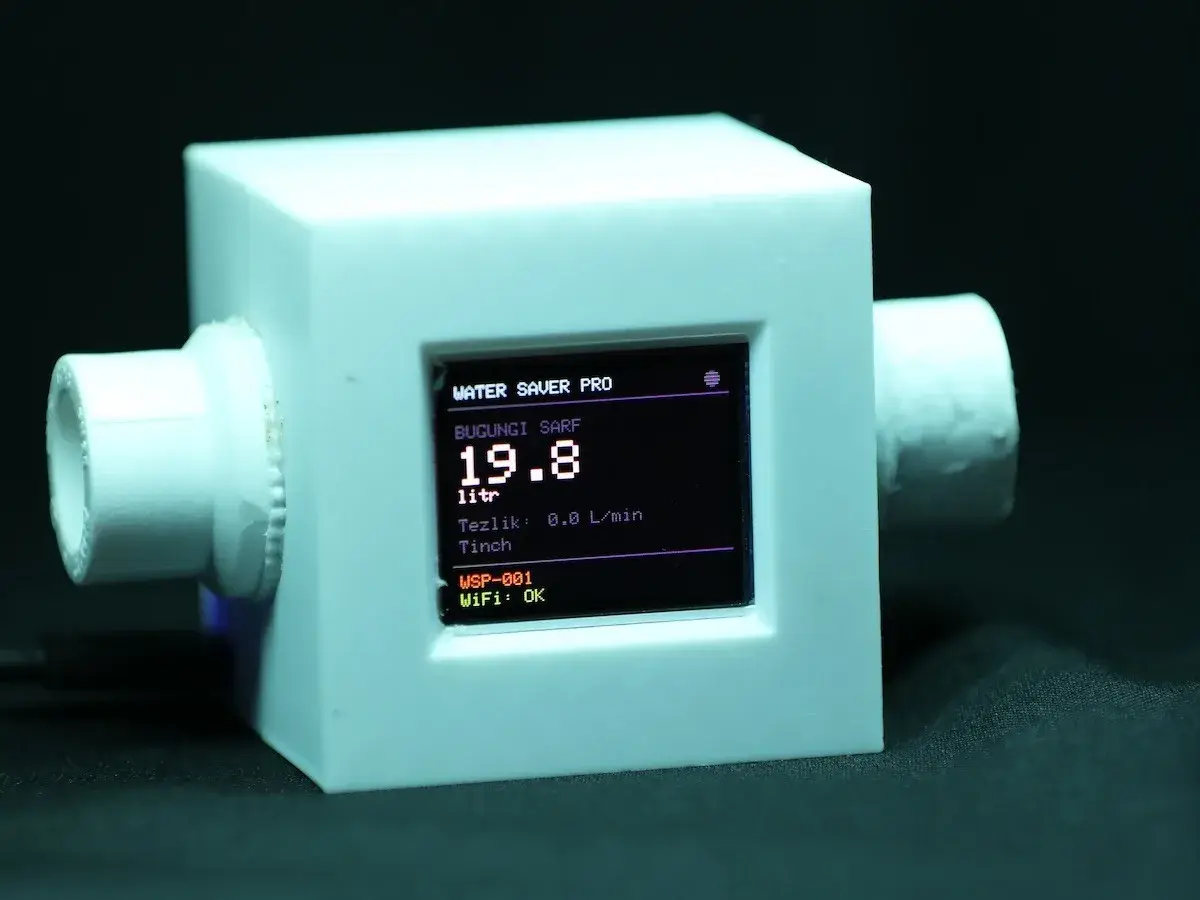
The prototype's screen reads "Bugungi sarf: 19.8 litr," and the words around the number are in Uzbek: "sarf" for the day's usage, "Tezlik" for flow rate, "Tinch" when nothing is running.1 This white box with its two pipe fittings wasn't designed for an international demo but for an Uzbek tap.
Behind the object sits Yadro Team: eight members, most under 20, a group founded in 2024 by Aziz Sayitkulov when he was 18.1 Their Water Saver Pro, started by Farrukh Nurliboyev, is announced as 90% done: an Arduino Nano ESP32 board, water flow sensors, Firebase for storage, Telegram for instant alerts.1
Water first
Water measurement there is no maker gimmick: agriculture absorbs roughly 90% of the country's water consumption, drawn mostly from the Amu Darya and Syr Darya rivers.3 The World Bank expects water availability to drop by 30 to 40% while irrigation demand rises 25%, and it approved $200 million to modernize an aging irrigation network.3 Its climate report is blunter: without adaptation, Uzbekistan's economy is predicted to be 10% smaller by 2050, with the Aral Sea disaster as backdrop.4
A household meter won't fix that, but the chain of "see what you use, get alerted at the right moment" starts exactly where the big programs struggle: at the tap. That's my analysis, not the team's claim; they make no such promise.
Twenty euros and a bot
The board they picked, the Nano ESP32, is Arduino's official gateway to the ESP32-S3: u-blox NORA-W106, Wi-Fi and Bluetooth, USB-C, 512 kB of SRAM, 16 MB of flash, 45 × 18 mm, programmable in both Arduino and MicroPython, at a list price of €20.40 on the official store.2 For a team that teaches, this matters as much as the spec sheet, because it's a board documented everywhere, one a newcomer can replicate exactly.
Elsewhere in the chain, the choices are just as telling: alerts run through a Telegram bot, storage through Firebase, while the mobile app is still "in development", along with AI features "planned" for later.1 In other words, the critical path, sensor to cloud to notification, already exists, and everything else is a roadmap. There's also no sign the device will ever go on sale, or at what price.
The screen speaks Uzbek
Read slowly, the photo Arduino published tells more than the headline does: WSP-001 means the object carries a serial number, so a notion of version; WiFi: OK gives the network state its own line, like on a home router; and above all, the whole interface is in Uzbek, not English.1
Here lies the most interesting detail of the story, since most student prototypes ship their screens in English by default, the language of demos and judges. This one speaks the language of the kitchen where the object will live, and that goes beyond aesthetics: it's the line between an object you show and an object you install.
Viral, then useful
Before water, the team got noticed with smart glasses for visually impaired people, built by Mukhammad Shukur and, according to Arduino Blog, watched millions of times on Instagram.1 That number comes from the outlet running the story, not an independent audit; it still tells you the club's order of priorities, first a project that reaches people, then a project that measures what they consume.
Seen end to end, the trajectory looks like a learning pipeline: Aziz Sayitkulov teaches Arduino and robotics to other students,1 and his Instagram profile presents him as a robotics and IoT professional, author of a book titled Perfect Robotics.7 Farrukh Nurliboyev describes himself as a "Yadro team" member and points to an @yadro.academy_ account, the mark of a club that grew an academy storefront.6 And Water Saver Pro just advanced to the next stage of StartupFest Uzbekistan, the startup and engineering festival that Arduino describes as a leading innovation and startup event in the country.15 Build, show it in competition, teach, repeat.
What other clubs can copy
Three choices, taken from the facts rather than the storytelling: start from a measurable local problem instead of a showcase project; lean on the messaging infrastructure already installed on the country's phones instead of building an app before having users; keep the interface in the language of real use.
One limit, too: 90% done doesn't make it a product, and the sensor's actual accuracy, the enclosure's durability and the final price all remain unknown so far. The team's roadmap lists a mobile app and AI features "later".1 The most instructive part already fits on the screen — 19.8 liters, in Uzbek — while the rest, the board, the cloud, the bot, exists only to get that number to the right place.