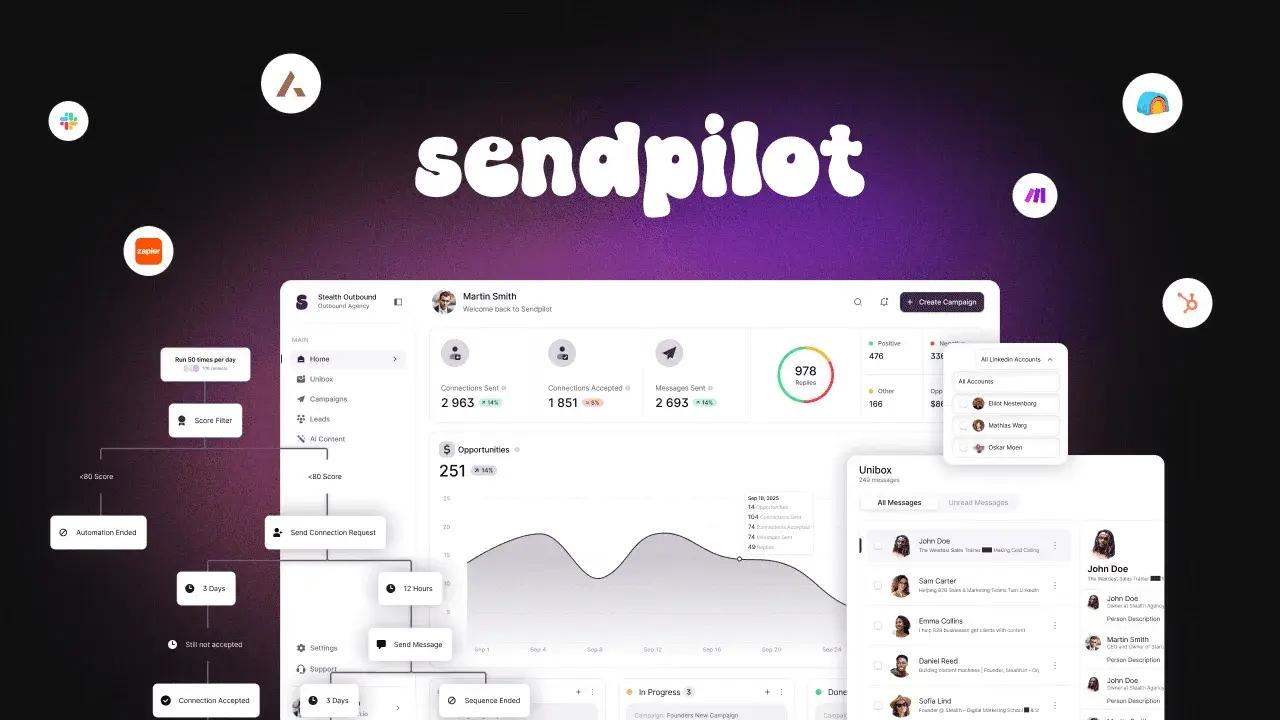
Twenty-three days into Sendpilot's AppSumo launch, cofounder Oskar Moen published three numbers: $270,000 in gross sales, 2,101 sign-ups and 82 five-star reviews.
The big number is the obvious hook. It is also very easy to describe badly.
$270,000 in gross sales does not mean $270,000 landed in the founders' bank account. It is not MRR, profit or necessarily net revenue after marketplace fees and refunds. Sendpilot was selling a lifetime deal, so some future product usage was exchanged for cash immediately.
What interests me more is how the team handled distribution during those three weeks. Customer support did not sit behind the sale. It became part of the mechanism that helped produce the next one.
Two-minute marketing
On Sendpilot's AppSumo page, Moen says the team reads reviews and support tickets and aims to respond to support within two minutes.
On its own, that sounds like an aggressive customer-service promise. Inside a marketplace, it does another job.
A buyer hits a bug or has a question. The team responds quickly. Once the problem is resolved, the buyer is asked for a review. Positive reviews then improve the product's social proof on AppSumo: more reassurance for the next buyer, more activity around the listing and more opportunity to appear in the platform's own selections.
An Indie Hackers post describes this loop from messages shared in the AppSumo Slack community. According to that account, AppSumo then amplified Sendpilot through different rankings and emails as sales and reviews increased.
I would keep that claim in its proper box: it is a launch account, not a documented formula for AppSumo's algorithm. We do not have a controlled experiment showing that five extra reviews produce a specific number of impressions.
The broader mechanism is still visible.
Support stops being only a cost used to prevent churn. It produces something a marketplace runs on: public trust.
The bad week
Moen's post is useful for another reason. He says the week when he published those numbers had actually been Sendpilot's slowest week of the launch.
A recent feature release introduced bugs, the servers ran into trouble and the team stopped marketing to focus on stability. The LinkedIn impressions Moen reported dropped sharply during that period.
So the $270,000 does not come from the clean founder story where every chart points upward because somebody discovered the correct posting schedule.
There is a struggling server in the middle of it.
That also changes the meaning of fast support. When a product starts breaking under new demand, replying quickly is no longer just a review-generation tactic. It prevents successful distribution from manufacturing its own bad reputation.
Small SaaS companies hit this problem constantly. Getting attention is described as the final victory when it often just moves the bottleneck into onboarding, support or infrastructure.
Users become the channel
A few weeks later, Sendpilot pushed the mechanism further on AppSumo.
The company offered free lifetime seats to users who published about Sendpilot on LinkedIn, YouTube or Reddit. Reactions, views and upvotes were converted into points that unlocked additional seats.
At that point distribution is clearly not something that happens after the product is built.
It has entered the offer itself.
A customer can buy the product, publish about it, earn more access, bring in new people and add to the social proof that helps the next sale. That is not automatically a strategy worth copying. Incentivized advocacy can easily turn into flattering reviews or a swamp of promotional posts nobody wanted to read.
But it is a system. That makes it more interesting than a launch summarized as "we posted on Product Hunt on Tuesday."
Lifetime cash, future costs
There is still a large caveat here.
Selling a lot of lifetime access creates cash today and users you may need to serve for years. Infrastructure, support and product development keep costing money while those accounts stop paying monthly.
The approach can finance a growth phase. It can also create operational debt if pricing, limits or unit costs were misjudged.
Sendpilot's public numbers do not yet tell us how this cohort behaves a year later, how many buyers remain active or how much money the company ultimately retained after the marketplace.
So the lesson is not "run a lifetime deal and make $270,000 in 23 days."
The smaller idea is much more useful: inspect every interaction after the purchase and ask whether it can also improve distribution without becoming manipulative or annoying.
Support, reviews, word of mouth and user-created content. Sendpilot connected those pieces instead of leaving them in four separate Notion tabs.
That looks less like a marketing campaign and more like a product loop. For a small team, that is probably the hardest part to copy well.