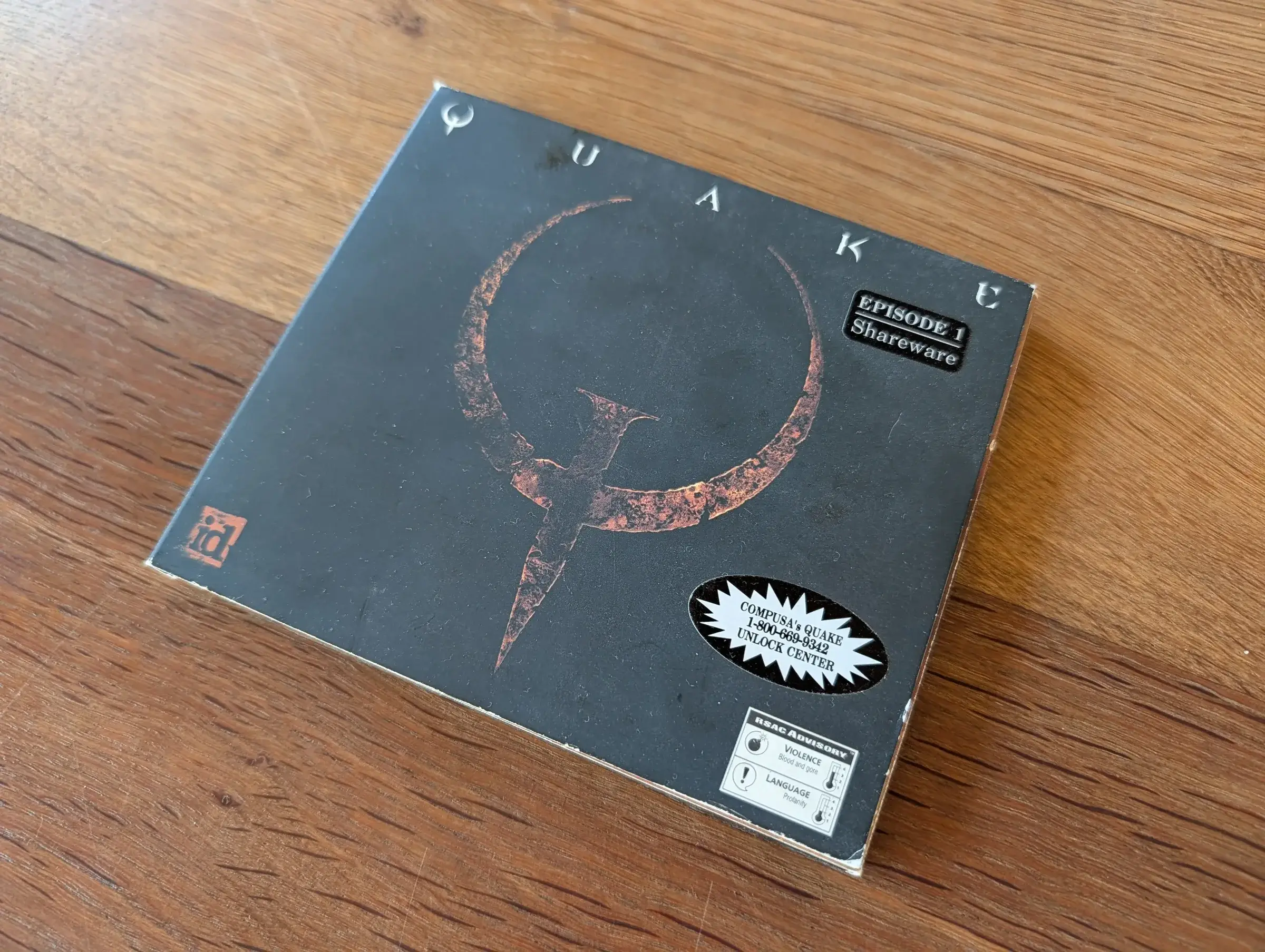
In 1996, the CD-ROM had acquired a peculiar surplus: the medium could hold far more software than many individual games required.
In this post, Fabien Sanglard starts with the mismatch between the Quake shareware CD's roughly 640 MiB of capacity and the roughly 22 MiB occupied by Quake in the layout he reconstructs.1
id Software and its distribution partners turned the empty space into a shop.
The disc sold for less than ten dollars and carried the Quake shareware release alongside locked versions of other id-related games; a customer could call a phone number, pay, receive an unlock code and immediately use software that had already been sitting in the drive.14
For a moment, the CD was both shipping medium and local content server.
Then somebody noticed that the lock knew enough to manufacture its own key.
Everything on the disc
The scheme makes much more sense if we stay in 1996.
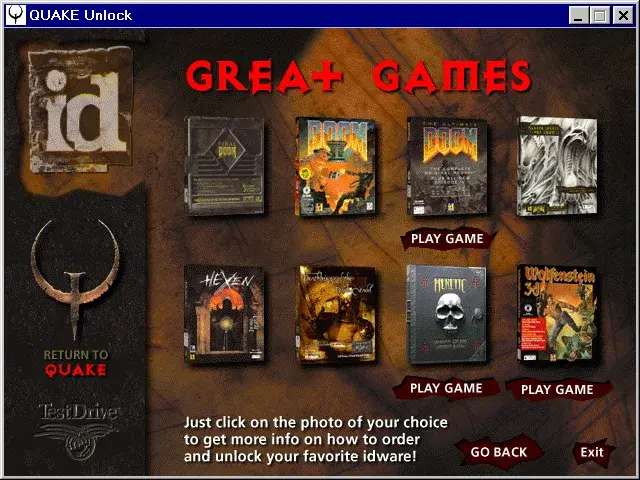
Downloading tens of megabytes could mean a long modem session, while retail software still needed boxes, discs, inventory and shelf space; a CD, meanwhile, had hundreds of megabytes left after storing Quake.1
So the distribution logic was elegant: press one disc containing a catalogue, ship it once, then turn later purchases into codes instead of deliveries.
A July 3, 1996 SFGate review described the model before retail release. It said a CD with a portion of Quake would cost less than $10 and that additional content could be purchased through the 1-800-ID-GAMES number.4
Sanglard's surviving copy shows how physical the transaction remained: the package carries phone instructions, different SOURCE CODE labels appear to identify retailers such as CompUSA, Computer City or Best Buy, and the interface presents a catalogue plus an unlock flow for games already on the medium.1
There is something wonderfully transitional about it.
The customer buys bytes in a store, then buys permission to use more bytes by telephone.
A phone-call secret
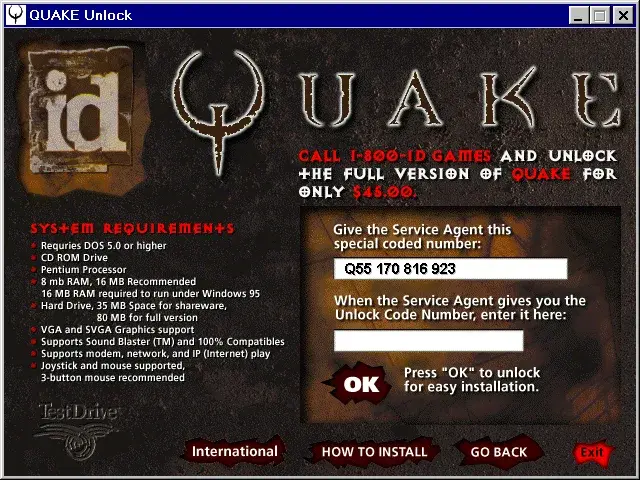
The unlock interface generated a code number, which Sanglard calls the challenge; the customer read it to a service agent and, after payment, received a serial or unlock code in return.1
The challenge changed between runs and rotated while the program was active. Checksums helped catch mistakes during the very human act of reading numbers over a telephone line.1
From the user's point of view, this resembles a classic challenge-response system.
The computer produces a value which a remote authority, presumed to possess information absent from the client, transforms into a valid response; the local software then verifies that response and releases the product.
The structure works only when the remote side owns a secret unavailable to the client.
That last condition is everything.
The lock makes keys
The protection system used software from TestDrive Corp. Sanglard describes executables whose first portion was replaced or "denatured," with information stored separately so the program could later be restored after a successful purchase.1
The files on the CD were not merely hidden behind a menu; TestDrive applied a real transformation that the unlock process later reversed.
But the serial itself did not carry an external secret.
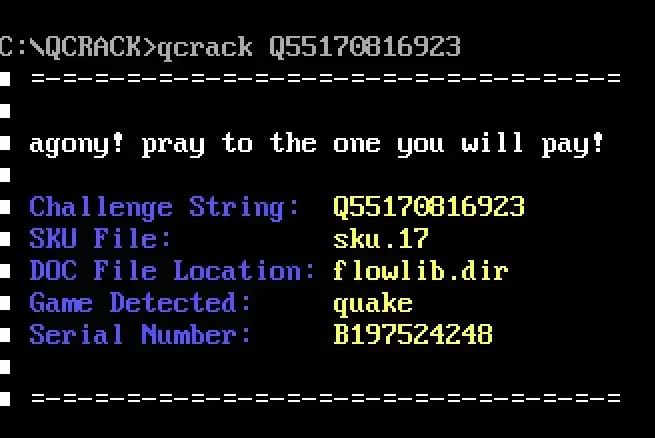
Sanglard's reconstruction, together with rmolina's reverse engineering of QCRACK.EXE, shows that the local FLOW.EXE program could derive the serial expected for a given challenge.13
That is the trust-boundary failure.
The software had to verify the serial, but in this implementation it also contained enough information to calculate the same value, so once that logic was understood the telephone service was no longer technically required to produce a valid response.
Sanglard dates the GNOMON group's QCRACK.EXE release 39 days after the retail shareware CD appeared. The tool automated serial generation from the challenge.1
The weakness was not that "encryption never works." It was much more specific.
A secret cannot remain external if the client ships with the machinery required to recreate it.
Payload already delivered
This design mistake had an unusual consequence because the encrypted catalogue was already distributed.
When a server-side access system fails today, an attacker may still need to download the protected data. In the Quake CD model, the expensive delivery step had happened before authorization. Every buyer already possessed the locked payload.1
That was the business advantage: pressing one fuller CD was cheaper and faster than shipping another disc after each telephone purchase, but it also placed the entire security boundary inside the local unlock mechanism.
Once that mechanism fell, there was no second gate.
The capacity of the CD therefore shaped both the product idea and the severity of the mistake, since surplus storage made pre-distribution rational and pre-distribution made local access control critical; a material constraint had quietly become software architecture.
A catalogue you can hold
Internet Archive preserves an image of the Quake Shareware CD today.2 That preservation makes the object unusually easy to inspect compared with many online commerce systems from the same period.
The catalogue is not a database entry remembered by a company. It is literally part of the artifact.
Sanglard can draw a file map of the disc, inspect the .MJ3 and .ST3 files, run the old interface and compare the protection code with reverse-engineering work published years later.13
That gives the CD an accidental archival property.
A modern storefront may silently delist a product, an API may disappear and a purchase server may close, whereas the Quake disc keeps carrying its commercial model long after the phone operator has vanished.
Sanglard even called the old number and found that it still connects, just not to an id Software unlock desk.1
The infrastructure died. The object kept the evidence.
The storefront survives
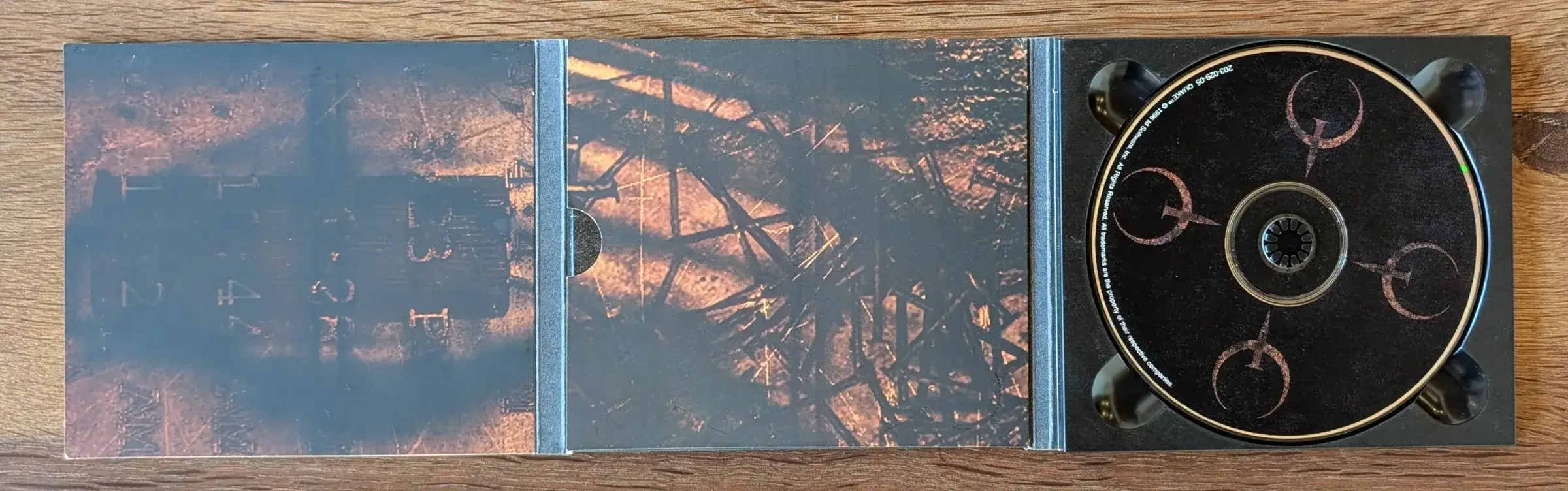
The Quake disc is unusually generous evidence because several layers of the old system remain online at once. Internet Archive preserves the CD image, Sanglard's post publishes photographs and screenshots from a surviving copy, and rmolina's older reverse-engineering post records the logic behind QCRACK.123
That combination matters. A magazine article from 1996 can tell us that the disc cost less than ten dollars and that additional content was sold by phone.4 The preserved image lets a modern user mount the actual medium, inspect its files and run the interface, while the later posts show what researchers found when they looked inside the protection.
Software history is often reconstructed from announcements and memory because the online services themselves have vanished. Here the physical medium kept a copy of the storefront, and preservation moved that object back online after the commercial infrastructure died.
There is a useful asymmetry in that survival. The phone service no longer performs the transaction, yet the disc still shows what the customer saw; the unlock server is gone, yet the local verifier can still be studied; the retail context disappeared, yet photographs of the package preserve the instructions printed around the software. The object preserves only part of the system, yet that surviving part contains far more evidence than a dead web store usually leaves behind.
Bytes already owned
It is difficult to look at the Quake shareware CD now without seeing later software distribution models in it.
Games now preload content before release, devices may ship with hardware features opened later by a license, and software packages routinely contain components that remain unavailable until an account or entitlement says otherwise.
To be sure, the technologies are different, and the Quake scheme should not be flattened into a prophecy of every modern licensing system.
But the underlying economic move is familiar: distribution and authorization are separated.
The vendor sends the expensive or slow thing early, then sells the right to activate it later.
That move is attractive whenever copying or shipping the payload costs more than checking permission.
In 1996 the slow thing was moving tens of megabytes through retail and modem-era networks. The authorization channel was a telephone call.
Today the payload may arrive during installation while a server token carries the entitlement. The architecture survives because the economic asymmetry survives.
The trusted side
The Quake CD is a small, almost comic security lesson because the consequences are so easy to see.
Because the user owns the disc, every program on it must eventually be treated as inspectable; obfuscation may slow reverse engineering, sometimes considerably, but it cannot turn client-side logic into a remote secret.
If payment is supposed to authorize access, some critical proof has to depend on information or authority the unpaid client does not possess.
That could mean a cryptographic signature generated with a private key held by the service, for example. The client may know how to verify a signature without knowing how to create one.
The 1996 system described by Sanglard instead allowed the client to reconstruct the value it was supposed to receive.13
The clever packaging, rotating challenge and denatured executables could not repair that boundary.
Complexity around a missing secret is still a missing secret.
Just full enough
Sanglard calls the CD-ROM "just a little too full," a good joke because the extra data was deliberate rather than accidental padding.
Unused capacity suggested the business model, the business model required local locking, and that local lock created a reverse-engineering target; because the catalogue had already been pressed into physical discs and delivered before authorization, breaking the lock exposed more than the shareware episode that justified buying the disc.1
The lesson is not that id should have left the CD empty.
Preloading was a clever answer to the distribution technology of its time.
The lesson is that when a physical medium lets you ship tomorrow's purchase today, the permission system becomes part of the product's engineering, not just its sales process.
Thirty years later the phone line is gone and most of the shops named on the stickers have disappeared, but the disc still contains the software, the storefront and the mistake.