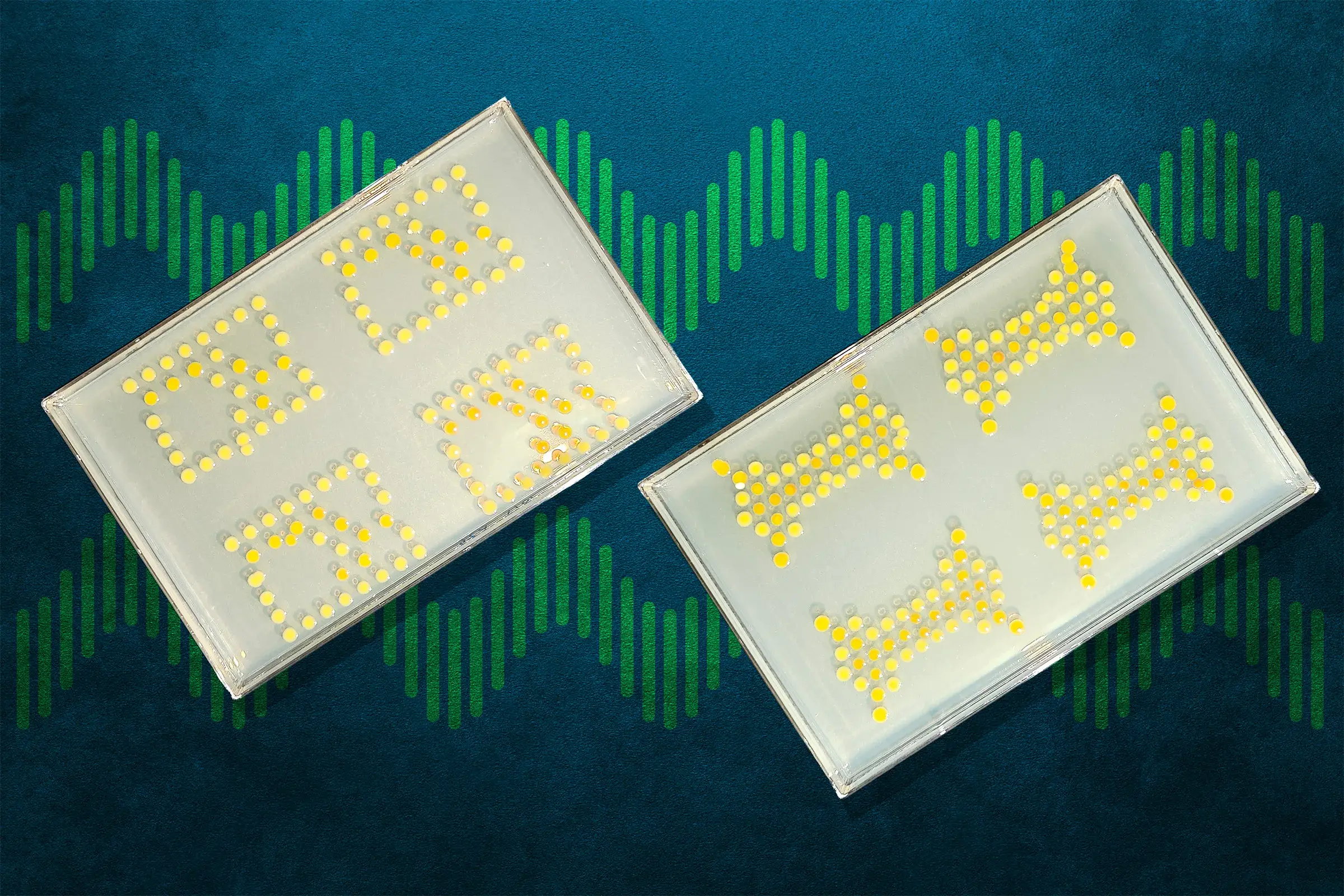
Two Petri dishes on a midnight-blue background. Across their surface, yellow bacterial colonies draw patterns: arrows, grids, paths that branch like the traces of a printed circuit board. The image comes from MIT's press office, but the object is real. Each dot was deposited by an acoustic liquid handler onto agar, roughly five millimeters from its neighbor, and the whole thing then grew for seven days to become a circuit that computes.2
On August 17, 2026, the team of Christopher Voigt, head of MIT's Department of Biological Engineering, published the description of these "living circuit boards" in Nature Chemical Biology.1 Five strains of the bacterium Pantoea agglomerans: two transistors, three relays. With those five components printed in different arrangements, the researchers built multi-input logic, a demultiplexer and binary adders.12
"Computationally, there's nothing that your iPhone can do that these circuits couldn't do," Voigt sums up.2 The sentence deserves to be placed next to its own numbers: each operation takes about eight hours, the circuit runs for about three days, and the largest published assembly wires twenty-four colonies together.23 The iPhone sleeps fine.
But the sentence is about something other than a speed race. What the team built is not a slow computer. It is a different way of programming living matter: instead of cramming a complete circuit into one cell, MIT manufactures component-cells and decides the computation by printing them in the right places. Between two machines, the DNA does not change. The pattern does.1
Two transistors, three relays
An electronic transistor barely knows how to do anything. Depending on the voltage at its gate, it passes or blocks a current. That's it. Everything else, adding, remembering, running a program, is a matter of assembly, and a modern processor stacks billions of them.
The biological version from MIT runs on the same minimalism, with molecules instead of electrons. Each "transistor" strain of Pantoea agglomerans carries a genetic switch controlled by a small signaling molecule, OC-6. When the switch is active, the cell watches for a second molecule, OC-12. Depending on the combination, switch open or closed, target present or absent, the colony produces, or does not produce, an output molecule called OHC-14.2
Two variants are needed to do logic. The N-type transistor switches on when OC-6 arrives; the P-type does exactly the opposite and shuts off in the same case.12 Electronics readers will recognize the pair: it is the vocabulary of complementary logic families, where an N network and a P network answer each other to decide a state.
The paper names the borrowed architecture outright: pass-transistor logic (PTL), a design family documented since the 1990s for building functions with fewer transistors than classic CMOS logic.14 In PTL, the transistor does not amplify the signal; it lets it pass or blocks it based on a condition. The component does not "compute". It conditions a passage.
Why borrow that one in particular? Because its economy of means matches the real cost of living matter. In electronics, PTL builds functions with fewer transistors, therefore less area and less energy.4 In synthetic biology, every extra component inside a cell costs months of engineering and a permanent metabolic burden. An architecture that rewards the minimal component is, literally, the cheapest one to grow.
The paper opens on an observation biology knows well: multicellular forms and functions are controlled by cellular communication and collective computation.1 Bacteria have been talking to each other forever, with diffusing molecules used to count their numbers and coordinate behavior. The team did not invent the channel; they imposed an engineer's grammar on a communication network that already existed.
Transposed into living matter, that renunciation becomes a strength. A cell that does not have to contain the circuit's logic only needs one simple mechanism: detect, relay. And a simple cell can be duplicated, deposited and arranged differently on every attempt.
The chemical wire
The wiring problem remained. In a chip, the wires are etched. In a Petri dish, a colony producing a molecule diffuses it in every direction, like a drop of ink in water. How do you move a signal from one component to the next without soaking the whole plate?
The answer lives in the three other strains, the relays. A relay picks up the OHC-14 emitted by a transistor and converts it into an input molecule for the next component. The paper describes them as converting molecular diffusion into unidirectional flow.1 Concretely, the signal moves stage by stage instead of spreading into a stain.
Geometry does the rest. Colonies are printed about five millimeters apart: close enough for the molecule to reach its neighbor, far enough that it cannot jump beyond.2 The one-way direction comes from how the relays are arranged, not from a physical barrier.
And the printing? An acoustic liquid handler, the same kind of machine that deposits nanoliters into lab plates, deposits the colonies following a pattern drawn in advance.1 Change the pattern, change the machine. "We've built some initial computer architecture components that are commonly used, but any operation can be built with these five strains," says Hamid Doosthosseini, the paper's lead author.2
That shift is the most interesting part of this work, and it is easy to miss. For fifteen years, changing a biological computation meant redoing the biology: cloning, assembling, transforming cells. Here, the five strains form a fixed stock of components. The program is the print plan.
"Printed" should not mislead either. The object does not come out of the machine finished: the depositor places microscopic dots of bacteria, and the circuit becomes itself by growing, for a week.2 Manufacturing and growth are the same operation here, which changes everything for anyone imagining production: you do not build these circuits, you cultivate them.
Too much for one cell
To understand why the team gave up on the single cell, you have to look at what jams up the classic approach. Synthetic biology knows how to build genetic circuits: stack sensors and transcription factors inside one bacterium, activating each other until the desired output appears. It works for a few gates. Beyond that, two walls always return, both recalled in the MIT article: the usable transcription factors are finite and interfere with each other, the famous crosstalk, and every added circuit overloads the cellular machinery that builds proteins.2
The field's history is a series of workarounds. In 2011, Voigt's team was already printing E. coli strains carrying NOR gates onto a Petri dish and letting diffusion do the wiring: multicellular computing, but with gates that had to be genetically redrawn for every architecture.5 Another attempt marked 2013: "amplifying" logic gates designed to behave like transistors inside a single cell, restoring a genetic signal instead of letting it degrade.6 The electronic vocabulary was there; the reachable complexity stayed locked inside the host cell. In 2016, the Cello design language automated the construction of circuits in a single cell, a compiler, still limited by what one cell can carry.7 Last year, a 2-bit hash function was split across 66 communicating cells: complexity climbs, at the price of a zoo of specialized strains.9
The word "transistor" travels far beyond biology, by the way: in 2023, a team published in Nature a microfluidic transistor that automatically controls liquid flows.8 When a metaphor spreads into materials as different as silicon, fluid channels and agar, it usually means it describes a real need: conditioning the passage of a signal with as little matter as possible.
The 2026 proposal is more radical: freeze the components, free the plan. Five cell types, each with a simple, stable function, and all the variability moved into geometry. The paper sums up the idea in one sentence: five cell types, each encoding one simple operation, are enough to build complex computational operations.1
I find that shift more important than the demonstration itself. Any electronics student can draw a binary adder. A library of reusable living components, reprogrammable with a pipette, is what the field has been missing to move from one-off parts to systems.
Twenty-four colonies
So what does it actually compute? The paper documents multi-input logic gates, OR and IMPLY gates, a 1-to-4 demultiplexer that routes an input signal to one of four outputs based on a control signal, then a half-adder and a full adder.12 The demultiplexer is worth a second look. Steering a signal toward one of several destinations is the building block of addressing. Without routing, a circuit only reacts. With it, information starts to be organized.
The largest published circuit is the half-adder: twenty-four colonies wired together, able to add two binary inputs and output both the sum and the carry.2 Twenty-four colonies, eight hours per operation, for a one-bit addition. The comparison with any 1970s processor is humiliating, and the team owns it: nobody here is chasing speed.
The pace has a mechanical explanation. Molecules travel by diffusion, at the millimeter scale. A colony's response goes through transcription then translation: minutes to hours, not nanoseconds.2 And the circuit is alive in the fullest sense of the word. Colonies grow, change size, compete for the substrate. Gizmodo notes that the whole thing runs for about three days before the geometry drifts out of spec.3 A silicon chip ages in decades; this one in days.
The Petri dish is still a calm environment: stable temperature, homogeneous food, zero wild competitors. It is the best possible case, and the paper does not pretend otherwise.
A bacterium already there
The choice of organism is worth a pause, because it says a lot about the real ambition. Pantoea agglomerans is not lab E. coli, the discipline's default organism. It is a bacterium that already lives where the team eventually wants to send its circuits: on the surface of plants.2
The literature describes it as an ordinary resident of the phyllosphere, the surface of leaves, and of roots and soils too. Strain 299R, a workbench model of leaf ecology for years, was isolated from a California pear tree.1011 Its genome tells that life on surfaces: genes for repairing DNA damaged by ultraviolet light, osmoprotectants like betaine and trehalose against drying out, high-affinity uptake of the sugars a leaf lets leak.11 A bacterium already equipped to survive where a leaf is hell, sun and thirst included. The genus Pantoea gathers dozens of yellow-pigmented ecotypes, with a well-documented double reputation.10
On one side, old agricultural allies. Several P. agglomerans strains are commercialized biocontrol agents: P10c protects pear and apple trees against fire blight, a neighboring Pantoea vagans strain is sold as BlightBan, and these bacteria produce their own antibiotics aimed at plant pathogens.12 On the other, pathogenic strains: some carry a pathogenicity island that lets them form plant galls, and opportunistic human infections exist, rare and concentrated in people already fragile.1213 A 2024 review insists on this point: telling beneficial strains from dangerous ones is a condition of agricultural use.12
In other words, if computing circuits are ever to coat roots, the team starts from an organism agriculture already knows, already grows at scale and has regulated for years. It is an engineer's choice: reuse a part whose target environment has already tested the host.
Fast enough overnight
The application the researchers describe fits in one image: a computing biofilm on roots or leaves, sensing a condition, drought, a pest attack, the presence of a fungus, then triggering a response, say the synthesis of a fungicide.2
The fatal flaw of these circuits in computing becomes the central argument here. "We're not trying to replace computers, but rather put computational control into biology," says Voigt. "If you have bacteria on the root of a plant, or the plant itself is doing the computing, running a simple calculation overnight is fast enough relative to a growth season."2
Eight hours against a season. The slowness changes category: it is no longer a performance defect, it is a clock compatible with the living thing it watches. A circuit that reacted in a millisecond would have nothing to say to a field.
Concretely, the inputs remain to be built. The paper demonstrates the computing machinery with lab molecules, OC-6 and OC-12, not drought or insect sensors.2 The agricultural promise first requires writing reliable sensors for a field's signals, then connecting them to this logic. Feasible in principle, the discipline knows how to build molecular sensors; not done yet for this host or these uses.
This vision should be read for what it is: a research program, not a result. The 2026 paper demonstrates logic operations in a Petri dish. No plant experiment appears in it.1 The distance remains whole.
The gap to the field
That distance is measured in workstreams, and the first is reading out. A circuit that computes underground is useless if its output stays invisible. The same lab showed in 2025 an elegant answer to that problem: bacteria engineered to produce molecules with unique light spectra, biliverdin in a soil bacterium, a bacteriochlorophyll in another, readable by hyperspectral camera from up to 90 meters away, camera mounted on a drone.1415 To pick them, the team had screened the spectral signatures of about 20,000 natural molecules with quantum calculations, looking for the ones detectable from afar with the fewest enzymes to transplant.14
Sensor, computation, readout: the stack is reassembling piece by piece, in separate papers. What does not exist yet is the assembly, and the real environment.
Hyperspectral cameras themselves came from elsewhere, and their history says something about why the readout matters. Around Chernobyl, they have been used to measure the slight color shifts that radioactive metals produce in the chlorophyll of plant cells; agronomists point them at crops to spot malnutrition or pathogen invasion.14 The cameras already knew how to interrogate a field. The lab's contribution was giving bacteria answers worth reading from 90 meters away.
In the 2025 tests, the sensors were deployed in closed boxes, in fields, deserts or on rooftops, precisely so they would stay contained.14 "The nice thing about this technology is that you can plug and play whichever sensor you want," lab postdoc Yonatan Chemla summed up.14 Arsenic, soil nutrients, and, mentioned by the team, landmine detection: the list of possible inputs stays open.
The second workstream is everything else: dispersal, containment, regulation. For the 2025 bacterial sensors, the team was already discussing with the EPA and the U.S. Department of Agriculture the questions to settle before any open-field deployment.14 The 2026 circuits still live in a dish. And the paper's funding comes from DARPA and IARPA, the U.S. intelligence agency.2 You can read a trajectory there that does not necessarily go through fungicide: bacteria that detect, compute and signal interest environmental surveillance first. The authors stop short of any such claim; I am reading the funding lines myself, and funders' logos rarely serve as decoration.
Dezeen's headline, "program plants for self-defence", extends the researchers' vision further than it describes the paper.16 The phrase is lovely. The demonstrated result lives in a Petri dish, and that is already a lot.
The pattern is the program
The reflex with a "living computer" is to look for performance: how many operations, how fast. This paper moves the question. The performance remains derisory, eight hours per operation, three days of life, twenty-four colonies. What progressed is reconfiguration: five frozen genetic components, unlimited patterns, zero DNA edits between two machines.1
For labs, the consequence is immediate: testing a new computation becomes a matter of print planning, not cloning. The team publishes its circuit analysis tooling on GitHub, for that matter.17 The compiler, here, is an acoustic pipette.
The next milestone that will matter is not a four-bit adder. It is the first printed circuit that leaves the agar: onto a root, in real soil, with molecules not deposited to five-millimeter precision. That day, the question will no longer be "does it compute". It will be: who decides what the plant computes?