Say Mark Francis turns sound into painting and a neat diagram appears immediately: audio file on the left, canvas on the right, helpful arrow in between. The paintings are less cooperative.
Read the Chroma text and older interviews and the imaginary cable disappears. Francis absolutely talks about frequency, echo, pulse and resonance.12 What nobody supplies is the legend that would turn the canvas into a graph: this frequency equals this yellow; this sound produces this line.
Sound behaves more like grammar: repetition, pulse, layering, interruption, anomaly. Enough structure to start a painting, not enough authority to survive wet paint unchanged.
The pulse stays
Sound did not arrive for the 2026 press release. In 2023 Francis was already looking back across decades and identifying it as one of the patterns that kept returning.5 His description of a surface is wonderfully plain: a pulse, then something aberrant inside the pulse.5
Music also gets in through titles. He listens across classical, punk, heavy metal, techno, industrial dance and ambient, and says work titles are often influenced by whatever he is hearing in the studio.5
The titles preserve that listening: Sequential Pulse, Cadence, Dub Echo, Reverb Mix. Sound Field is there in 2022, Sequencer in 2023, Subtonic and Sea of Sound in 2024.47 By the time Chroma arrives, the vocabulary has already spent years in the paintings.
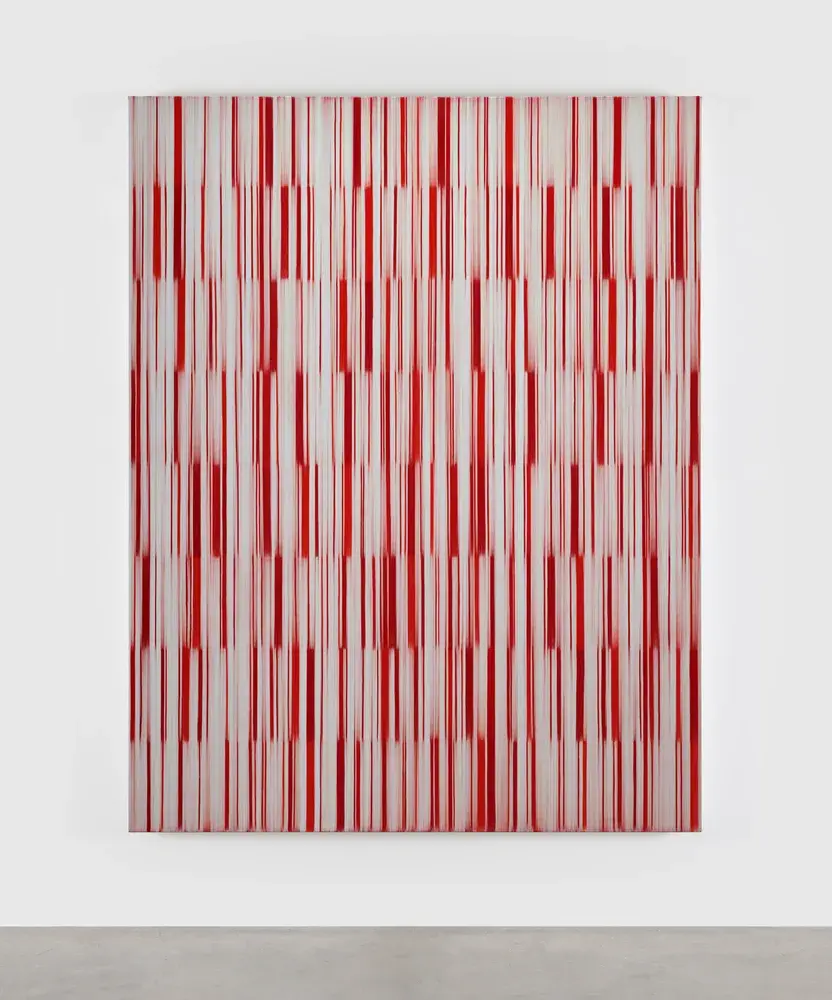
Kerlin described Acoustic Oceans in 2024 as paintings where binary sequences and data become pulsing bands of colour, while Francis compared their construction to improvised abstract noise that can be melodic and chaotic.4 His own studio site speaks of colour and “sound data”, with hues carrying information.3
So “data” is fair. The conversion table is not there, and inventing one on Francis’s behalf would be a fairly odd form of criticism.
No decoder
Designboom says Francis “visualizes sound and frequency”.1 On its own, that verb promises quite a machine. A few lines later the same piece gets more exact: the paintings suggest echoes and layered frequencies without literally illustrating them.1
Bernhard Knaus Fine Art uses similar language. Colour behaves as an acoustic phenomenon; lines recall oscillation and echo; Francis gives sound form through movement, intensity and rhythm.2 The gallery also says his starting structures can resemble networks, cellular systems and scientific models before they gradually dissolve during painting.2
Almost everything hangs on the verb recall.
With an actual encoding you can ask a boring but useful question: if the input changes and the rule stays fixed, what changes in the image? The texts here cannot answer it. No published mapping from frequency to pigment, waveform to length, loudness to density.
Nothing has necessarily failed. It is simply a different kind of borrowing.
Wet deadline
His painting process adds another constraint with nothing digital about it: drying time.
The harshest constraint is almost disappointingly ordinary: paint dries. Francis told The Irish Times he works one painting at a time in a very systematic process.5 Once the surface dries too far, that way of working is gone. He has even put plastic in front of a painting to slow the air.5
Chroma supplies the other half: the composition is prepared, then often painted alla prima.2 The plan enters the studio; the wet surface is allowed to disobey it.
That wet deadline makes rhythm physical in the studio. The motif may pulse, but the painter is also working against a material clock.
Accident since 1989
Chance did not arrive with the sonic theme.
Francis says that around 1989 he made monotypes and then wondered how to carry their visual qualities into paintings. He smoothed canvases with a spatula and brought rollers and other printmaking tools into painting to reproduce a related surface.5 He says that process has run through his practice ever since.
Monotype suited him because a one-off image keeps its accidents.5 Plate, ink and pressure can be prepared; lifting the paper still returns something that was not fully negotiable in advance.
Seen from 1989, Chroma feels less like a new theory attached to striped paintings. Control and accident were already built into a practice where printmaking taught Francis that a prepared system could hand back something he had not ordered.
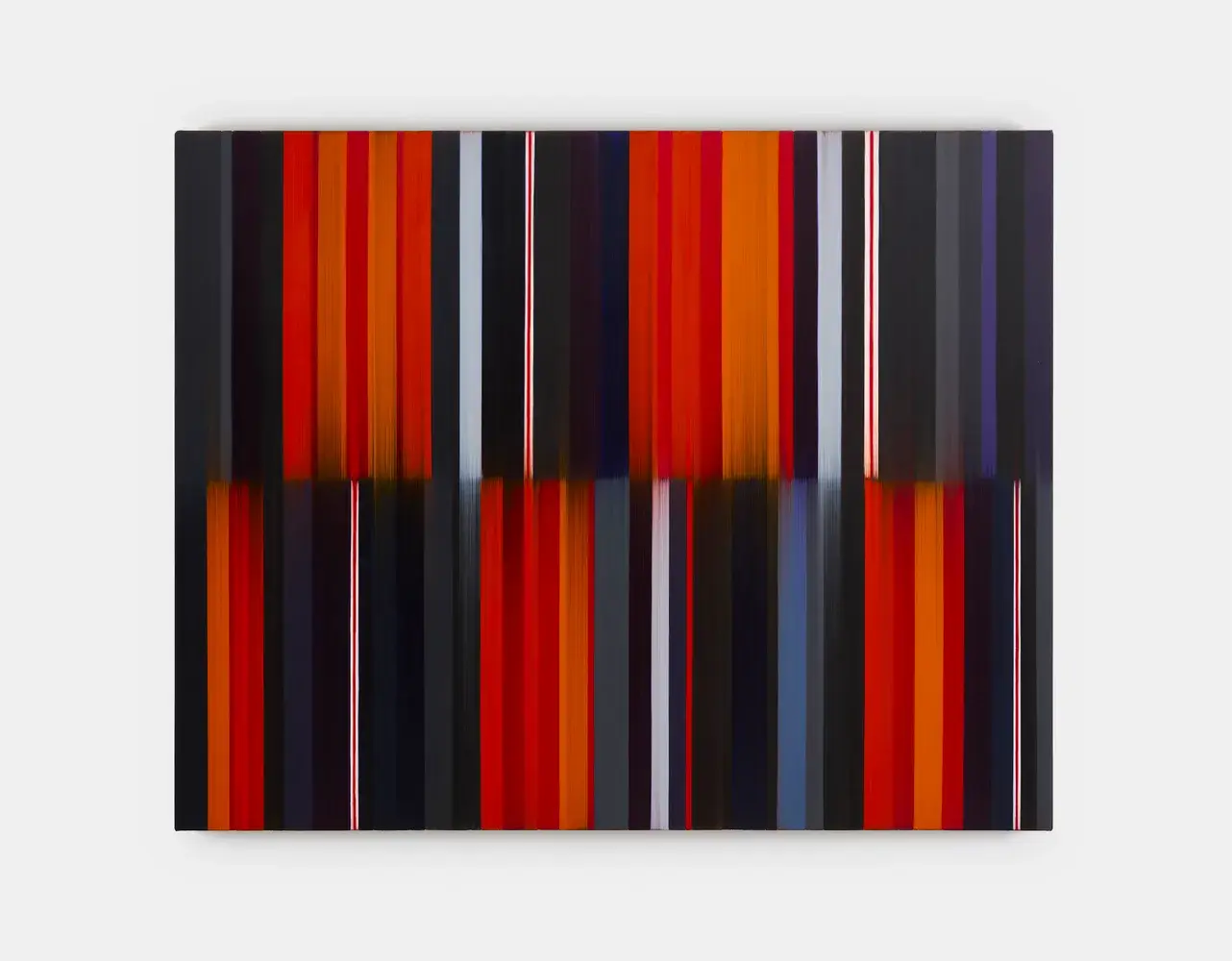
The Irish Times review of Acoustic Oceans describes stacked bands of vertical lines whose divisions are blurred with brushwork. The eye struggles to settle which layer is in front, and compressed lines create visual noise.6 That is a perceptual mechanism, not merely a theme announced by the title card.
Copy a relation
The useful recipe is not “pick a song and paint it”. Without a mapping rule, that sounds more like a cheerful Sunday workshop than a method.
A sturdier move is to steal relationships instead of shapes.
The vocabulary is easy to list: frequency/interval, pulse/break, signal/noise, repetition/echo, layer/reverb. None of that requires a canvas to look like Ableton. One band returns, another shifts the beat, a gap breaks the run, neighbouring colours nearly beat against each other.
Painting then gets to remain painting: viscosity, tools, drying time, mistakes and all. It does not become an analogue monitor for imaginary software.
Science starts it
Sound is only half of this machinery. The other half comes from science.
In the 1990s he looked at disease and cells. Later came radio astronomy, dark matter, networks and crystalline structures.52 Kerlin summarizes his work as painting fed by what scientific technology makes visible: electron microscopy, seismic patterns and sonic data gathered from space.7
Chroma actually calls those structures catalysts.2 They start the painting and then lose their original context. What survives is the trace of a system, not its legend.
That qualification matters when “data-driven” can make almost any intuition smell faintly of a laboratory. Francis borrows systems from science and sound that are strong enough to start a composition, then permits those systems to lose authority during execution.
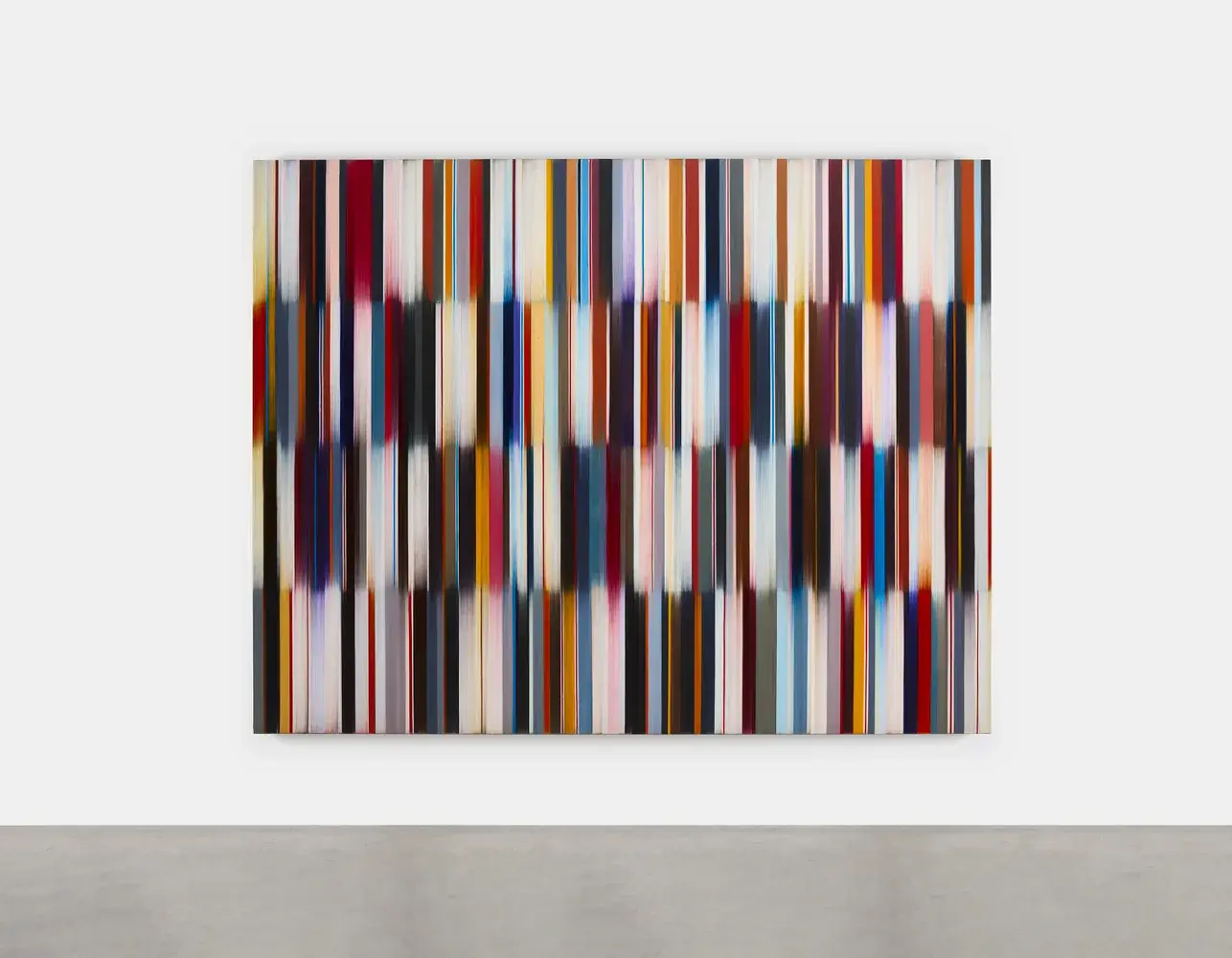
Frequency suggests
“Painting sound” still works as shorthand if it means pulse, frequency, resonance, noise and listening. If it makes you imagine an audio signal mechanically converted and copied to canvas, it describes a pipeline the sources never show.
The available sources do not show that second pipeline. They show something less demonstrative: a prepared structure, vocabulary borrowed from other disciplines, paint that has to be worked before it dries, and enough accident to stop the structure surviving intact.
Sound does not hand Francis an answer to copy. It gives him questions that paint is allowed to answer badly.