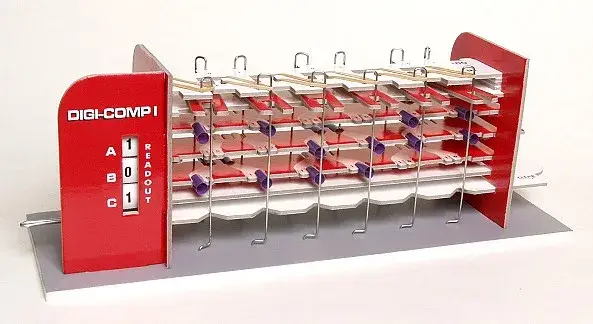
In 1963 the Digi-Comp I promised a “real operating digital computer in plastic”. The slogan aged faster than the mechanism. The Rhode Island Computer Museum reduces its core to three mechanical flip-flops linked by rods and small plastic tubes, with state changing when the user works the CLOCK lever.1
Three flip-flops mean three bits and only eight states, 000 through 111. That is laughably little for a computer and close to ideal for learning binary state because the value exists in front of the user as the position of a physical piece rather than somewhere behind a display.
Digi-Comp's useful trick was not merely shrinking a computer; it shrank how much computing could remain hidden.
Three flip-flops
A flip-flop holds a state until an event changes it, and Digi-Comp turns that electronic idea into visible mechanics. Three elements carry the three digits in the readout, while the hand-operated clock drives logic rods that can change one or more of them according to the current configuration.1
Small cylindrical tubes provide the programming mechanism. Their positions allow or block movements that determine what can happen at the next clock action.15 Boolean logic leaves the diagram and becomes a condition made visible by moving parts.
A modern Arduino LED can expose a bit too, yet the decision that produces its next value happens inside a microcontroller the eye cannot inspect. Digi-Comp separates memory, condition and transition into pieces that physically meet.
Eight states
A three-bit binary counter is almost tailor-made for the machine, since each clock movement can advance through 000, 001, 010, 011, 100, 101, 110, 111 and back around.1 The carry that disappears inside written arithmetic becomes a flip-flop physically causing the next stage to change.
Museum descriptions and the modern reproduction also document exercises involving addition, subtraction, multiplication, comparison, a bank lock, automatic elevator, spacecraft countdown and Nim.24 The 1963 copy loved missiles and “electronic brains”, but most examples are different uses of a very small state machine.
Memory runs out quickly enough to become a lesson. Minds-On Toys preserves the story of a former child owner who attempted perfect tic-tac-toe, drew the game tree on poster board and eventually discovered that Digi-Comp simply did not contain enough state to hold the strategy.2 Sometimes an idea has an algorithm and still does not fit in memory.
Programming with tubes
Program is an unusual word here. Digi-Comp does not keep a sequence of instructions in a separate program memory; the arrangement of rods and tubes directly determines how the current state can become the next state on a clock action.15
Program and circuit nearly coincide. Changing the problem means physically reconfiguring the conditions, and a misplaced tube becomes a bug with an actual location in space.
What 1963 oversold
Minds-On Toys, which revived Digi-Comp in 2005, is more sceptical than ESR's original advertising. Its current site repeats the old claim that the machine was a “mechanical equivalent of an electronic digital computer” and calls that description a stretch.3
Three flip-flops and a handful of conditions obviously do not reproduce the architecture, memory or I/O of a large 1960s computer. The commercial toy itself appears to have been simplified from an earlier concept: history collected by FriendsOfDigiComp describes a first version with six circular planes followed by a simpler redesign after Sears asked for one.2
Minds-On prefers the phrase transparent logical gizmo, built to make binary numbers and Boolean algebra tangible.3 That modest description is more useful. The toy shows digital computation emerging from states, conditions and transitions simple enough to be executed by plastic.
Clock by hand
The CLOCK lever matters as much as the readout. A current processor exposes clock speed as a frequency users never watch directly, while Digi-Comp makes the person supply every cycle by moving a lever.1
The current state is read first, the user causes motion, pieces click, then the next state appears. Stored value and the logic producing its successor occupy separate moments.
A script printing 0 and then 1 would produce an answer faster. It would also hide the location of memory, the instant a condition acts and the mechanism that creates the transition.
Still being made
ESR sold Digi-Comp from 1963 as a polystyrene kit for $4.99, according to the Rhode Island Computer Museum.1 The Strong Museum of Play places it in a period when most public encounters with computing came through large institutional machines and stories of the space programme.4
The current reproduction grew from collector archives and discussion. Minds-On Toys describes rebuilding the mechanism in card, then offering a first run of one hundred kits in November 2005.23 In August 2026 its site lists a twentieth production run and says more than 1,500 further kits have sold since that first batch.3
The material is now heavy die-cut board with piano-wire rods, rubber bands and plastic tubes.3 The mechanism was not replaced with software; preserving physical logic is the entire reason for the reproduction.
A bad computer
Nobody needs Digi-Comp to learn binary today, when a browser can simulate logic gates and a cheap microcontroller can execute real software and drive real I/O; the mechanism's value comes instead from its slowness and lack of capacity.
Three bits prevent a huge machine from hiding beneath the educational interface, the lever keeps time visible and the tubes keep configuration physical, so a failed program has no fifty-layer stack of runtime, firmware and operating system in which to hide its cause.
Digi-Comp is a bad computer and an excellent object for watching computation form. In 1963 that compromise brought children closer to mysterious “electronic brains”. In 2026 it works almost in reverse: a reminder that computing can be understood before it becomes a black box.