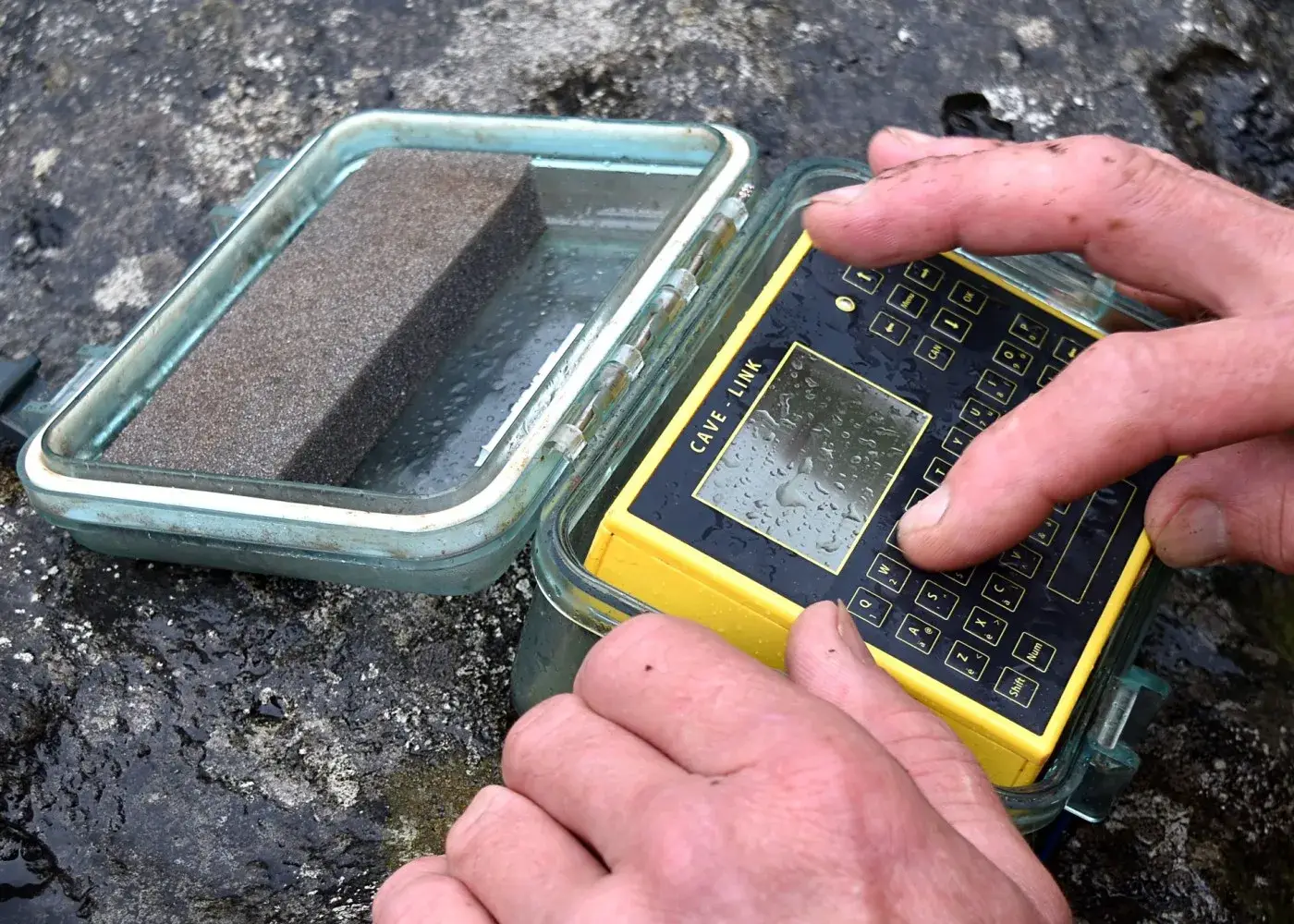
Inside a cave, an ordinary handheld radio can become useless after a few bends even when the person at the other end is only tens of metres away.
That behaviour becomes less surprising once “radio” stops being treated as a magic property of the device: conventional VHF and UHF links like relatively open paths, whereas a cave turns, drops, narrows, crosses boulder piles and disappears under tens or hundreds of metres of rock until the geometric path that looked obvious outside has vanished.
Cave radio therefore learned to play a different game.
Instead of relying only on a wave travelling through open space, through-the-earth systems move towards much lower frequencies, large loops or long electrode arrays on the ground, with coupling mechanisms in which the surrounding terrain becomes part of what the antennas see.12
The result is less like “shouting through a thicker wall” and more like redrawing the circuit until the ground itself becomes part of the electromagnetic system.
This is old technology that remains surprisingly alive: the Cave Radio & Electronics Group of the British Cave Research Association still publishes on the subject, recent work reaches a new Nicola 4 generation of rescue radio,24 and even historical mental models remain under discussion. A 2026 BCRA seminar by David Gibson asks the deliberately provocative question of whether there is really “current in the earth” in a so-called earth-current antenna, with the seminar description calling the popular explanation fallacious.3
Even the antenna name therefore needs some care.
The geometric enemy
A VHF or UHF handheld works beautifully outdoors when a useful fraction of its energy can reach the receiver along a direct path or through manageable reflections.
A cave rewrites that problem.
Walls are close, passages turn, cross-sections change, water and minerals alter the electrical properties of the environment, and a link that crosses one chamber can collapse behind the next corner, which is why some underground communication systems avoid transmitting directly through rock at all.
Leaky-feeder systems use cable laid along the route to guide and radiate radio. Make also discusses older single-wire telephone systems in which earth provides the return path, along with newer experiments where LoRa relays can be dropped progressively along a cave.1
Those solutions follow the passage and are extremely useful when infrastructure can be installed between teams, but they do not solve the stranger case in which a rescue party is below a mountain and wants to reach somebody almost vertically overhead.
Following kilometres of passage merely because two stations are separated by 200 metres of rock would be a peculiar definition of efficiency.
Through-the-earth radio tries to take the shortcut.
Going lower
Cave TTE systems have historically used VLF/LF frequencies, far below ordinary handheld radios. Make uses roughly 87 kHz as a common example.1
At 87 kHz, free-space wavelength is close to 3.5 kilometres, which creates an antenna problem immediately: a conventional efficient radiating antenna would be enormous, and nobody is going to deploy a half-wave structure more than a kilometre long in a muddy passage.
The practical response is to accept antennas that are electrically tiny compared with the wavelength.
They no longer behave like the familiar mental picture of an antenna neatly launching a far-field wave, because a large part of the useful interaction sits in the near field around the antenna; with a loop, low-frequency operation can exploit magnetic coupling even though field strength drops extremely quickly with distance compared with an ideal far-field link.1
That would be dreadful for communicating with another continent.
It can be acceptable when the useful distance is a few hundred metres between cave and surface.
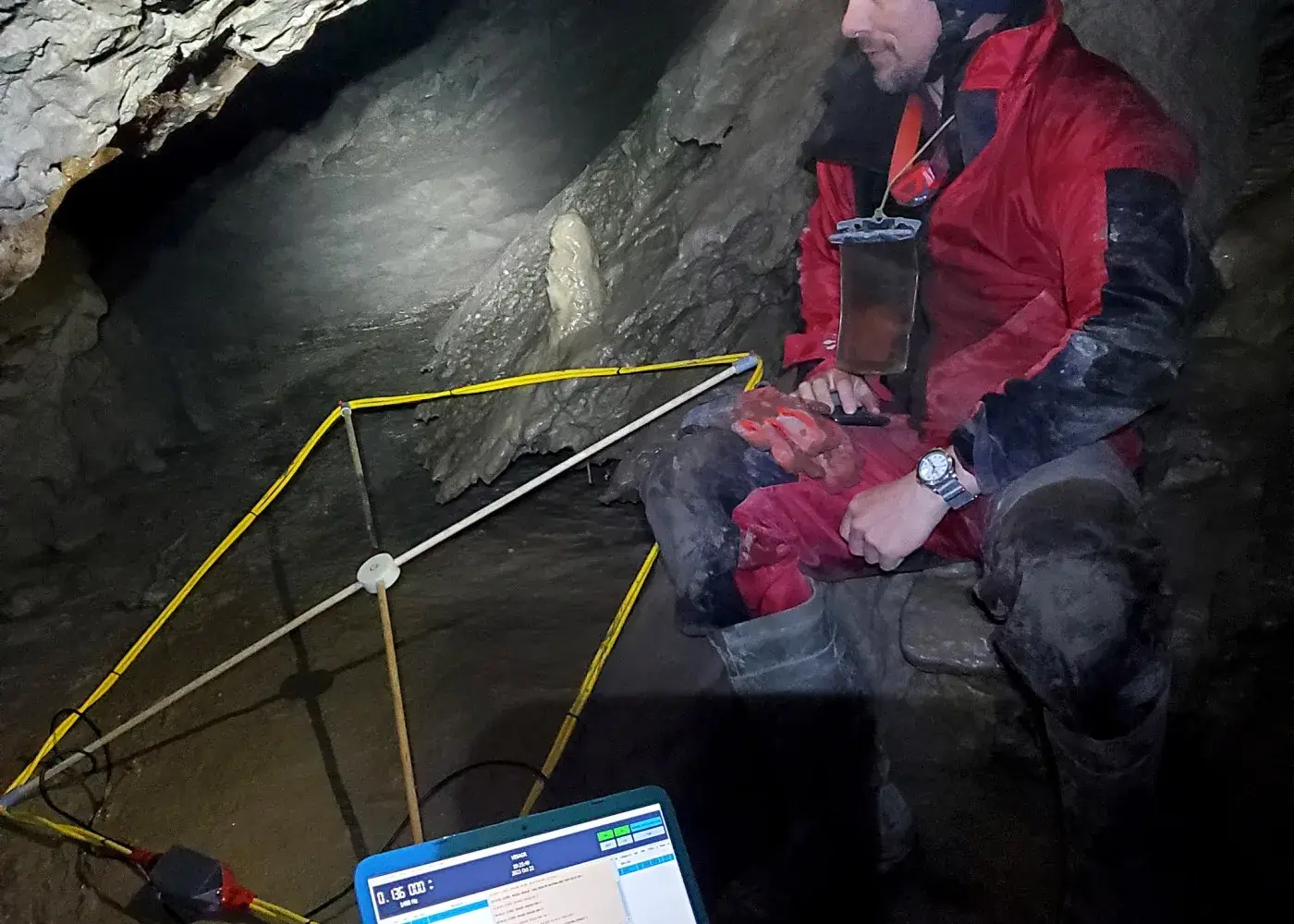
The trade-off has a certain brutal elegance: choose a frequency low enough to work better through the environment, then discover that the same frequency makes a conventional antenna absurdly large. Much of cave-radio history is the art of making that contradiction useful.
Lower still?
Early TTE systems did exactly that. Make notes that some cave radios transmitted directly in the audio range, roughly 300 Hz to 3 kHz, before operation in the tens of kilohertz became more common.1 The attraction is obvious, but the antenna bill arrives immediately: those very-low-frequency loop systems had to be tuned to resonance, and historical examples could reach about 1,000 turns on a 10-metre-diameter loop.1
That is a formidable object to carry, deploy and recover underground, and it captures the engineering problem better than any slogan about lower frequencies “going through rock”. Every improvement moves cost somewhere else: lowering frequency can help with one part of the propagation problem while making the antenna harder to build, raising power buys signal at the cost of batteries and heat, and reducing data rate buys robustness by making communication slower.
Earth arrays made very-low-frequency experiments possible without requiring the same gigantic resonant loops,1 although their apparently simple geometry should not be confused with a settled physical model, particularly given the BCRA's continuing argument over how the antenna should actually be understood.3
To be sure, there is no magic frequency hiding below the dial. Choosing frequency mostly chooses which family of compromises the rescue team is willing to carry into the cave.
Rock negotiates
Saying that a signal “passes through rock” suggests a homogeneous material with one predictable attenuation.
Mountains are less cooperative.
Dry limestone, clay, water, fractures, conductive mineralisation and different geological layers do not have the same electrical properties, so ground conductivity and operating frequency change the losses enough that two caves at the same depth do not guarantee the same link.
Depth itself is an incomplete measure. Antenna orientation, local geometry and the distribution of materials between stations also matter.
This dependence is what turns geology into something close to a circuit component.
On the bench an engineer chooses resistors, capacitors and inductors. In the field the engineer inherits a volume of rock that cannot be ordered from another supplier.
Calibration becomes partly site measurement.
A radio that works perfectly in one field can lose enormous margin in a more conductive cave environment, forcing the installation to account for noise, attenuation and geometry that no electronic schematic controls completely; the hardware does not manufacture the channel, it negotiates with it.
The stubborn loop
A large wire loop is a relatively intuitive historical TTE antenna.
Alternating current in the loop produces a changing magnetic field, and another loop in that field can detect the variation and recover the signal.
At low frequency and limited distance, that picture is enough to understand why communication can work through terrain without line of sight.
The difficulty is size.
Producing more magnetic moment asks for loop area, current or more turns, and underground every one of those choices has a cost: wire to carry, installation time, electrical resistance and battery demand.
A loop is also directional, with coupling changing according to the relative orientation of transmitting and receiving antennas, and that apparent disadvantage can become a measurement tool for radio-location.
A surface operator can rotate or move the receiving loop, look for characteristic maxima or nulls, and use those observations to estimate the position of the underground transmitter. The same directionality that complicates conversation becomes geometrical information.12
An antenna is no longer only a transmitter or receiver.
It becomes a position sensor at the scale of a mountain.
Two enormous wires
Another important rescue-radio antenna family is the earth array.
In the practical installation described by Make, two wires run away from the station in opposite directions for tens of metres and end in electrodes making contact with the ground.1
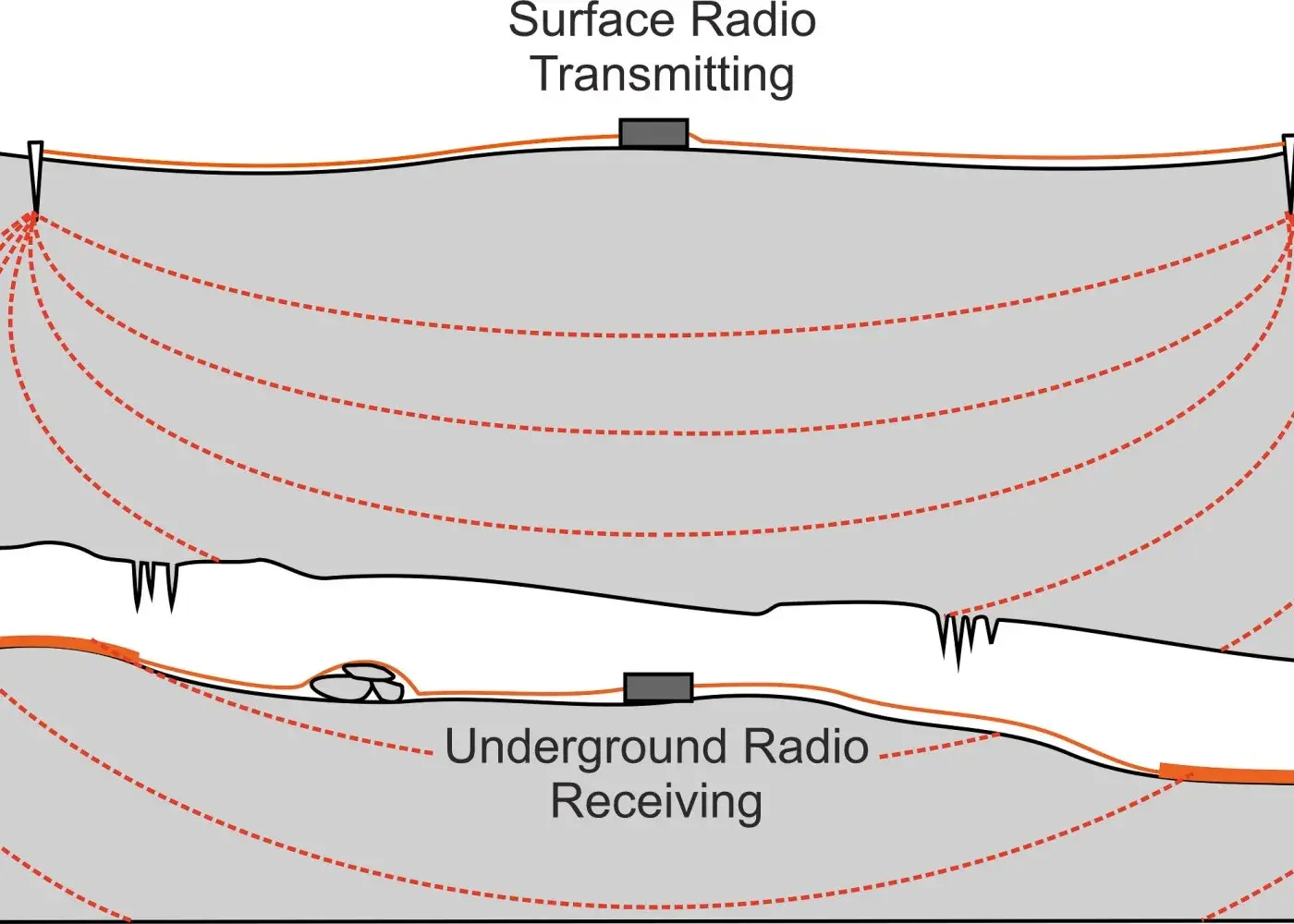
The easy explanation is that the transmitter injects current into the earth between the electrodes and another pair detects that current elsewhere, which is precisely the model attacked by David Gibson's 2026 BCRA seminar.3
The seminar description says the common picture of current simply flowing through the ground is fallacious and that understanding the actual behaviour matters when optimising the antenna.3
The disagreement is more useful than an overconfident explanation because it shows how an engineering name can survive longer than the physical model that created it: users can know that an antenna geometry works, measure its performance and improve it while the best description of the mechanism remains an active technical question.
For makers, the lesson is uncomfortable: reproducing a schematic does not mean understanding why it works.
And changing wire length, orientation or termination to optimise a wrong mental model can push the design in exactly the wrong direction.
Noise travels down
An underground receiver is not listening only to its partner.
At low frequencies, electrical distribution systems become particularly noisy neighbours, with European 50 Hz or North American 60 Hz power and their harmonics contaminating the receiving environment,1 so the frequency range that helps TTE communication also opens a door to power infrastructure, industrial installations and local electromagnetic noise.
Receivers need filtering.
The constraint can influence where a surface station is placed. A point directly above the cave is not automatically ideal if it happens to be beside a noisy installation.
Modern systems can also use digital signal processing to filter, detect and extract weak signals.
Software-defined radio changes a great deal of electronics without changing the physical channel.
Filters, demodulators and communication modes that once needed dedicated circuitry can increasingly move into software. BCRA publications continue to explore that evolution through recent generations of Nicola radios.24
The rock remains stubbornly analogue.
Voice costs dearly
Natural conversation is ideal during rescue, but voice consumes bandwidth and requires enough signal-to-noise ratio to remain intelligible continuously.
When the channel becomes poor, reducing information rate changes the problem.
A short digital message can be repeated, coded, checked and accumulated for much longer than a syllable. The receiver can search for a known structure in noise instead of reconstructing speech immediately.
This is why underground communication is not simply a competition over which radio reaches furthest.
The content itself has a physical cost.
“Team 2 OK” does not demand the same channel as ten minutes of conversation. A sensor reading may tolerate several seconds. A critical rescue message may be short while demanding a very robust acknowledgement.
That principle connects cave radio with many extreme communication problems: space links, underwater channels, buried sensors and ultra-low-power networks. As the channel gets worse, engineers work on the information as much as the antenna.
The mountain bench
A cave radio cannot be validated only with a dummy load and instruments on the bench because the real environment adds too many variables at once: rock type, moisture, electrical noise, available antenna space, orientation and the actual separation between stations.
This is why CREG publications have long mixed electronics with field measurements, rescue experience and radio-location work.2 The same receiver can look excellent in a sensitivity test and then reveal underground that the antenna takes too long to deploy, while a theoretically ideal surface position can become useless because local electrical noise swamps the band.
The pattern will feel familiar to anyone who builds physical systems, although the cave is far less forgiving than a workshop: the prototype is not finished when the circuit works; it is finished when the whole procedure works in the environment for which the circuit was designed.
For cave radio, that procedure includes carrying equipment to the site, deploying tens of metres of wire, finding workable ground, checking orientation or tuning where required, establishing the link and eventually packing everything again. A theoretical 3 dB improvement that doubles deployment time is not automatically an operational improvement.
To be sure, laboratory measurement remains essential because it lets teams compare electronics under controlled conditions. The point is that component performance and system performance are different objects, and the second one includes a mountain plus the people working inside it.
Optimising for rescue
A prototype can be excellent on a bench and useless at the bottom of a cave.
Rescue radio has to tolerate water, mud, cold, impact, exhausted operators and hours of transport before the equipment is even switched on, while antennas must remain deployable in spaces never designed for them, connectors have to survive, batteries have to remain manageable and controls have to make sense with gloves and in darkness.
The Nicola radios were developed inside this cave-rescue culture. BCRA's CREG Journal traces a line from older Molefone designs through generations of Nicola equipment, and 2026 publications continue with Nicola 4.24
Modernisation therefore means more than replacing old analogue electronics with a more capable DSP.
It has to preserve a system that rescue teams know how to deploy under real conditions.
A theoretically better design can lose to a more predictable device that is documented, maintainable and already integrated into rescue procedure.
In this field, training and maintainability are part of radio performance.
The surface moves
A TTE link has one peculiar advantage: the surface station does not have to remain near the cave entrance.
If a team is deep below a distant part of the cave system, the surface operator can look for a position that minimises direct rock distance rather than following the underground route.1
That changes rescue logistics.
The useful point might be a field, hillside, road or plateau, perhaps easier to reach with batteries and a team but perhaps also inaccessible in bad weather, far from shelter or filled with electrical interference.
The topographic map starts to behave like an RF installation diagram.
Operators care about the point above the cave, but also the ground available for electrodes, electromagnetic noise and human access.
The antenna spreads into the landscape.
This may be the most literal example of geology becoming part of the circuit: design work continues after leaving the radio enclosure.
Field becomes geometry
Radio-location deserves to be separated from conversation.
An underground team installs a transmitter. On the surface, an operator measures the signal with an orientable antenna at several positions or orientations. Changes in strength and directional nulls can be used to estimate where the underground transmitter lies below the terrain.12
At that point, transmitting a rich message is no longer the useful target.
The field itself is the information.
This has practical uses in cave surveying, linking underground features to the surface or locating an important point in a cave system.
It also reveals something more general: a communication system can measure its own channel.
The signal carries a message, but its variation through space also reveals the geometry of the link.
Inside a cave, where GPS and external landmarks have disappeared, that second function becomes unusually valuable.
More watts?
Because physics invoices aggressively.
In the near field of a small loop, useful signal drops very rapidly with distance. Make highlights the steep distance dependence in this region.1
More transmit power helps, but batteries become heavier, components dissipate more heat and antennas have to tolerate greater current, while none of that fixes a bad model of the channel.
If an antenna is poorly oriented, the terrain is unusually lossy, interference sits on the useful band or an electrode geometry is poor, multiplying watts may be a much worse optimisation than changing the system elsewhere.
A better frequency, antenna deployment, narrower filter or slower digital mode may buy more.
This is exactly where modern software helps: optimisation can move away from the power amplifier and into signal processing or coding.
Electronics negotiates
On a laboratory bench, a circuit appears to have clean inputs and outputs.
In cave radio, the schematic continues into fifty metres of wire, two electrodes, wet limestone, surface relief, a distant power line and the orientation of another team installing an antenna in the dark.
There is no clean boundary around the PCB.
That is what makes the field so interesting for engineering and fabrication.
The product is not only the enclosure. It is the enclosure plus its deployment procedure plus the terrain plus the physical model used to interpret that terrain.
Even the last piece continues to move, with BCRA still discussing in 2026 how earth-current antennas should be understood,3 which means a technology can remain operational for decades while retaining an open technical question about the best explanation of its behaviour.
This looks nothing like the tidy story in which an engineer completely understands the physics first and designs the product afterwards.
Reality is messier: measure, build, correct, use, then sometimes return decades later to explain why the model that once seemed obvious was probably not the right one.
Under a mountain, electronics never controls the entire experiment.
It learns to negotiate with the rock.