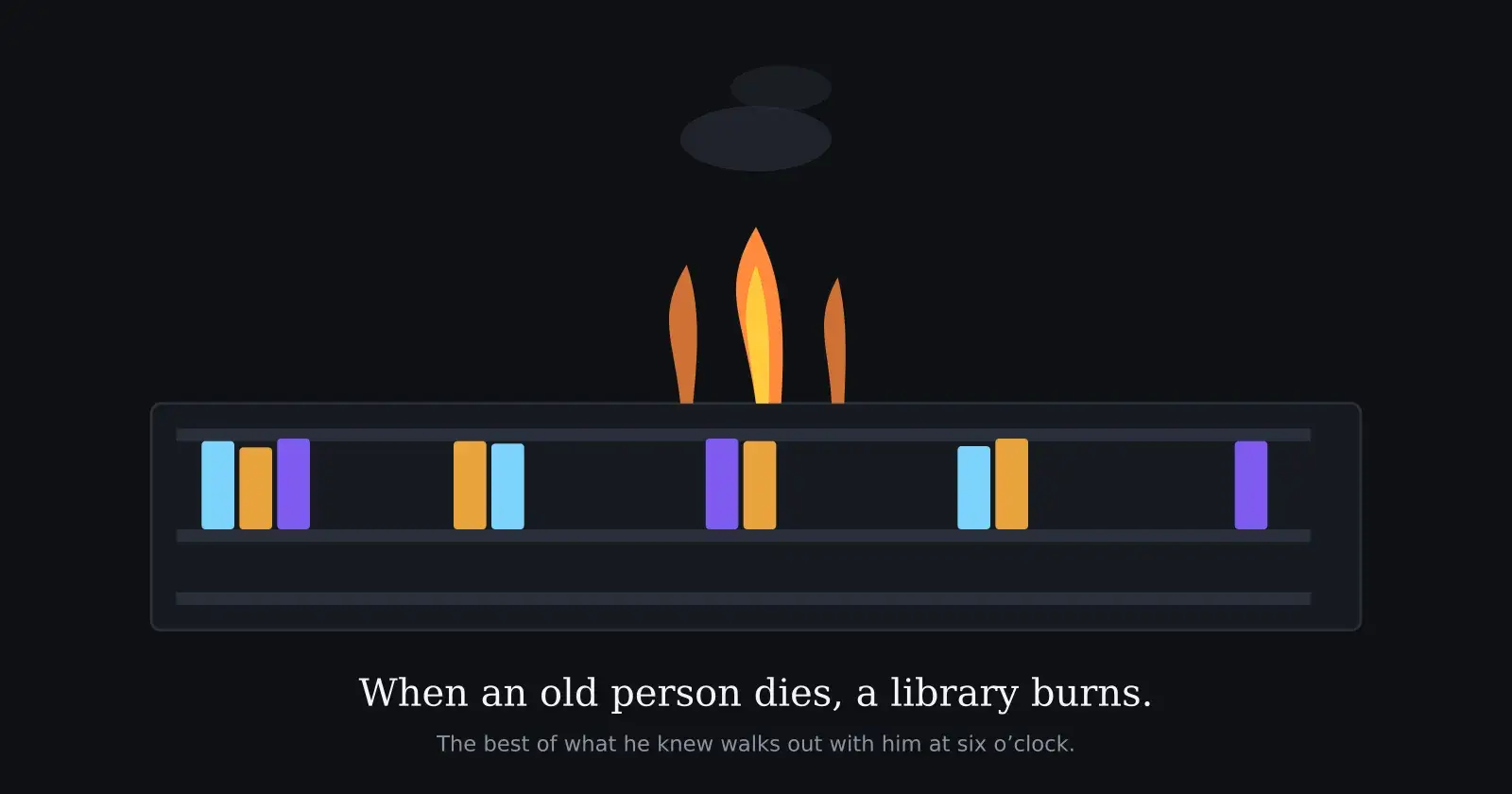
There is an African proverb that a library burns to the ground every time an old person dies. Dan Maccarone quotes it at the start of an essay about what he calls “productizing a person”: taking the way one person works through a hard decision — the instincts, the taste, the method built over a career — and packaging it so others can use it without that person in the room.1
His claim is that AI is the first tool that makes this worth attempting. Not because the machine should do the deciding, but because it can help get the judgment out of a single head.1
The essay is honest about the difficulty, which is what makes it worth reading.
What words miss
The obstacle is not technical. It is that most expertise never makes it into words.
Maccarone borrows the vocabulary of people who have studied this for decades. Michael Polanyi called it tacit knowledge — “we know more than we can tell”. Dorothy Leonard and Walter Swap called it “deep smarts”, the hard-won judgment stored in your best people, and were blunt about what happens to it: it walks out the door when someone quits or retires.1
Ask a brilliant person why they made a decision and you often get a shrug. They are not being coy. The instinct for which corner to cut and which to defend does not live in words. It lives underneath them, built from ten thousand small decisions the person long ago stopped noticing they were making.
This is the same problem every workshop and every craft have faced forever. You can teach the steps; the feel is harder. The essay’s contribution is to ask what happens when you try to capture the feel too.
Two opposite heirs
The most useful part of the essay is that Maccarone describes two co-founders who have landed on opposite answers to the same problem.
One is convinced he can get his judgment out of his own head. For months he has been feeding AI the way he works — his decisions, his reasoning, the emails he has sent — until it started coming back sounding like him and, more unsettling, deciding like him. He does not want to clone himself. He wants his judgment to be portable, out of the one skull it has been stuck in and into something the rest of the company can use.1
The other co-founder is uneasy. He agrees with the principle — you should try to distill how a founder sees patterns — but he refuses to flatten it. He does not want a version of himself that people could parrot. Ask him how his judgment actually spreads and he points at people, not documents. Nobody is really onboarded, he says, until they have stood in the room and felt firsthand what the thing is. His judgment travels by proximity.1
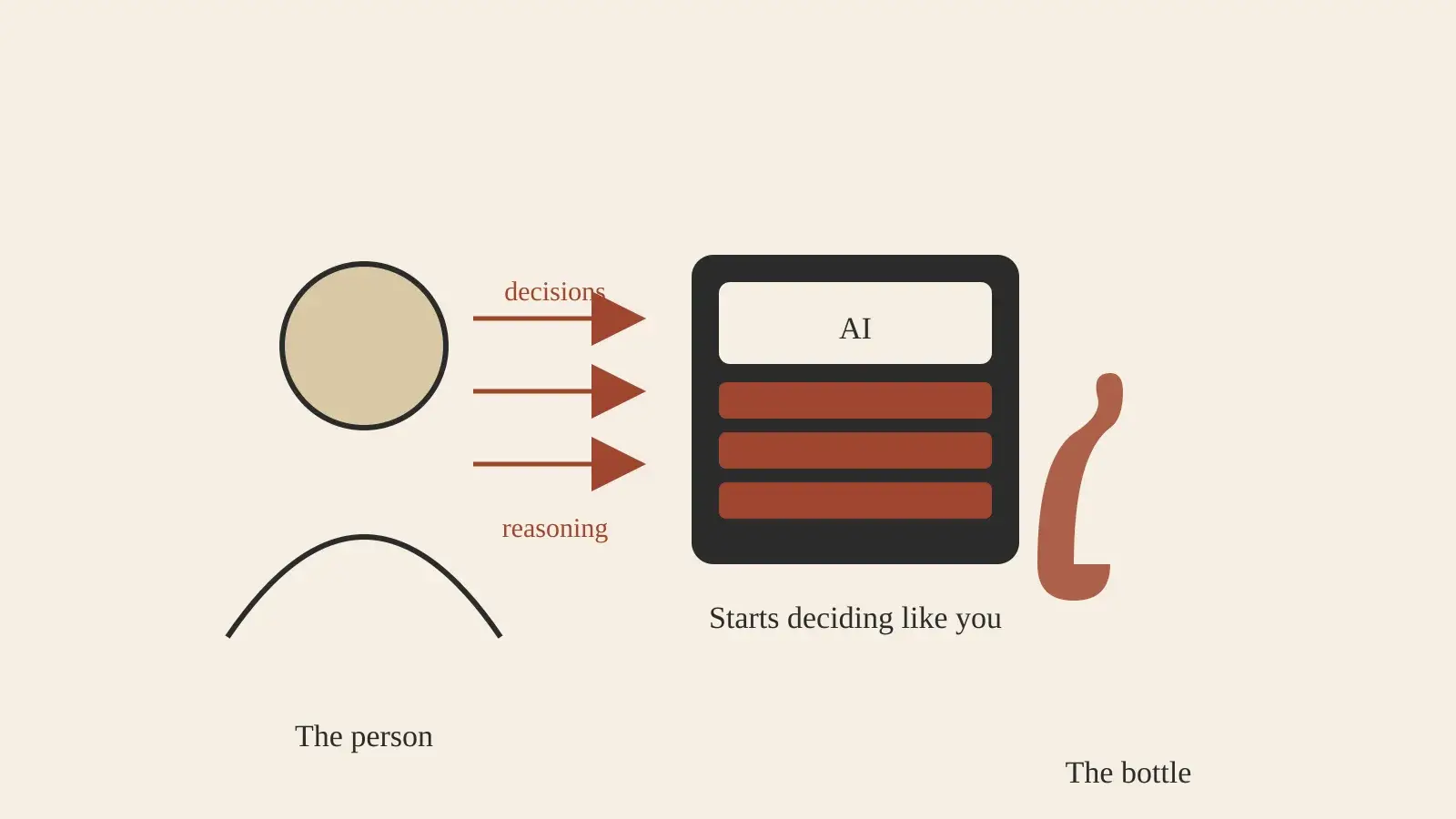
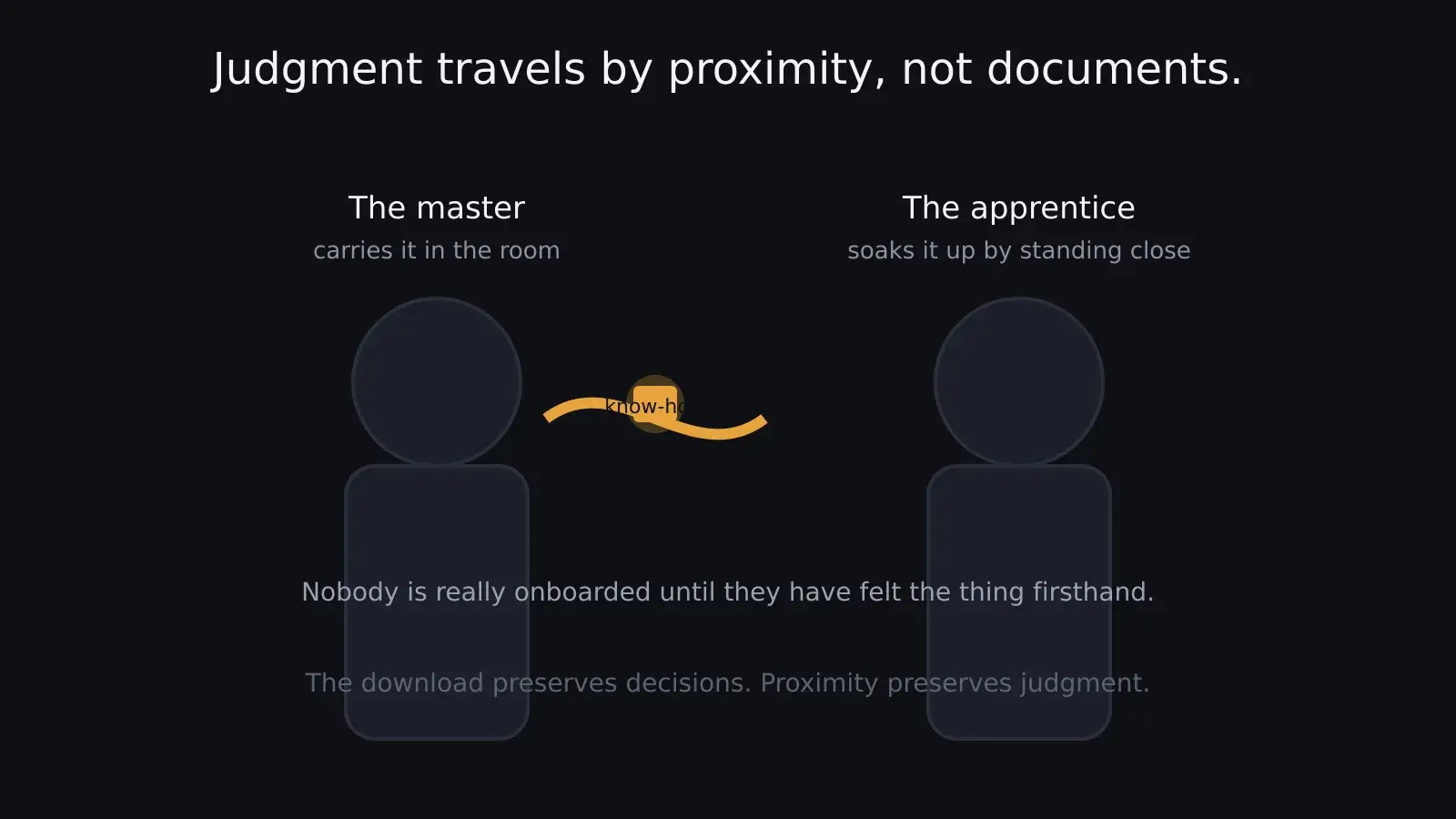
Neither answer is obviously right, and the essay does not pretend otherwise. The download risks producing a version that is close enough to be dangerous and flat enough to be wrong. The apprenticeship preserves the thing but keeps it fragile — it still walks out the door when the last person who carries it leaves.
There is also a cost to the download path that is easy to underestimate. The essay quotes a line from Jenny Ouyang that captures it: “Trying a tool was easy. Teaching it how I work was the expensive part.” Extracting judgment is not a one-off export. It is a long process of feeding the machine decisions, correcting its output, and explaining reasoning — which is itself the hard work of making the tacit explicit. The founder who wants his judgment to outlive him is not recording it; he is, in effect, teaching an apprentice that never gets tired and never leaves. Whether that is a blessing or a curse depends on how much the teaching changes the teacher.
The kiln test
The essay is written about founders and software, but it is really about a problem IRZ keeps returning to: how a practice moves from one person to the next.
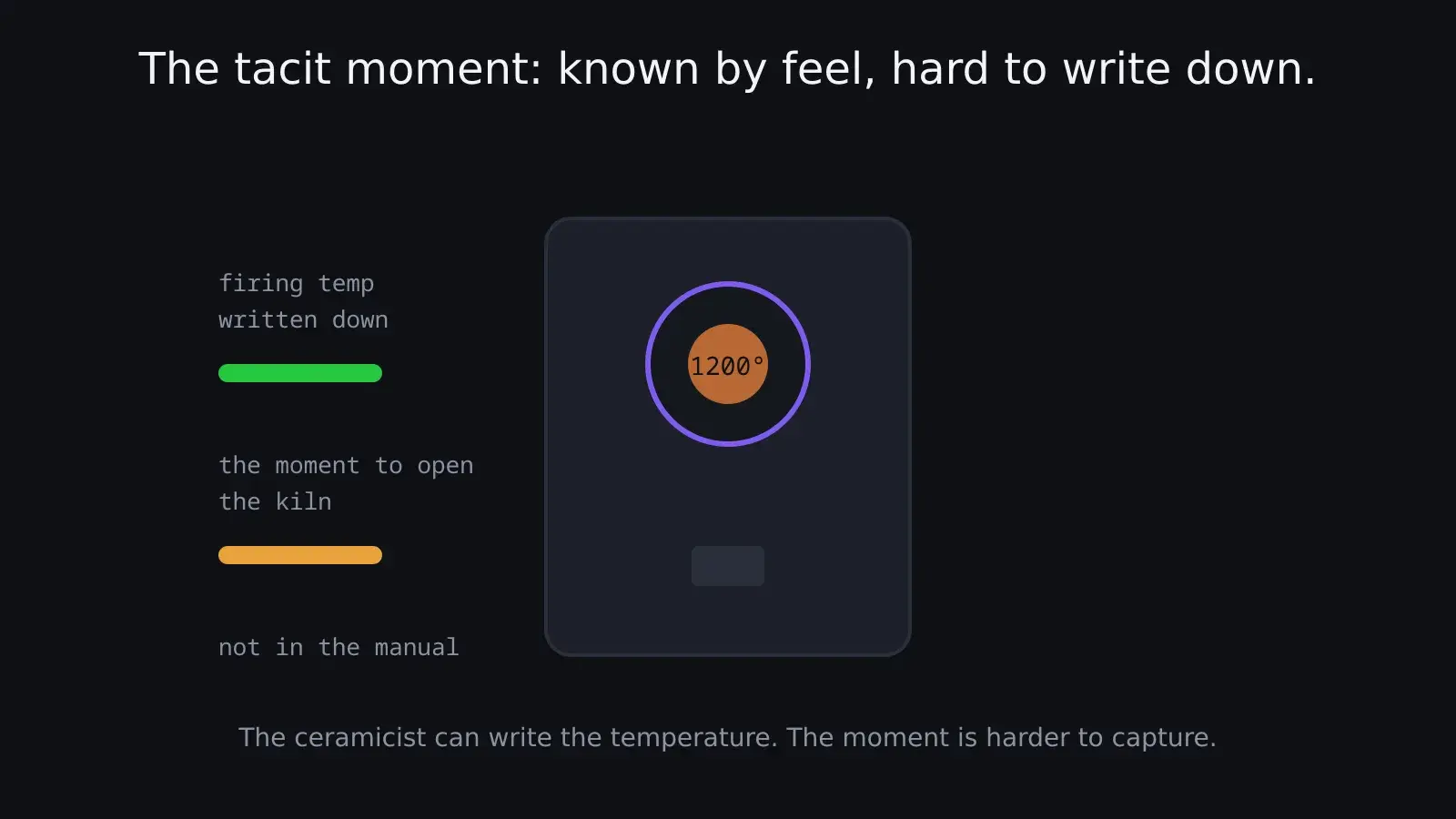
Every craft has its tacit layer. A ceramicist can write down firing temperatures; the moment to open the kiln is harder to capture. A carpenter can document joinery angles; knowing when a piece of wood will fight you is not in the manual. The history of craft is full of libraries burned to the ground, of techniques that died because the person carrying them did not write them down and no one stood close enough to learn.
What Maccarone describes is the first plausible attempt to change that arithmetic. If judgment can be extracted, the library does not have to burn. But the essay’s own example of the second co-founder is the caution: extraction may preserve the decisions while losing the judgment — the part that knows which decision is worth making in the first place.
The honest conclusion is not that one path wins. It is that the question has finally become practical. For most of history, “how do we keep the good judgment” had one answer: please do not leave. AI has made a second answer thinkable. Whether that answer is a real one — and what it costs — is now something we get to find out, one kiln at a time.
What the essay leaves open is the deepest question of all. If a person’s judgment can be turned into a product, what was it while it was still stuck in their head? The download assumes it was a set of decisions waiting to be recorded. The apprentice assumes it was something that only exists between people. The two co-founders are not disagreeing about tools. They are disagreeing about what judgment is.