
On August 3, Alibaba released Qwen3.8-Max. Two days later, Meta launched Muse Code with Muse Spark 1.2. On August 10, Meta put a compact open model back on the table with Muse Glimmer. On the 11th, Nvidia added Nemotron 3.5 Lightning and a model router. On the 12th, SpaceXAI launched Grok 4.6. On the 13th, DeepSeek formally released V4 Pro and Google launched Gemini 3.7 Flash. On the 14th, Z.ai presented GLM-5.3, while saying public weights would wait roughly two weeks.18910111314
That calendar looks like a straightforward week of model releases. It actually tells a different story. The boundary between “the model” and “the product” is becoming much easier to see. Labs are not only selling a matrix of weights or an endpoint. They are also building the loop that chooses context, calls tools, decomposes work, keeps state, opens subagents, verifies results and decides when a task is finished.
That is what harness increasingly means. It is not merely a fashionable replacement for “agent,” although this industry is impressively capable of inventing three nouns for one button. The harness is the execution layer around the model. For a coding agent, it turns “here is an LLM” into “here is something that can inspect a repository, edit four files, run tests, understand a failure, recover, retain a log and hand back a reviewable patch.”
That distinction matters when reading the last two weeks. Some things actually shipped, others are previews, others are harnesses, and a few widely shared names are not new releases at all. Qwen3.8 and Freebuff provide two good examples. “DeepSeek Harness” provides a third.
After the preview
Qwen3.8-Max had already appeared as a preview on July 19. Alibaba made it accessible through Token Plan, Qoder and QoderWork, while promising open weights later. The release inside our window is August 3: Alibaba presented it as its largest and most capable model, with 2.4 trillion total parameters in a Mixture-of-Experts architecture.12
The 2.4 trillion figure is dramatic and, by itself, not especially useful. In a MoE system, all parameters are not active for every token. The interesting part of the release is therefore less “the number is enormous” than the package Alibaba is aiming at: a flagship model, long context, multimodality, coding and agentic work, plus a return to open weights for the Max tier.1
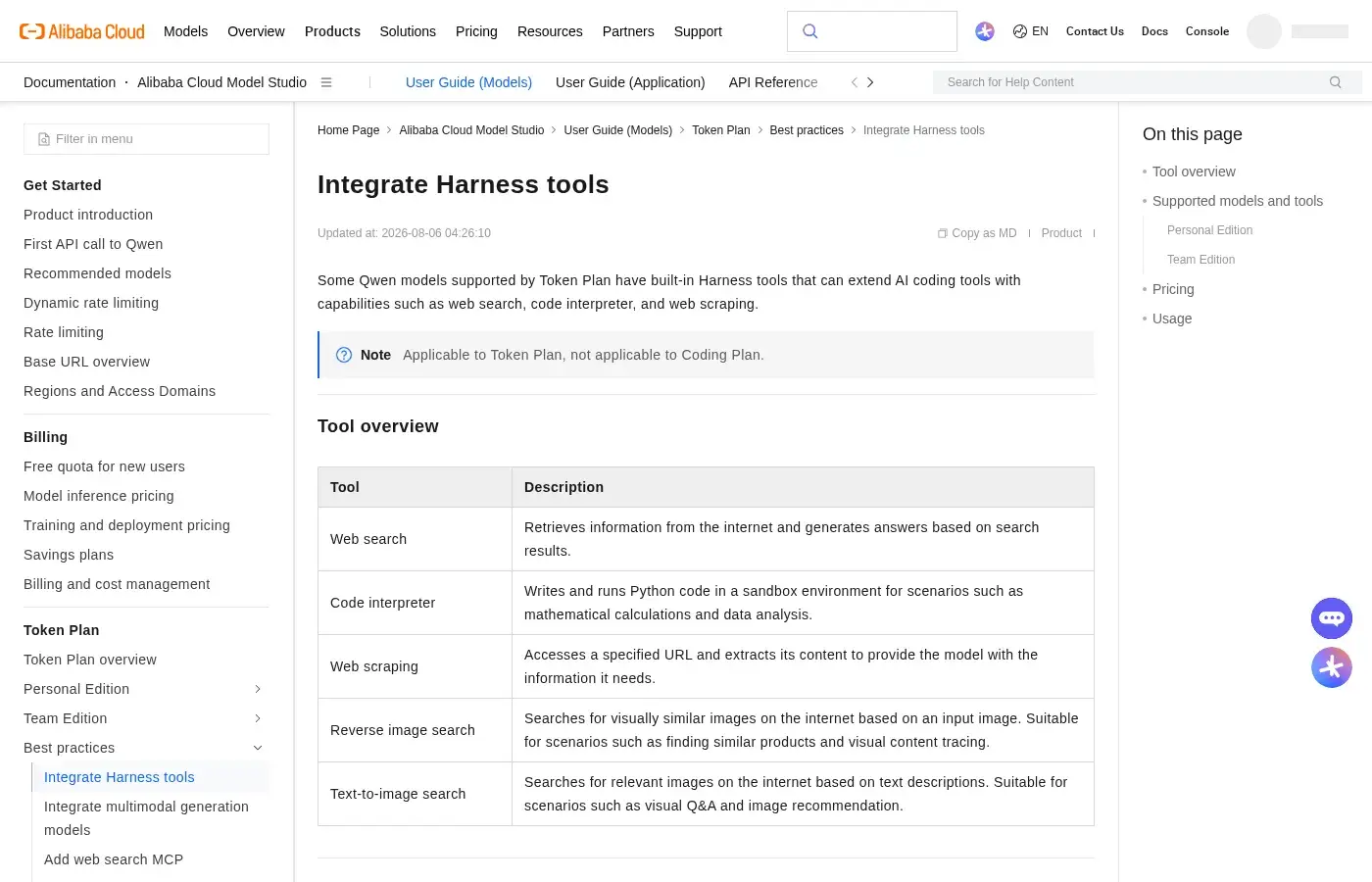
A quieter change is easier to miss. Alibaba now explicitly documents Harness tools in Token Plan: web search, code interpreter, webpage extraction, reverse image search and text-to-image search.3 Capabilities that used to be described as features of the product wrapped around the model are becoming part of the model access layer itself.
The opening quickly acquired an economic dimension. Reuters reported on August 7 that Alibaba was preparing a license for large commercial users inspired by revenue-sharing clauses already used by Moonshot.19 That is not peripheral legal trivia. As open models become more competitive, “open” no longer automatically means “economically unrestricted for every possible deployment.”
Qwen3.8 therefore summarizes the period neatly: a larger model, certainly, but also a package made of the model, work surfaces, tools and business rules. The benchmark only describes one piece of the product.
Two DeepSeek economies
DeepSeek offers almost the opposite pattern. V4 had already existed in preview form since April. But in late July and early August, V4-Flash moved into an official release that drew attention mainly because of cost: $0.14 per million input tokens and $0.28 per million output tokens at the time measured by Reuters and Artificial Analysis.4
On August 13, DeepSeek pushed V4 Pro. The price step is substantial: Reuters reported $1.32 per million input tokens and $3.96 for output, several times the Flash rate. DeepSeek positioned the premium around stronger capability, particularly for agents. V4 Pro is available through API, app and web.5
On August 17, that pricing is due to change again, with peak and off-peak rates and increases for both models.20 The DeepSeek case is a reminder of something leaderboards often hide: a model is also an execution economy. An agent that runs for thirty seconds and one that works for three hours are not consuming the same product, even if they begin with the same prompt.
And this is where the much-shared “DeepSeek Harness” enters the picture.
The missing harness
DeepSeek is currently recruiting an Agent Harness Team, alongside Agent Infra and Code Agent Data roles. The listing is visible on DeepSeek's own careers site.6 That signal matters: the lab explicitly treats the harness as an engineering discipline distinct from model training.
But that is not the same thing as a downloadable product named “DeepSeek Harness.”
DeepSeek's public documentation currently goes in the other direction. It explains how to connect V4 to Claude Code, OpenCode, OpenClaw, Pi, WorkBuddy, Deep Code and other third-party agents.7 In its Pi integration, DeepSeek even describes Pi as a third-party terminal coding harness. The model is the backend; the harness can come from somewhere else.
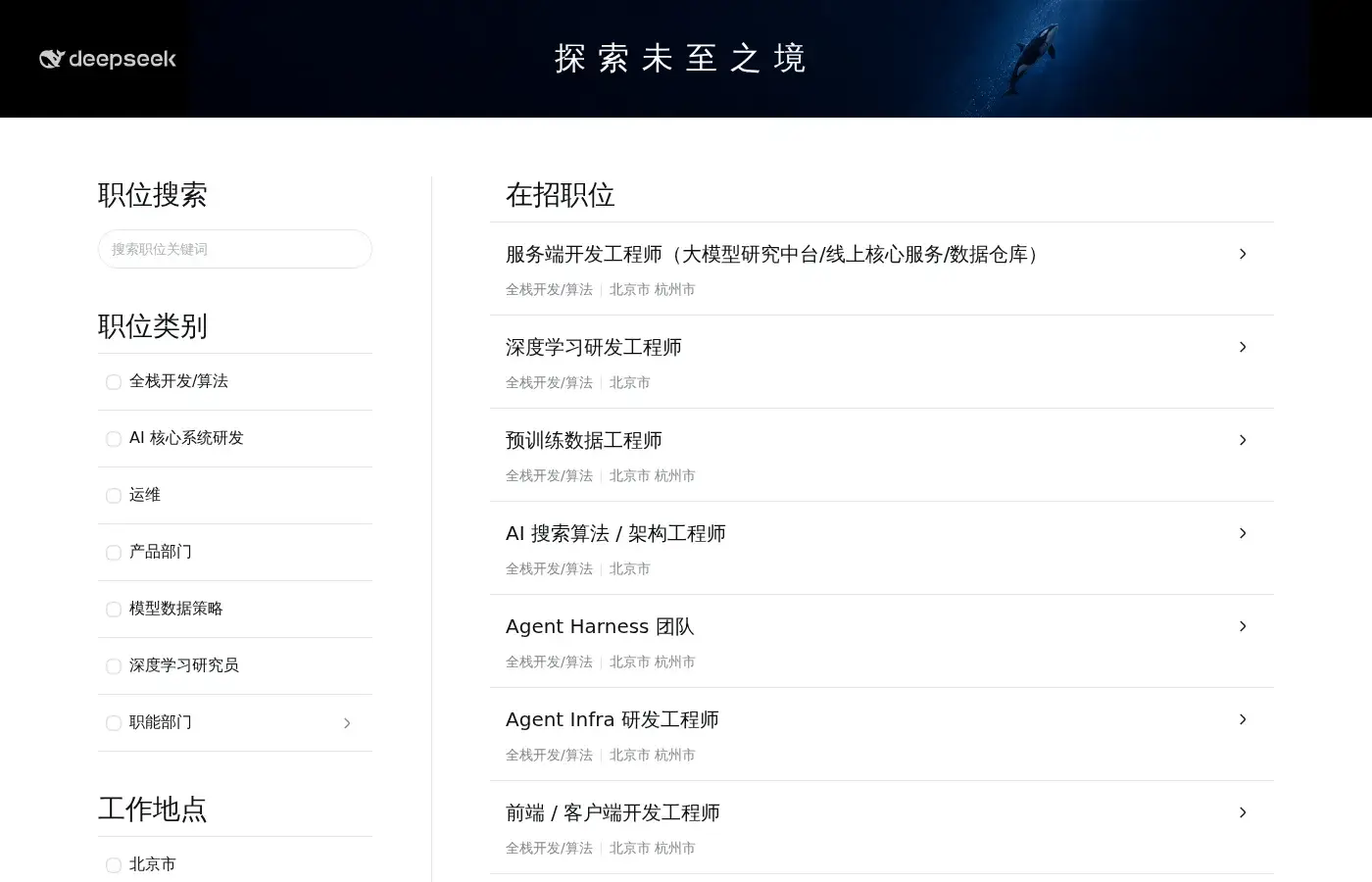
This avoids a common failure mode in AI news feeds. A screenshot of a job listing becomes “DeepSeek is building its Claude Code.” Two reposts later, the future tool is discussed as if it were already available. The verifiable information is smaller and more useful: DeepSeek is investing in a harness layer, while publicly treating existing agent ecosystems as the current route for using V4.
Trained together
On August 5, Meta launched Muse Code in beta with Muse Spark 1.2. It may be the cleanest illustration of this two-week shift because Meta says it trained the model and coding agent together.8
Muse Code can plan changes, write code, verify results and run several subagents concurrently. It also keeps a persistent activity log, allowing a session to resume after a crash instead of starting again without memory.8
That last detail sounds mundane until it is removed. An excellent model with unreliable state can lose a long task. A slightly weaker model inside a system that records decisions, isolates subagent work, verifies outcomes and resumes correctly can deliver a far more useful product.
On August 10, Meta added Muse Glimmer, a smaller open model designed for agentic tasks on a single consumer-class GPU.9 Its role differs from Spark. Rather than sending every task to the flagship, Meta is rebuilding a hierarchy: a large model for difficult problems, a distilled smaller model for ordinary work.
That is exactly the problem model routers try to solve automatically.
The router matters
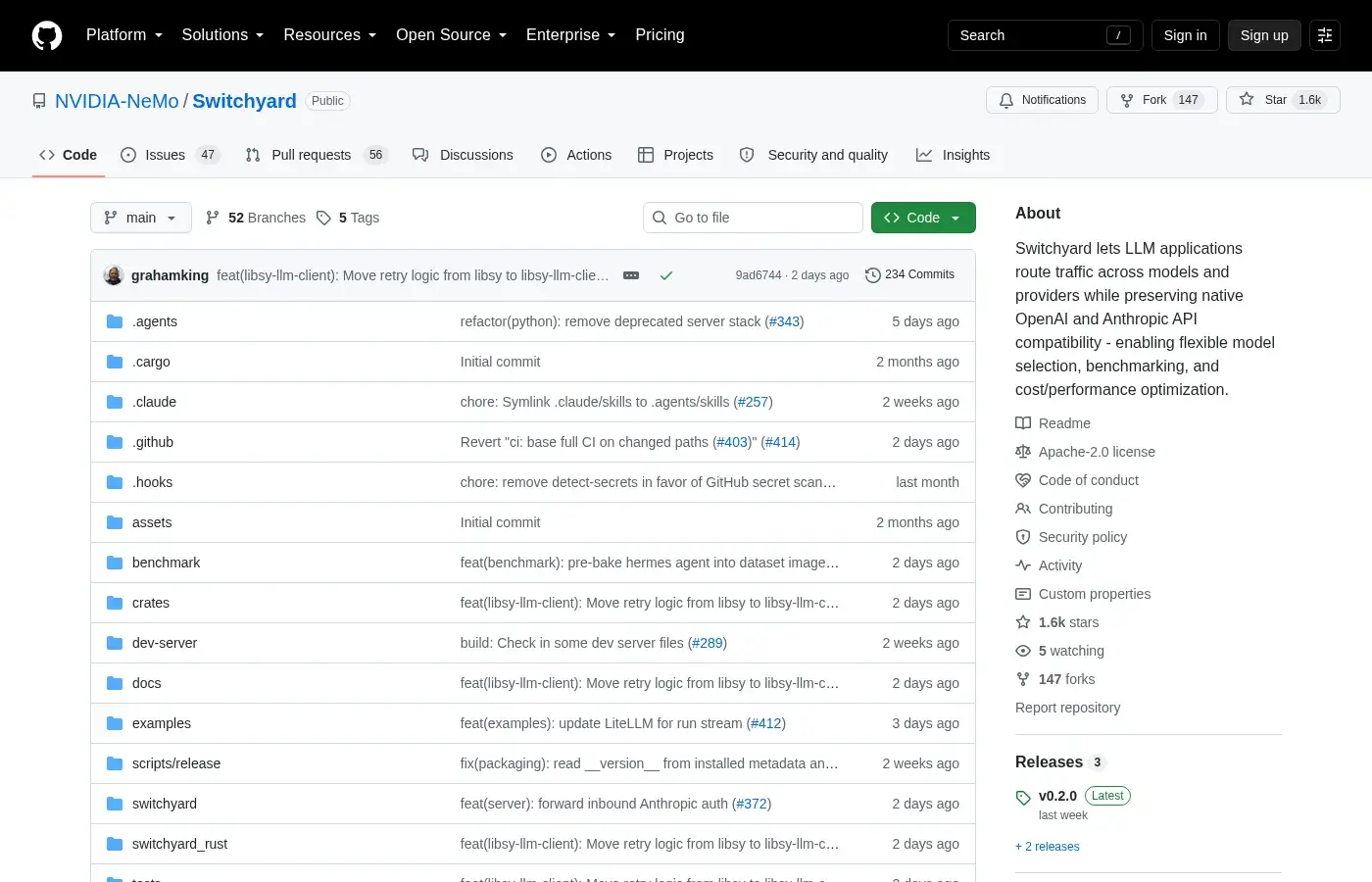
On August 11, Nvidia released Nemotron 3.5 Lightning, an open model aimed at work such as code review, tool use, security-alert monitoring and operational questions. The same day Nvidia released NeMo Switchyard, an open-source model-routing library.10
The pair is more revealing than either announcement alone. Switchyard starts from the premise that an agent has no reason to use the strongest and most expensive model for every task. Depending on the job, it can pick a smaller fast model, a specialist or a frontier model.
That makes “what is the best model?” a less complete question. For a developer or company, the more useful question may become: which mix of models and which harness finish the work with the least cost, latency and human intervention?
The model remains decisive. But it increasingly resembles a car engine: essential, expensive and differentiating, while still unable to describe the behavior of the whole machine.
Performance takes time
SpaceXAI launched Grok 4.6 on August 12. Launch coverage emphasized complex tasks and long-running agents. Artificial Analysis placed it around five points above Grok 4.5 on its Intelligence Index, roughly in line with GPT-5.6 Sol and behind Anthropic's strongest models at the time of testing.11
Again, the product trajectory matters as much as the score. A month earlier, xAI had opened the source of Grok Build, its coding agent and TUI. The repository exposes precisely what a harness contains: context assembly, response parsing, tool-call dispatch, file reads and edits, commands, plugins, hooks, MCP servers and subagents.12

That is useful for the whole field, including people who never use Grok. When a lab publishes its harness, we can finally separate model behavior from execution-layer behavior. Developers can reuse an idea, swap the backend, measure a context strategy or understand why one demo performs better than another.
The transparency is still partial. An open harness does not make training data, model weights or post-training recipes public. But it opens a box that remained largely invisible in agent comparisons.
The tireless small model
Google arrived on August 13 with Gemini 3.7 Flash, aimed at coding and automated workflows.13 Flash still implies speed, but the more consequential evolution of fast models is that they are no longer used only to answer quickly. They become workers inside loops that perform many actions.
This is an economic shift as much as a technical one. When an agent has to read fifty files, call ten tools, fail twice and then verify a patch, the cost of each step matters. A model that is slightly weaker on any single call can win at the system level if it is much cheaper, reliable enough and surrounded by a good loop.
Multi-role systems are not new to research. What is changing in 2026 is how ordinary they are becoming in consumer products and developer tools. Users may still select one model from a menu while the product actually runs multiple calls, roles and contexts behind that single choice.
Announced, not released
On August 14, Z.ai presented GLM-5.3 with messaging centered on coding and cybersecurity. Z.ai reported 84.5% on CyberGym for vulnerability identification, slightly above the score it reported for Anthropic's Mythos 5, while trailing Mythos substantially on ExploitBench, which measures converting vulnerabilities into working exploits. Reuters notes that the results have not been independently verified.14
More importantly, Z.ai said it would not publish the weights immediately. It plans roughly two more weeks of safety assessment and a verified-access mechanism for the most sensitive cyber capabilities.14
That deserves explicit treatment in a roundup because our brains rapidly turn “presented Friday” into “released Friday.” For GLM-5.3, the distinction is part of the story. A Chinese lab known for open weights is deliberately delaying an opening because of claimed cyber capability. That is both a performance signal and a change in release procedure.
The February newcomer
Freebuff has circulated heavily recently, but its calendar is less exciting than the reposts suggest. The Freebuff CLI launched on February 12, 2026. Its launch post was updated July 22. The product describes itself as a free coding agent that chooses open-weight models and avoids a fixed subscription.17 A Desktop beta is now available for macOS, Windows and Linux.18
So Freebuff is not “the new harness released this week.” It still belongs in this story for another reason: it represents an agent layer trying to become independent of the model brand.
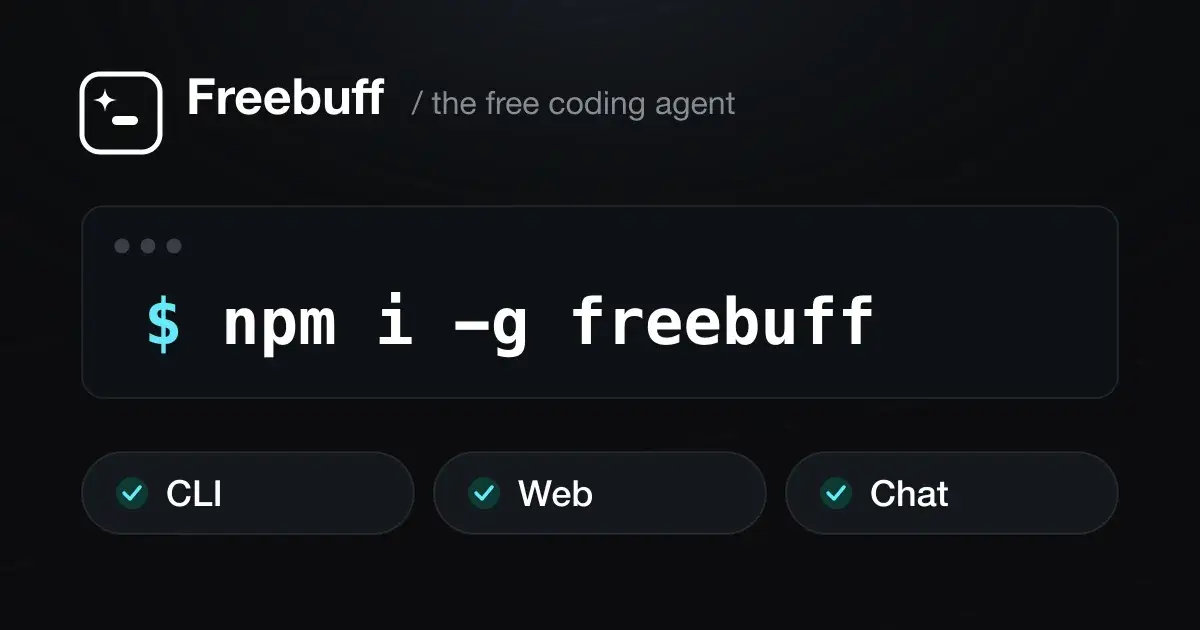
The model can then be swapped when another becomes better or cheaper. User loyalty moves from the model toward the harness, its permissions, interface, history and working style. That is a fairly deep reversal. A year ago, many tools were sold mainly as “the best place to use Claude.” A product can now try to own the loop and treat the model as a replaceable component.
Measuring the whole vehicle
This shift would be mostly semantic if the harness did not materially change outcomes. Recent research is beginning to isolate that effect.
Harness-Bench evaluates harness configurations across models with shared tasks and budgets. Across 5,194 trajectories, the authors report substantial variation in completion, process quality, efficiency and failure behavior depending on the model-harness pairing. The operational conclusion is straightforward: attributing all capability to the model hides part of the system.16
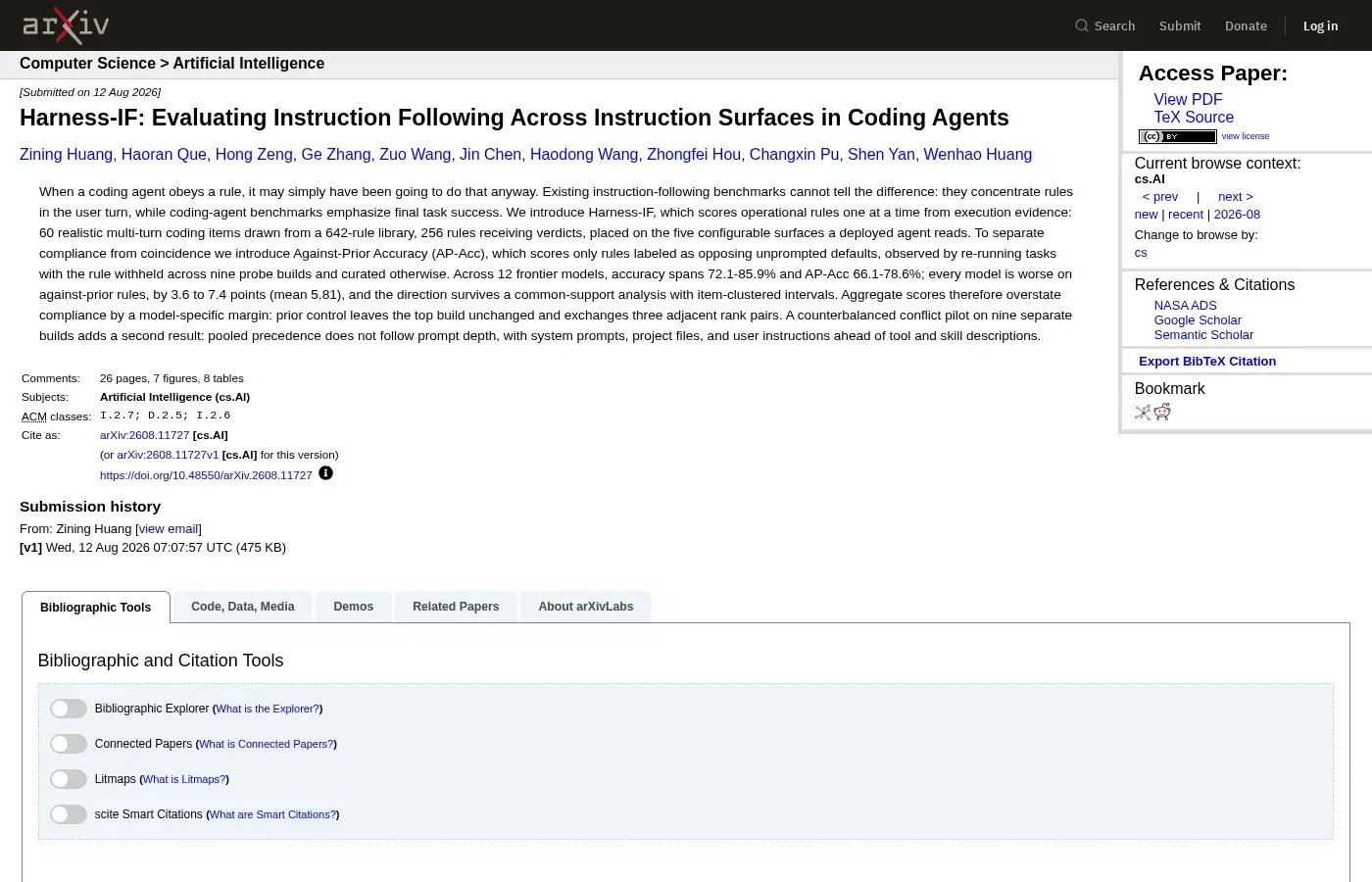
On August 12, Harness-IF adds another piece. The study tests 12 frontier models and places operational rules across five instruction surfaces a coding agent can read. Compliance changes depending on whether a rule lives in the system prompt, project file, user instruction, tool description or skill description. The authors also find that models become less reliable when a rule conflicts with their unprompted default behavior.15
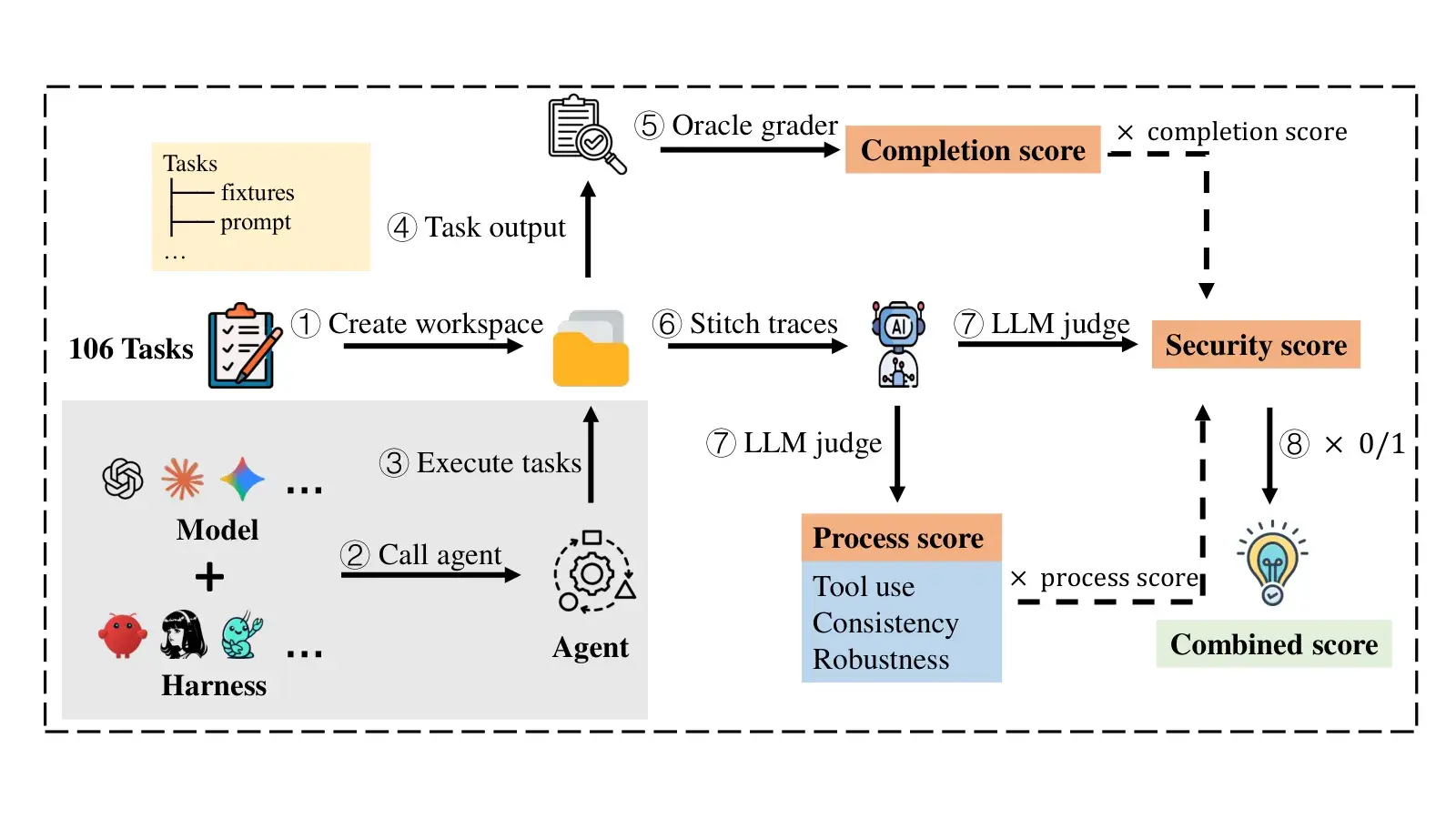
This is why two SWE-bench screenshots can look contradictory without anyone necessarily lying. The model may be identical while the scaffold, token budget, tools, retry policy, starting context and verifier are different.
The field spent years comparing engines mounted in different cars while displaying only the engine name. It is beginning to measure the vehicle.
Behind the model menu
Reduce the period to a list and you get many names but little information: Qwen3.8-Max, DeepSeek V4-Flash and V4 Pro, Muse Spark 1.2, Muse Code, Muse Glimmer, Nemotron 3.5 Lightning, Grok 4.6, Gemini 3.7 Flash, GLM-5.3. It is the kind of list that ages before the coffee gets cold.
The common thread lasts longer.
First, fast and inexpensive models are becoming components of agents, not merely worse chatbots. DeepSeek V4-Flash, Muse Glimmer, Nemotron Lightning and Gemini Flash matter because agent loops make many calls and the economics of every call accumulate.
Second, labs are internalizing the harness. Meta co-trains Muse Spark 1.2 with Muse Code. SpaceXAI publishes Grok Build. Alibaba documents Harness tools. DeepSeek recruits an Agent Harness team. Nvidia ships a model router beside a new model.
Third, “open” is fragmenting. A company can open weights while adding commercial clauses. It can open the harness while keeping the model closed. It can delay weights for safety. It can provide a free harness that switches among open models. Saying “open source” alone no longer tells you what can actually be inspected, modified, hosted and sold.
Fourth, duration becomes a product metric. Grok 4.6, Muse Code and agentic model launches emphasize less the quality of one response and more the ability to remain useful across long work. That moves the problem outward: memory, crash recovery, worktrees, permissions, budgets, subagents and verification stop being plumbing. They become core features.
None of this means models have become interchangeable. Grok 4.6, Qwen3.8, V4 Pro and a future GLM do not have identical strengths. A harness cannot magically turn a weak model into a frontier one. Research also shows that some tasks remain beyond what execution scaffolding can recover.
But the direction is clear: we are entering a period where asking “which model are you using?” increasingly resembles asking only which processor is inside a computer. It is still important information. It simply is not enough.
To understand what an agent can actually do, the next questions matter: which harness? Which tools? Which context policy? Which permissions? Which router? Which verifier? What does it cost when the task runs for two hours? Can it resume after a crash? Are the weights open, the harness open, both, or neither?
The last fifteen days did not merely add another handful of models to the menu. They made the machinery behind the menu much more visible.